Top Things to Do in Arusha National Park
Arusha National Park offers one of Tanzania's most diverse activity menus in a remarkably compact setting — game drives, TANAPA-approved canoe safaris, armed ranger walking trails, and multi-day Mount Meru treks all within roughly 30 minutes of Arusha city centre. Unlike the predator-focused savannah parks of the Northern Circuit, Arusha rewards travelers who value habitat variety, scenic photography, and active experiences over Big Five checklist safaris. For a single free day before Serengeti National Park departures, a Kilimanjaro acclimatization hike, or a gentle wildlife introduction after landing at Kilimanjaro International Airport, Arusha National Park safaris deliver extraordinary returns on time invested.
Game Drives — Ngurdoto & Momella Loop
The essential Arusha National Park safari follows maintained loops from Ngongongare Gate past Ngurdoto Crater rim viewpoints to Momella Lakes picnic areas — half-day or full-day circuits with giraffes, buffalo, zebras, and prolific lake-edge birdlife. Morning drives maximise wildlife activity before afternoon cloud builds on Mount Meru's slopes; late-afternoon sessions capture golden light on grassland glades and pink-tinged alkaline shallows when flamingo numbers align.
Guides coordinate routes between the park's three defining zones: the forest-fringed Ngurdoto Crater marshlands nicknamed "Little Ngorongoro," open grassland where giraffes and zebras graze beneath Meru's volcanic shoulders, and the Momella Lakes chain where hippos, waterbuck, and thousands of flamingos concentrate when lake chemistry supports feeding. TANAPA prohibits off-road driving on standard circuits — experienced guides know productive pullouts and current wildlife stakeouts.
Canoe Safari on Small Momella Lake
Among Tanzania's most unusual wildlife experiences, TANAPA-approved canoe safaris on Small Momella Lake bring visitors water-level with greater and lesser flamingos, pink-backed pelicans, yellow-billed storks, and hippos at respectful distance. Two-hour morning or late-afternoon paddles include safety equipment, trained guides, and a perspective impossible from vehicle viewpoints — giraffes grazing the shoreline, buffalo approaching freshwater inlets, and waterbirds feeding at eye level across alkaline shallows.
Canoe availability depends on lake water levels and seasonal conditions — confirm with TANAPA or your operator before booking, especially during long rains (March–May) when levels may restrict operations. The experience pairs naturally with a morning game drive through Ngurdoto and an afternoon paddle before returning to Arusha hotels.
Mount Meru Summit Trek
Three- to four-day ascents from Momella Gate through Miriakamba Hut and Saddle Hut to Socialist Peak (4,566 m) traverse rainforest, montane meadow, and volcanic ridges with summit sunrise views of Mount Kilimanjaro on clear mornings. Armed TANAPA ranger guides are mandatory; standard routes include overnight stays at park huts with porter support arranged through licensed operators.
Mount Meru is Tanzania's second-highest peak and widely regarded as excellent altitude acclimatization before Kilimanjaro summit routes — similar hut trekking, progressive elevation gain, and a serious summit day without Kibo's crowds. Meru also works as a standalone adventure for trekkers who want a challenging East African summit within a compact park footprint rather than committing to a full Kilimanjaro expedition.
Walking Safaris & Forest Trails
Guided walks with licensed armed rangers reveal black-and-white colobus monkeys, blue monkeys, Hartlaub's turacos, and bushbuck on foot — forest immersion impossible in vehicle-only parks like Tarangire National Park. The Tululusia Waterfall trail descends through montane forest to a cascade active after rains, while Ngurdoto Crater rim walks offer marshland panoramas and buffalo spotting from forested viewpoints.
All walking safaris require TANAPA ranger escort and advance booking through the TANAPA portal or licensed operators. Walking rewards travelers who want primate encounters, waterfall scenery, and the sensory detail of forest birding that game drives rush past.
Ngurdoto Crater Viewpoints
Rim pullouts reveal the "Little Ngorongoro" bowl — grassy marshland and swamp enclosed by rainforest slopes where buffalo herds, warthogs, and bushbuck thrive. The crater floor is not visited on standard game-drive circuits; viewpoint photography from the rim captures forest canopy, marshland wildlife, and on clear days Mount Kilimanjaro on the eastern horizon from Leitong viewpoint. Ngurdoto previews the caldera drama of Ngorongoro Crater in miniature — a useful Northern Circuit opener before the full crater descent days later.
Fig Tree Arch & Scenic Stops
The drive-through Fig Tree Arch — a hollowed strangler fig large enough for vehicles to pass beneath — is among Arusha National Park's most photographed landmarks. Shorter scenic routes include grassland glades for giraffe photography and Momella Lakes shores where Mount Meru and Kilimanjaro frame compositions on clear October–February mornings.
Wildlife in Arusha National Park
Arusha National Park wildlife emphasises herbivores, primates, and wetland species across montane forest, grassland, and alkaline lake habitats — a different profile from predator-focused Serengeti or Ngorongoro Crater. TANAPA protection across approximately 552 square kilometres safeguards Mount Meru water catchments, montane forest biodiversity, and the Momella wetland system while providing accessible tourism within an hour of Tanzania's fastest-growing urban region.
Primates — Colobus Stars
Black-and-white colobus monkeys are the park's primate highlight — dramatic mantled figures leaping through montane forest canopy with flowing white tail plumes. Troops are regularly encountered on game drives through forest sections and walking trails near Tululusia. Blue monkeys, vervet monkeys, and olive baboons occur across woodland zones, with forest-edge baboon activity visible from vehicle viewpoints on standard loops.
Herbivores & Plains Game
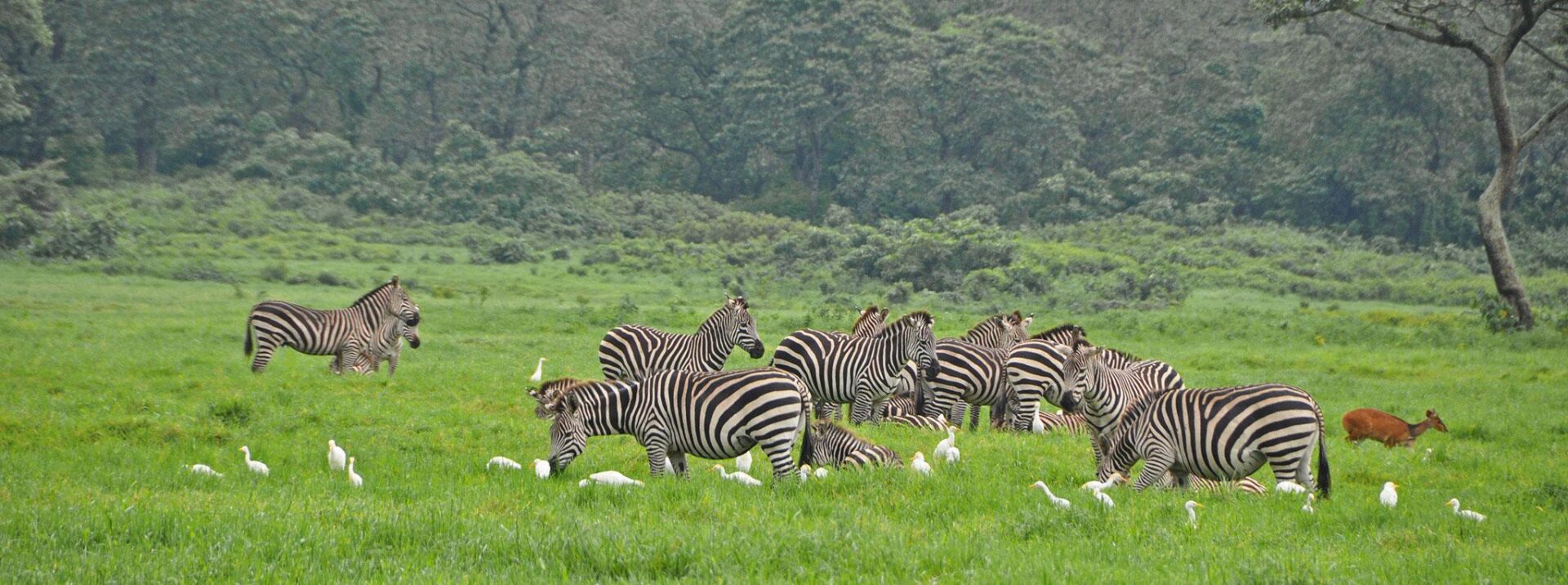
Giraffes, zebras, buffalo, warthogs, bushbuck, reedbuck, and waterbuck are regularly seen on game drives. Ngurdoto Crater marshlands concentrate buffalo and antelope in the grassy bowl visible from rim pullouts. Open grassland glades between forest patches and Momella shores deliver approachable herbivore viewing suitable for families and photographers who want calm encounters without predator tension.
Lake & Wetland Species
Hippos occupy freshwater sections of the Momella Lakes chain — seven alkaline and freshwater lakes varying in mineral content and algae, shifting colour from green to pink as conditions change. Greater and lesser flamingos feed on alkaline shallows when cyanobacteria blooms support them; pelican and wading bird concentrations fluctuate with lake levels across seasons. Canoe safaris and lakeshore picnic areas offer the closest waterbird viewing in the park.
Predators — Manage Expectations
Leopards exist in montane forest but sightings are rare. Spotted hyenas occur in low numbers. Lions are absent from Arusha National Park — this is not a Big Five destination in the traditional sense. Travelers prioritising lion and leopard photography should pair an Arusha day trip with Lake Manyara National Parktree-climbing lions or continue west to Ngorongoro and Serengeti on the standard Northern Circuit progression.
What Makes Arusha Different
Arusha National Park's wildlife strength is intimacy and habitat diversity within a day-trip radius — colobus forest, canoe-level flamingos, Ngurdoto marshland buffalo, and Meru summit vistas in one TANAPA ticket. The experience complements rather than competes with longer savannah safaris, functioning as Northern Circuit opener, Kilimanjaro acclimatization venue, or standalone scenic wildlife day from Arusha.
Continue planning Arusha National Park with Arusha National Park bird watching, Arusha National Park best time to visit, and Arusha National Park getting there, or read the main Arusha National Park destination guide.