
1 Day Shoebill Safari — Mabamba Swamp
Uganda · Wetland birding by boat
No-obligation proposal with named lodges, included permits and a complete safari price.
Tour overview
1 Day Shoebill Mabamba Swamp Tour
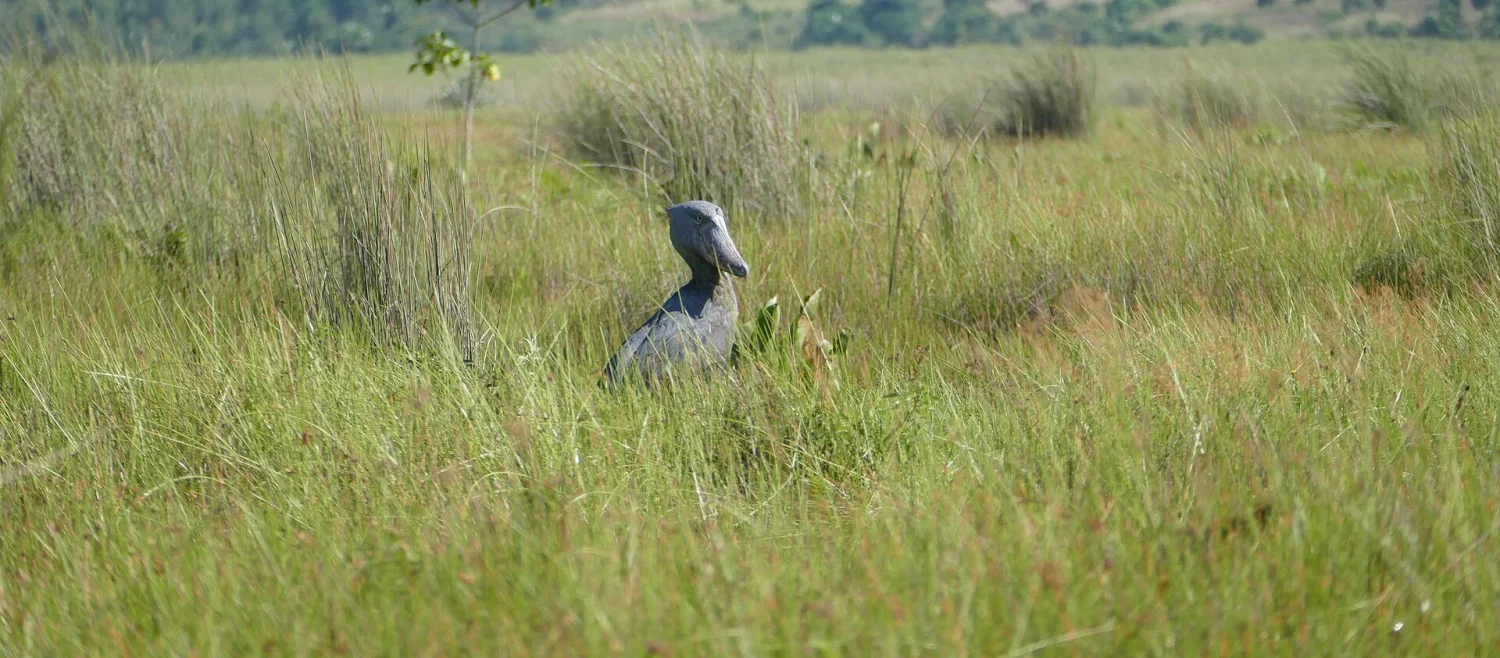
Mabamba Bay on Lake Victoria is one of the most reliable places in Africa to see the shoebill stork — a towering, prehistoric-looking bird that hunts l ungfish in papyrus channels. The wetland is a Ramsar site an hour west of Entebbe, with 300+ bird species including papyrus gonolek, malachite kingfisher, jacanas and fish eagles.
This half- to full-day excursion works brilliantly for airport layovers, pre-safari birding or a free day in Entebbe. Most departures start at 7:00 am when shoebills are still hunting at the swamp edge. You reach Mabamba by road through Nansana and Kisubi, or by motorised canoe from Nakiwogo landing site (about 45 minutes across the lake).
Places you visit
Key stops along this itinerary — customise dates and lodges when you enquire.
- Entebbe (Start, End)
Day-by-day itinerary
Mabamba swamp shoebill canoe excursion — Entebbe birding classic
Your driver-guide collects you from your Entebbe hotel or Entebbe International Airport in the cool of early morning — typically between 6:00 and 6:30 am for Entebbe guests, or around 5:30 am if you are staying in Kampala and need the extra transfer time west. Most departures aim to be poling through the papyrus by 7:00 am, when shoebills are still hunting lungfish and mudfish at the channel edges and the light is soft enough for photography before heat haze builds over Lake Victoria.
Mabamba Bay lies on the northern shore of Lake Victoria, roughly 12 km west of Entebbe as the crow flies but closer to 50 km by road via Nansana, Kisubi and the Mpigi district. The wetland is a Ramsar site covering roughly 2,424 hectares of papyrus swamp, open water and sedge — one of the most reliable shoebill stork sites on the continent, with resident pairs monitored year-round by community guides who know individual territories by name. Shoebills occur patchily from South Sudan to Zambia; fewer than 10,000 remain in the wild, and Mabamba’s accessible channels make it a cornerstone of Uganda birding alongside Bwindi gorillas and Kibale chimps on longer circuits.
Two routes reach the landing site. The road transfer (approx. 1–1.5 hours from Entebbe, longer from Kampala) follows the lakeshore through fishing villages and smallholder plots — wooden canoes pulled up on mud beaches, women sorting tilapia on drying racks, and the distant Kampala skyline hazy on the eastern horizon. You register at the community office, pay the wetland fee and meet your boat team. Alternatively, many birders prefer the motorised canoe crossing from Nakiwogo landing site in Entebbe — about 45 minutes across open lake, passing fish eagles, long-tailed cormorants, whiskered terns and pied kingfishers before you enter the quieter channels at Mabamba. Life jackets are provided on both legs; the lake crossing can be choppy on windy mornings, so a dry bag for camera gear is sensible.
At the landing, you board a stable wooden canoe poled by an experienced local boatman and joined by a community site guide trained in shoebill behaviour and wetland ecology. The craft sits low in the water — ideal for slipping into narrow channels where motorboats cannot go — and moves almost silently as the boatman pushes through floating papyrus mats with a long pole. Channels narrow quickly as tall reeds close overhead; purple gallinules step across floating vegetation, African jacanas work lily pads, and malachite kingfishers flash turquoise along the fringe. Your guide scans ahead for the tell-tale grey bulk of a shoebill standing motionless in the reeds — or the sudden collapse-and-lunge strike as one snatches a lungfish from the shallows.
 The shoebill boat safari typically lasts 2–3 hours on the water. When a bird is located, your guide positions the canoe at a respectful distance — usually 15–30 metres — so you can watch without disturbing hunting behaviour. Shoebills (Balaeniceps rex) stand up to 1.5 metres tall with a massive shoe-shaped bill evolved for lungfish and mudfish; they are solitary, patient ambush hunters that may stand frozen for twenty minutes, then explode forward with a bill snap audible across the swamp. Young birds are brown; adults develop the blue-grey plumage and pale staring eyes that make them look almost prehistoric. Success rates at Mabamba are high by African standards, though wildlife is never guaranteed; guides communicate by mobile phone when multiple boats are searching different channels, and your boatman will pole slowly to minimise disturbance.
Photographers should bring a telephoto lens (400 mm or equivalent) and expect low light in the channels at dawn — a monopod or beanbag on the canoe gunwale helps. Flash is discouraged near nesting birds; your guide will advise on minimum approach distances. Even without a shoebill, the swamp rewards patience: papyrus yellow warblers flit through reed stems, black-and-white casqued hornbills cross between trees on the swamp margin, and African marsh harriers quarter low over the sedge.
Beyond the headline species, Mabamba holds 300+ recorded bird species. Regular sightings include papyrus gonolek, white-winged swamp warbler, blue-breasted bee-eater, swamp flycatcher, lesser jacana, African pygmy goose, black crake, common waxbill and spur-winged goose. Palm-nut vultures and African fish eagles perch on dead stems; occasional sitatunga antelope slip through the reeds at dawn — Africa’s only amphibious antelope, superbly camouflaged in papyrus. The site is community-managed under the Mabamba Wetland Eco-Tourism Association; your permit fee supports local conservation stewards, school bursaries and channel maintenance that keeps access open without damaging nesting areas.
Mid-morning, pole back to the landing as the sun climbs and shoebills retreat deeper into shade. Return by road to Entebbe or cross the lake again to Nakiwogo. If your international flight allows, we can add lunch at a lakeside restaurant in Entebbe (fresh tilapia grilled with groundnut sauce is a local staple) or a brief stop at the Entebbe Botanical Gardens for colobus monkeys, Ross’s turaco and palm-nut vultures before hotel or airport drop-off. Travellers on tight layovers should book flights leaving after 2:00 pm to allow comfortable margins; same-day arrivals can often be met at the airport and driven straight to Nakiwogo if luggage is stored at the hotel.
What to pack: Binoculars (8×42 ideal); telephoto camera; sun hat and sunscreen; light rain jacket (showers possible year-round); insect repellent; waterproof bag for electronics; closed shoes that can get muddy at the landing; passport or national ID for registration. Community wetland fee and guide tip are included or handled by your driver — carry small cash for craft purchases at the landing if desired.
Drive time: Approx. 1–1.5 hours each way by road from Entebbe; Kampala add 45–60 minutes
Boat time: 2–3 hours in the swamp (plus optional 45-minute lake crossing each way)
Best season: Year-round; dry months (June–August, December–February) often give easier channel navigation and lower water levels that concentrate birds
Meals: Breakfast before departure; lunch optional in Entebbe
Accommodation: Day trip — ideal before or after a flight
The shoebill boat safari typically lasts 2–3 hours on the water. When a bird is located, your guide positions the canoe at a respectful distance — usually 15–30 metres — so you can watch without disturbing hunting behaviour. Shoebills (Balaeniceps rex) stand up to 1.5 metres tall with a massive shoe-shaped bill evolved for lungfish and mudfish; they are solitary, patient ambush hunters that may stand frozen for twenty minutes, then explode forward with a bill snap audible across the swamp. Young birds are brown; adults develop the blue-grey plumage and pale staring eyes that make them look almost prehistoric. Success rates at Mabamba are high by African standards, though wildlife is never guaranteed; guides communicate by mobile phone when multiple boats are searching different channels, and your boatman will pole slowly to minimise disturbance.
Photographers should bring a telephoto lens (400 mm or equivalent) and expect low light in the channels at dawn — a monopod or beanbag on the canoe gunwale helps. Flash is discouraged near nesting birds; your guide will advise on minimum approach distances. Even without a shoebill, the swamp rewards patience: papyrus yellow warblers flit through reed stems, black-and-white casqued hornbills cross between trees on the swamp margin, and African marsh harriers quarter low over the sedge.
Beyond the headline species, Mabamba holds 300+ recorded bird species. Regular sightings include papyrus gonolek, white-winged swamp warbler, blue-breasted bee-eater, swamp flycatcher, lesser jacana, African pygmy goose, black crake, common waxbill and spur-winged goose. Palm-nut vultures and African fish eagles perch on dead stems; occasional sitatunga antelope slip through the reeds at dawn — Africa’s only amphibious antelope, superbly camouflaged in papyrus. The site is community-managed under the Mabamba Wetland Eco-Tourism Association; your permit fee supports local conservation stewards, school bursaries and channel maintenance that keeps access open without damaging nesting areas.
Mid-morning, pole back to the landing as the sun climbs and shoebills retreat deeper into shade. Return by road to Entebbe or cross the lake again to Nakiwogo. If your international flight allows, we can add lunch at a lakeside restaurant in Entebbe (fresh tilapia grilled with groundnut sauce is a local staple) or a brief stop at the Entebbe Botanical Gardens for colobus monkeys, Ross’s turaco and palm-nut vultures before hotel or airport drop-off. Travellers on tight layovers should book flights leaving after 2:00 pm to allow comfortable margins; same-day arrivals can often be met at the airport and driven straight to Nakiwogo if luggage is stored at the hotel.
What to pack: Binoculars (8×42 ideal); telephoto camera; sun hat and sunscreen; light rain jacket (showers possible year-round); insect repellent; waterproof bag for electronics; closed shoes that can get muddy at the landing; passport or national ID for registration. Community wetland fee and guide tip are included or handled by your driver — carry small cash for craft purchases at the landing if desired.
Drive time: Approx. 1–1.5 hours each way by road from Entebbe; Kampala add 45–60 minutes
Boat time: 2–3 hours in the swamp (plus optional 45-minute lake crossing each way)
Best season: Year-round; dry months (June–August, December–February) often give easier channel navigation and lower water levels that concentrate birds
Meals: Breakfast before departure; lunch optional in Entebbe
Accommodation: Day trip — ideal before or after a flight
Safari activity | Shoebill boat safari at Mabamba Bay
Two to three hours poling through Ramsar-listed papyrus channels with a community guide — one of Africa’s most reliable shoebill stork sites, with respectful positioning for photography as the bird hunts lungfish at the swamp edge. Day 1 | Accommodation
What's included
- Hotel or airport pick-up and drop-off in Entebbe (Kampala on request)
- Mabamba wetland community fee
- Canoe, life jackets and local bird guide
- Bottled water


What's not included
- Lunch unless requested
- Kampala transfers (supplement applies)
- Camera fees / personal expenses


Accommodation & comfort level
Ideal for travellers with one free day or an overnight in Entebbe before a longer safari.
Request Pricing & booking information
Request Quote: Fill in the contact form below.