Why are chimpanzees important?
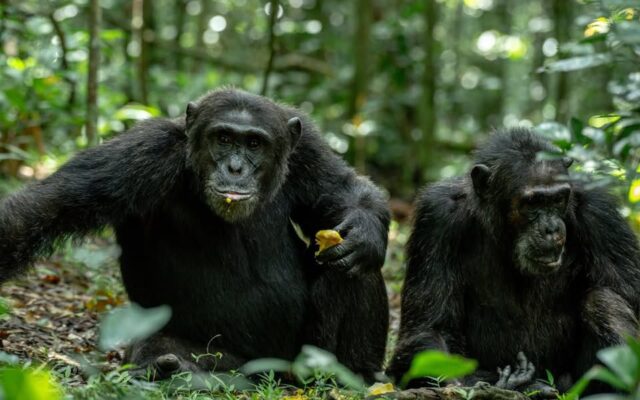
Chimpanzees occupy a unique position in the natural world. They are among the few animals that use tools, maintain complex social alliances, and demonstrate behaviours once considered uniquely human — from cooperative hunting to what researchers describe as individual names in vocal calls. They are also disappearing. Understanding why chimpanzees matter ecologically, scientifically, and economically helps explain why East African countries invest heavily in protecting them — and why chimpanzee trekking has become a cornerstone of Uganda and Rwanda safari itineraries alongside gorilla trekking.
Ecological importance: forest engineers and seed dispersers
Chimpanzees (Pan troglodytes) are large-bodied frugivores. A significant portion of their diet consists of fruit, and they travel long distances through forest canopies and understory each day. Every fruit consumed becomes a potential seed dispersal event — seeds deposited in dung far from the parent tree, often with pulp removed and germination enhanced by gut passage.
Research by Richard Wrangham, Colin Chapman, and colleagues in Uganda's Kibale Forest Reserve — published in the Journal of Tropical Ecology — found that 98.5% of chimpanzee dung samples contained seeds. Large-seeded species were well represented, including Mimusops bagshawei with an average of 26.5 seeds per sample despite individual seeds measuring 15 mm in diameter. Germination trials showed that gut passage increased both the speed and probability of germination compared to seeds collected directly from parent trees. The researchers estimated the Kibale chimpanzee population dispersed approximately 369 large seeds per kilometre per day.
This matters because large seeds often depend on large animals for dispersal. When megafauna disappear, tree species that produce big fruits lose their transport mechanism and decline — a phenomenon called dispersal limitation. Chimpanzees fill that role in forests where elephants and other large dispersers are scarce or absent.
Rwanda's montane forests
Studies in Rwanda reinforce the pattern. Research in Nyungwe National Park documented chimpanzees dispersing 37 fruiting species across 20 plant families, with 35% being large-seeded trees. In the recovering Gishwati Forest Reserve — a small montane fragment — chimpanzees were identified as particularly important for regenerating degraded forest because large-bodied seed dispersers are disproportionately valuable in fragmented landscapes where few alternatives exist.
Chimpanzees also influence forest structure through their fallback foods. When preferred fruits are scarce, they eat bark, leaves, and stems — pruning vegetation and creating gaps that allow light to reach the forest floor. In montane forests where fruiting tree diversity is lower than in lowland rainforest, each dispersal relationship becomes more critical.
Ecosystem services for people
A 2021 study in Senegal's Fongoli savanna-woodland demonstrated that western chimpanzees effectively disperse seeds of Saba senegalensis — a vine whose fruit is harvested by local communities. Gut passage and manual pulp removal increased germination success, and chimpanzees deposited seeds in habitats most suitable for seedling establishment. The authors concluded that chimpanzees provide a tangible ecosystem service linking wildlife conservation to human livelihoods — a finding with relevance across chimpanzee range states where forest products support rural economies.
Scientific importance: windows into evolution and behaviour
Chimpanzees share approximately 98.7% of their DNA with humans. They are our closest living relatives alongside bonobos, making them unparalleled models for understanding human evolution, cognition, social behaviour, and disease susceptibility.
Decades of research — from Jane Goodall's work at Gombe Stream in Tanzania to ongoing long-term studies at Kibale, Budongo, Mahale, and Taï — have revealed:
- Tool use — chimpanzees fashion sticks to extract termites, stones to crack nuts, and leaf sponges to drink water
- Culture — different communities exhibit distinct behavioural traditions passed socially, not genetically
- Cooperative hunting — coordinated prey capture with meat sharing that reinforces alliances
- Complex communication — vocalisations, gestures, and facial expressions with contextual meaning
- Self-awareness — mirror recognition and planning behaviours documented in experimental settings
Chimpanzees are also medically important. Because of genetic similarity, they are susceptible to many human diseases — respiratory infections, Ebola, scabies — that can devastate wild populations. This vulnerability is why trekking regulations require visitors who are sick to stay away, and why the seven-metre distance rule during gorilla and chimp encounters protects both species.
Conservation status: endangered and declining
The IUCN classifies chimpanzees as Endangered. Wild populations are estimated at 170,000 to 300,000 across equatorial Africa — spread across 21 countries but fragmented into increasingly isolated forest patches. Uganda and Rwanda hold significant populations in protected areas:
- Kibale Forest National Park (Uganda) — approximately 1,500 chimpanzees, the highest density in East Africa
- Budongo Forest Reserve (Uganda) — roughly 600–800 chimpanzees
- Kyambura Gorge (Queen Elizabeth, Uganda) — a small, isolated community in a forested ravine
- Nyungwe National Park (Rwanda) — an estimated 400+ chimpanzees in montane forest
- Gishwati-Mukura National Park (Rwanda) — a recovering population in a reforested fragment
Threats include deforestation for agriculture, snaring intended for bushmeat, illegal pet trade, and disease transmission from humans. Isolated communities — such as Kyambura's chimps surrounded by savannah — face genetic and demographic risks from inbreeding and inability to disperse.
Economic importance: tourism as a conservation tool
Chimpanzee trekking is a major tourism product in Uganda and an emerging draw in Rwanda. In Kibale Forest, habituated communities allow visitors to track chimps on foot with ranger guides — permits currently around US $250 for foreign non-residents (confirm current UWA tariffs when booking). Revenue funds ranger patrols, habituation programmes, community projects, and anti-snaring teams.
Tourism gives chimpanzees measurable economic value alive. A habituated community generating permit income year after year is worth more to a district than bushmeat sold once. This is the same logic that recovered mountain gorilla populations — high-value, low-impact tourism creating constituencies for protection among communities, government, and the private sector.
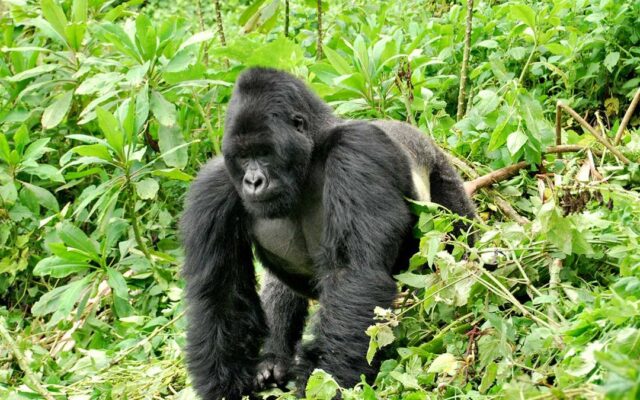
Many travellers combine gorilla and chimpanzee trekking in a single Uganda itinerary: gorillas in Bwindi or Mgahinga, chimps in Kibale, with Queen Elizabeth or Lake Mburo adding savannah wildlife between forest experiences. Rwanda offers chimp trekking in Nyungwe as a complement to Volcanoes gorilla treks.
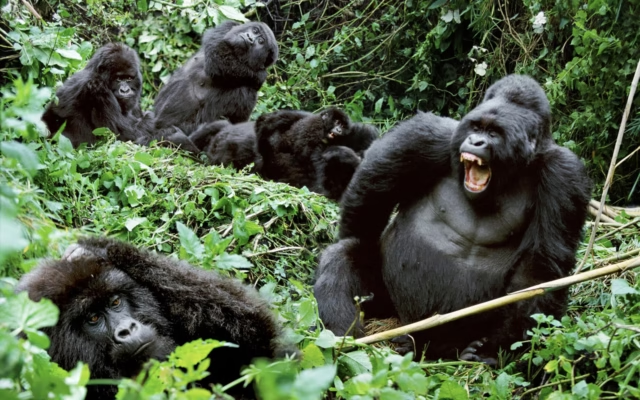
Chimpanzee encounters differ from gorilla trekking in energy and atmosphere. Gorillas tend toward calm, ground-dwelling family groups. Chimpanzees are louder, more mobile, and often partially arboreal — crashing through canopy branches, pant-hooting across valleys, and occasionally displaying with charging runs that keep observers alert.
Treks typically last two to four hours, starting early when chimps are still in night nests. Success rates at Kibale exceed 90% for habituated groups. Kyambura Gorge offers a dramatic setting but lower numbers and a smaller community. Nyungwe's montane terrain is steeper and wetter, rewarding fit trekkers with a rainforest atmosphere distinct from Kibale's lower-altitude forest.
Photography is permitted but challenging — dappled light, fast movement, and distance regulations require patience and reasonable telephoto reach. The reward is behavioural observation at close quarters: grooming, feeding, mother-infant interaction, and the electric energy of a species that feels recognisably social.
Cultural and ethical dimensions
In many East African traditions, chimpanzees and other great apes occupy a liminal space between animal and human. Their intelligence and social complexity evoke respect — and, historically, exploitation. The illegal pet trade removes infants after killing mothers, a practice that conservation education programmes work to eliminate by explaining chimpanzees' ecological role and the impossibility of keeping them as pets once they mature.
Ethical trekking practices include:
- Maintaining prescribed distances to reduce disease transmission
- Never feeding or attempting to touch wild chimpanzees
- Staying home when ill — even a common cold can kill a chimp
- Following ranger instructions during aggressive displays
- Choosing operators who book official permits and employ qualified guides
Why losing chimpanzees would matter
Remove chimpanzees from a forest and the consequences unfold over decades. Tree species lose primary dispersers. Forest gaps close differently. Fruiting phenology shifts. Insect communities tied to specific trees change. The forest still exists — but as a simplified, less resilient version of itself.
Remove chimpanzees from the scientific landscape and we lose the best available reference for understanding the evolutionary roots of human cooperation, conflict, tool use, and culture. Remove them from the economic landscape and rural communities lose tourism income that funds schools, clinics, and anti-poaching patrols.
Chimpanzees are important not because they are cute — though their expressions are undeniably compelling — but because they knit together ecological processes, evolutionary science, and conservation economics in forests that East Africa cannot afford to lose. Protecting them is protecting the intelligence, complexity, and connectivity of the landscapes that define Uganda and Rwanda as safari destinations.

 BestSeller
 BestSeller
 BestSeller
 BestSeller