
This detailed guide explores the most compelling shoebill stork facts, from taxonomy and anatomy to hunting behaviour, conservation status, and extraordinary adaptations. In Uganda, most encounters happen during dawn canoe trips at Mabamba Swamp or delta cruises in Murchison Falls National Park — see our where to see shoebills guide for site comparisons.
Shoebill Stork Quick Facts
| Scientific name | Balaeniceps rex |
|---|---|
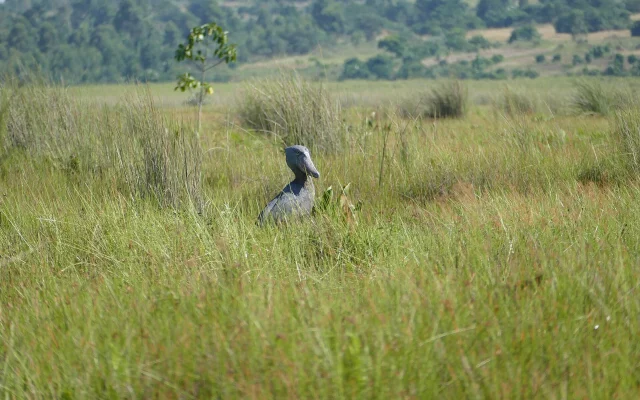
| IUCN status | Vulnerable |
| Height | up to 110–152 cm |
| Weight | males ~5.6 kg, females ~4.9 kg |
| Wingspan | up to ~230 cm |
| Bill length | up to 24 cm |
| Lifespan | up to 35 years |
| Uganda stronghold | Mabamba Bay, Murchison delta, Queen Elizabeth wetlands |
1. The Shoebill Is the Only Member of Its Family
Balaeniceps rex is the sole living species in the family Balaenicipitidae. This evolutionary isolation makes the shoebill a true specialist — when its wetland habitat disappears, the species has nowhere else to go. Taxonomists once grouped shoebills with storks, but genetic evidence now places them near pelicans and hamerkops within the order Pelecaniformes.
2. The Bill Is a Precision Hunting Weapon
The shoebill's enormous, shoe-shaped bill is not merely ornamental. It is a powerful tool for ambush hunting — broad enough to scoop lungfish from shallow water, sharp enough at the hooked tip to decapitate prey in a single strike. The mandibles can snap shut with enough force to kill a catfish instantly.
3. Shoebills Are Among Africa's Tallest Birds
Standing up to 1.5 metres tall, adult shoebills tower above most wetland birds. Their broad wingspan of roughly 2.3 metres supports slow, heavy flight between feeding territories. Males are typically larger and heavier than females.
4. They Hunt Like Living Statues
Shoebills are patient ambush predators. They stand motionless at the water's edge — sometimes for 20 minutes or more — waiting for lungfish or catfish to surface nearby. When prey is within range, they lunge with startling speed. This hunting style is covered in depth on our shoebill behaviour page.
5. Lungfish Are Their Primary Prey
African lungfish (Protopterus species) form the core of the shoebill diet. These fish survive dry seasons by burrowing into mud and breathing air — behaviour that brings them to the surface where shoebills wait. Catfish, frogs, and small reptiles supplement the diet. See our shoebill diet guide for seasonal feeding patterns.
6. Shoebills Are Predominantly Solitary
Unlike colonial waterbirds, shoebills space themselves across vast swamps. Even breeding pairs maintain distance, often feeding at opposite ends of their territory. Density rarely exceeds three nests per square kilometre.
7. Bill Clattering Is Their Signature Display
Shoebills communicate through rapid bill clattering — snapping their mandibles together in a display that carries across open water. This behaviour serves territorial and social functions, especially during breeding season.
8. They Fly With Neck Retracted
Unlike true storks, which fly with neck extended, shoebills retract their neck in flight — a trait they share with pelicans and herons. Their flight is slow and heavy, with deep wingbeats above the papyrus canopy.
9. Juveniles Look Different From Adults
Young shoebills wear browner, less grey plumage than adults and develop the distinctive bill shape gradually. Juvenile identification requires experience — another reason local guides at Mabamba are invaluable.
10. Breeding Pairs Build Floating Nests
Shoebills construct nests on floating vegetation platforms in extensive swamps. Both parents incubate eggs, feed chicks, and shade young birds from equatorial sun. Nest sites are vulnerable to disturbance and wetland fires.
11. They Practice Siblicide
Females lay one to three eggs, but pairs typically raise only one chick. The eldest chick often attacks or outcompetes younger siblings — a harsh but common strategy among large wetland birds where food supply is uncertain.
12. Global Population Is Small and Declining
The IUCN estimates 3,300 to 5,300 mature shoebills remain globally, with populations declining across much of the range. Uganda is one of the few countries where sightings remain relatively reliable — a fact that drives the country's birding tourism economy.
13. Uganda Hosts Multiple Shoebill Sites
Shoebills occur in at least a dozen Important Bird Areas across Uganda, including Mabamba Bay, Murchison Falls, Queen Elizabeth, Lake Mburo, and eastern wetlands in the Lake Kyoga system. Mabamba is the most accessible and best-known for tourism.
14. Mabamba Is a Ramsar Site and IBA
Mabamba Wetland was designated an Important Bird Area in 2001 and a Ramsar site in 2006. It supports over 300 bird species alongside shoebills, including the globally threatened blue swallow and papyrus gonolek.
15. Shoebills Can Live for Decades
Wild shoebills may live up to 35 years. Slow reproduction — pairs raise one chick at long intervals — means population recovery is gradual even when conservation efforts succeed.
16. They Are Sensitive to Disturbance
Shoebills abandon nests when disturbed by fishermen, hunters, or careless tourists. Research at Mabamba has documented significant nest failure linked to human disturbance — a key reason regulated, guide-led tourism matters.
17. Illegal Trade Is a Serious Threat
Shoebills are targeted for the illegal live-bird trade, with high mortality during capture and transit. International protection under CITES and national wildlife laws aim to curb this trade, but enforcement remains challenging.
18. Climate Change Affects Wetland Habitat
Drought, altered flooding patterns, and increased wetland burning linked to climate variability threaten shoebill habitat across Africa. Protecting intact papyrus swamps is the single most important conservation action.
19. Tourism Supports Conservation at Mabamba
The Mabamba Wetland Eco-Tourism Association channels birding revenue to local guides, canoe operators, and nest monitors. Former fishermen and hunters now earn livelihoods from shoebill tourism — a model cited in international species action plans.
20. Shoebills Are a Global Birding Trophy
Birdwatchers travel from every continent to see shoebills. Uganda's reliable access at Mabamba — often within a half-day trip from Entebbe — makes it one of the most practical shoebill destinations in the species' entire range.
Shoebill Size and Anatomy Facts
Adult males stand up to 152 cm tall and weigh around 5.6 kg. The bill alone can measure 24 cm in length and 20 cm in width at the base. Broad feet distribute weight across floating vegetation. Pale eyes provide excellent vision for detecting prey movement in murky water.
Shoebill Taxonomy Facts
- Order: Pelecaniformes (with pelicans, hamerkops)
- Family: Balaenicipitidae (monotypic)
- Genus and species: Balaeniceps rex
- Common names: shoebill, whale-headed stork, shoebill stork
Shoebill Conservation Facts
- IUCN Red List: Vulnerable (VU)
- Population trend: decreasing
- Protected in Ugandan national parks and Ramsar sites
- Community conservation at Mabamba Bay
- International Single Species Action Plan under AEWA
For habitat detail, see where shoebills live; for safari planning, browse shoebill safari experiences in Uganda.