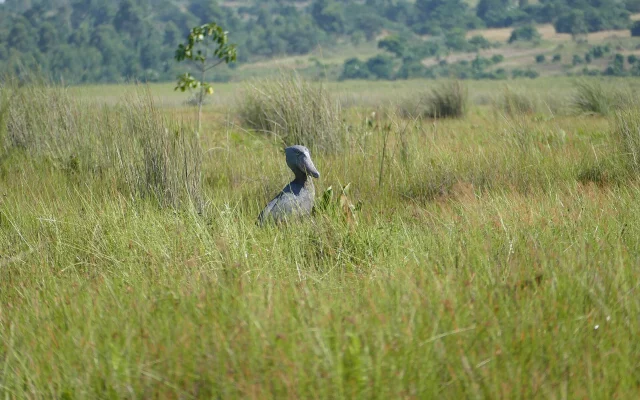
Shoebill stork conservation sits at a critical intersection between wetland protection, community livelihoods, and responsible tourism. Listed as Vulnerable on the IUCN Red List with an estimated 3,300 to 5,300 mature individuals remaining globally, shoebills face habitat loss, nest disturbance, wetland fires, and illegal trade. Uganda's community-led efforts at Mabamba Bay demonstrate how birding tourism can support both local economies and species survival — explore shoebill habitat and safari experiences that fund these programmes.
IUCN Conservation Status
The shoebill is classified as Vulnerable (VU) on the IUCN Red List, meeting criterion C2a(ii) — a single small declining population of fewer than 10,000 mature individuals within a broad but fragmented range. Population trend is decreasing across most of the shoebill's distribution.
- Estimated mature individuals: 3,300–5,300 (BirdLife International / IUCN)
- Population trend: decreasing
- Generation length: approximately 10–15 years
- Reproductive rate: slow — one chick per successful breeding attempt
Major Threats
Habitat Loss and Degradation
Wetland drainage for agriculture, rice cultivation, and settlement destroys papyrus swamps across Africa. Shoebills cannot adapt to small or degraded wetlands — they require vast, intact freshwater systems. In Uganda, unprotected wetlands in the Lake Kyoga system face the greatest habitat pressure.
Seasonal Burning
Fishermen and farmers burn papyrus swamps to clear channels, manage fishing access, or prepare land for cultivation. Fires destroy nest platforms, kill chicks, and reduce prey habitat. Burning is a documented threat at Mabamba and across the species' range.
Nest Disturbance
Shoebills abandon nests when approached by fishermen, hunters, or unregulated tourists. Research at Mabamba documented nest failure rates of 33% at the egg stage, with human disturbance identified as a primary cause. Regulated, guide-led tourism reduces this risk.
Illegal Live-Bird Trade
Shoebills are targeted for private collections and zoos, with high mortality during capture, transit, and captivity. CITES Appendix II listing restricts international trade, but enforcement remains challenging in remote wetland areas.
Overfishing and Prey Depletion
Intensive fishing reduces lungfish and catfish populations that shoebills depend on. When prey density falls below viable thresholds, shoebills abandon territories even where vegetation remains intact.
Climate Change
Altered rainfall patterns, prolonged drought, and increased wetland fire frequency linked to climate variability threaten shoebill habitat across central Africa. The species' specialist ecology leaves little room for adaptation.
Uganda's Conservation Framework
Uganda protects shoebills through multiple mechanisms:
- National parks — Murchison Falls, Queen Elizabeth, Lake Mburo
- Ramsar sites — Mabamba Bay, Lutembe Bay, Lake Nabugabo
- Important Bird Areas — at least 12 IBAs with shoebill records
- Wildlife laws — shoebills protected under Uganda Wildlife Act
- CITES — Appendix II international trade restrictions
Protected area coverage is relatively strong in Uganda compared with many range countries, but the main unprotected shoebill habitat — Lake Kyoga system wetlands — remains vulnerable.
Mabamba Community Conservation Model
Mabamba Bay represents Uganda's most celebrated shoebill conservation success. The Mabamba Wetland Eco-Tourism Association (MWETA) organises local fishermen, bird guides, canoe operators, and craftspeople into a site support group that manages tourism access and monitors shoebill territories.
Key elements of the Mabamba model:
- Former fishermen and hunters trained as bird guides and nest monitors
- Canoe tourism revenue distributed to community members
- Regulated access routes that minimise nest disturbance
- Monitoring of breeding success and territory occupancy
- Education on sustainable fishing and fire prevention
This approach is cited in the International Single Species Action Plan for the Shoebill (AEWA Technical Series) as a model for community-based wetland bird conservation.
Breeding Success and Monitoring
Nest monitoring at Mabamba from 2016 to 2025 revealed that nest success (proportion of nests producing a fledgling) reached approximately 40%, with egg-stage failure at 33% — figures largely attributed to human disturbance. These statistics underscore why responsible tourism protocols matter: the difference between a successful fledging and a failed nest can be a single careless canoe approach.
International Conservation Action
The shoebill is covered by an International Single Species Action Plan under the Agreement on the Conservation of African-Eurasian Migratory Waterbirds (AEWA). The IUCN Stork, Ibis and Spoonbill Specialist Group coordinates range-wide monitoring, research, and Green Status assessment — measuring not just extinction risk but recovery potential through ongoing conservation action.
Role of Tourism in Conservation
Responsible shoebill tourism generates direct economic incentives for wetland protection. Every canoe fee, guide tip, and safari booking at Mabamba reinforces the value of intact papyrus swamp over drained farmland or burned fishing channels. Tourism also funds ranger patrols, nest monitoring, and community education in protected areas like Murchison and Queen Elizabeth.
Visitors contribute conservation value by:
- Using licensed community guides at Mabamba
- Following distance and behaviour protocols
- Choosing operators who support local conservation programmes
- Combining shoebill trips with longer safaris that fund park entry fees
Conservation Challenges Ahead
Despite progress at Mabamba, shoebill conservation faces persistent challenges. Wetland loss continues across the range. Climate-driven fire frequency may increase. Illegal trade persists. And growing tourism demand must be balanced against disturbance thresholds — more visitors does not automatically mean better conservation unless access remains regulated.
How Travelers Can Help
- Book shoebill excursions through reputable operators using MWETA guides at Mabamba
- Maintain respectful distance — never surround or chase a shoebill
- Do not use playback calls or drones near nesting areas
- Support longer Uganda safaris that include park fees and community levies
- Learn about threats on this page and share awareness
Conservation Quick Reference
- IUCN status: Vulnerable (declining)
- Global population: 3,300–5,300 mature individuals
- Primary threats: habitat loss, fire, disturbance, trade
- Uganda protection: national parks, Ramsar sites, IBAs
- Key community site: Mabamba Bay (MWETA)
- International plan: AEWA Single Species Action Plan
- Tourism role: direct funding for community conservation
See shoebills responsibly through our where to see shoebills guide and shoebill safari experiences.