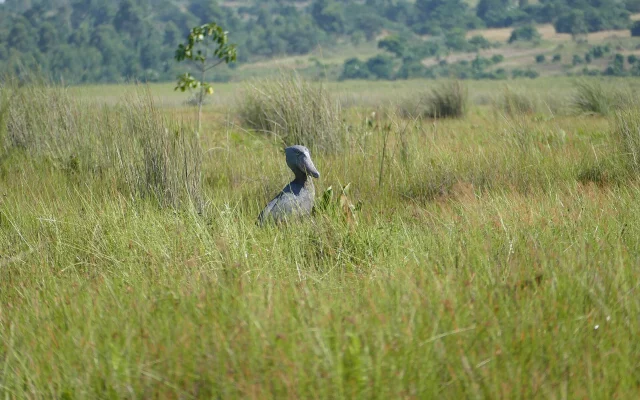
Shoebill stork behaviour is as distinctive as the bird's appearance. Solitary, patient, and deceptively still for long stretches, shoebills hunt like feathered statues before exploding into action. Their slow movements, bill-clattering displays, territorial spacing, and unusual breeding dynamics make them one of the most compelling subjects in African wetland ecology. Uganda's Mabamba Swamp and Murchison delta offer some of the best opportunities to observe these behaviours — see where to see shoebills for site details.
Solitary Nature and Territorial Spacing
Shoebills are predominantly solitary birds. Unlike colonial herons, pelicans, or storks that nest and feed in groups, shoebills maintain wide spacing across extensive swamps. Territory density rarely exceeds three nests per square kilometre — a reflection of the large hunting areas each bird requires.
Even during breeding season, paired shoebills often feed at opposite ends of their shared territory. This spacing reduces competition for lungfish and catfish prey while maintaining the low-density population structure that defines the species.
Ambush Hunting Behaviour
The shoebill's signature behaviour is patient ambush hunting. Birds stand motionless at the water's edge — sometimes for 20 minutes or longer — watching for prey movement in murky shallows. Muscles remain coiled; only the eyes track lungfish surfacing to breathe.
When prey enters strike range, the shoebill lunges with startling speed. The massive bill closes with enough force to kill a catfish instantly. After a successful catch, the bird may swallow prey whole or decapitate it first. This hunting style is energy-efficient but demands vast, prey-rich territories — see our shoebill diet page for prey details.
Bill-Clattering Display
Shoebills communicate through bill clattering — rapid snapping of the mandibles that produces a loud, mechanical sound carrying across open water. This display serves multiple functions:
- Territorial assertion between neighbouring birds
- Courtship and pair-bond reinforcement during breeding season
- Post-feeding display after a successful strike
- Threat response when approached too closely
Observers at Mabamba sometimes hear bill clattering before seeing the bird — a useful cue for guides scanning papyrus channels.
Flight Behaviour
Shoebills fly with neck retracted — unlike true storks that extend their neck in flight. Their wingbeats are slow and heavy, carrying the large body above papyrus canopy between feeding territories. They typically fly low over swamps rather than soaring at height. Takeoff requires a running start or drop from an elevated perch.
Daily Routine
Shoebills follow a rhythm shaped by temperature, prey activity, and territorial structure.
Dawn
Peak hunting period. Birds stand at channel edges and wetland margins as lungfish surface in cool morning air. This is when Mabamba canoe trips most often find active shoebills.
Midday
During equatorial heat, shoebills roost in papyrus shade, standing on one leg or sitting on floating vegetation. Activity drops sharply.
Late Afternoon
Second hunting period as temperatures cool and fish become active again.
Night
Limited nocturnal activity near territory boundaries. Most roosting occurs in sheltered papyrus stands.
Breeding Behaviour
Shoebills breed in extensive swamps during or after the rainy season, though timing varies across the range. Breeding behaviour includes elaborate courtship displays, nest building, shared incubation, and intensive chick provisioning.
Courtship
Pairs perform mutual bill clattering, bowing displays, and circling flights above the territory. Courtship reinforces pair bonds that may persist across multiple breeding seasons.
Nest Building
Both partners construct a platform nest on floating vegetation — typically a mound of papyrus stems, reeds, and aquatic plants anchored to emergent vegetation. Nests are large, flat structures that rise and fall with water levels.
Incubation and Chick Rearing
Females lay one to three eggs. Both parents incubate for roughly 30 days. After hatching, both parents feed, guard, and shade chicks from equatorial sun. Despite multiple eggs, pairs typically raise only one chick.
Siblicide and Chick Competition
Shoebills commonly hatch more than one chick but raise only one per breeding attempt. The eldest chick often attacks or outcompetes younger siblings for food — a behaviour known as siblicide. If the eldest is weak or dies, a younger chick may survive. This harsh strategy reflects uncertain food supply in large wetland territories.
Territorial Defence
Shoebills defend breeding territories aggressively against intruders — including other shoebills, fish eagles, and humans who approach nests. Defence displays include bill clattering, wing spreading, and forward lunging. Nest abandonment from disturbance is a documented cause of breeding failure at Mabamba.
Response to Humans
Habituated shoebills at regularly visited sites like Mabamba may tolerate canoe approach at moderate distance, continuing to hunt while observers watch. However, birds flush if surrounded, approached too quickly, or subjected to loud noise. Responsible guiding maintains distance and avoids chasing birds through channels.
Communication Summary
- Bill clattering — primary vocal/display communication
- Wing spreading — threat and territorial display
- Bowing — courtship behaviour
- Bill pointing — subtle threat posture
- Low grunts — occasional vocalisations, especially at nests
Behaviour and Conservation Connection
Shoebill behaviour makes the species vulnerable to human disturbance. Solitary nesting, low reproductive rate, and sensitivity to nest approach mean that unregulated tourism and wetland encroachment have outsized impacts. Community-managed guiding at Mabamba — where trained operators know territory boundaries and nest locations — demonstrates how behaviour-aware tourism supports conservation.
Observing Shoebill Behaviour in Uganda
Best observations come from dawn canoe trips at Mabamba, where guides position boats for hunting and roosting views. At Murchison, delta cruises reveal shoebills along channel edges. Allow at least two to three hours in the swamp — patience mirrors the bird's own hunting style.
Shoebill Behaviour Quick Reference
- Social structure: solitary, territorial
- Hunting: patient ambush, explosive strike
- Display: bill clattering, wing spreading
- Flight: neck retracted, slow heavy wingbeats
- Breeding: floating nest, shared incubation
- Chick rearing: one chick per attempt (siblicide common)
- Peak activity: dawn and late afternoon
- Human tolerance: moderate at habituated sites with respectful approach
Plan a behaviour-focused visit through shoebill safari experiences or our shoebill tracking Uganda guide.