This detailed guide explores the most compelling mountain gorilla facts, from biology and anatomy to social behaviour, reproduction, conservation, and extraordinary adaptations. In Uganda, most encounters happen during gorilla trekking in Uganda in Bwindi Impenetrable National Park or Mgahinga Gorilla National Park — see our where to see mountain gorillas guide for park comparisons.
Mountain Gorilla Quick Facts
- Scientific name: Gorilla beringei beringei
- Subspecies of eastern gorilla
- Share approximately 98% DNA with humans
- Among the largest living primates
- Found only in Uganda, Rwanda, and DR Congo
- Primarily herbivorous
- Live in social family groups
- Led by dominant silverbacks
- Population exceeds 1,000 individuals
- One of conservation’s major recovery stories
1. Mountain Gorillas Are One of Humanity’s Closest Relatives
Mountain gorillas share roughly 98% of human DNA, placing them among our closest living relatives. This genetic similarity helps explain their emotional expressiveness, social intelligence, communication systems, and recognizable behaviours.
2. Mountain Gorillas Are a Subspecies
Mountain gorillas are not a separate species but a subspecies of the eastern gorilla.
- Species: Gorilla beringei
- Subspecies: Gorilla beringei beringei
Their closest relatives are eastern lowland gorillas.
3. Silverbacks Are Exceptionally Powerful
Adult silverbacks possess extraordinary strength. Their muscular upper bodies are adapted for forest movement, protection, and dominance displays.
While exact comparisons are often exaggerated online, silverbacks are undeniably far stronger than humans in raw physical power.
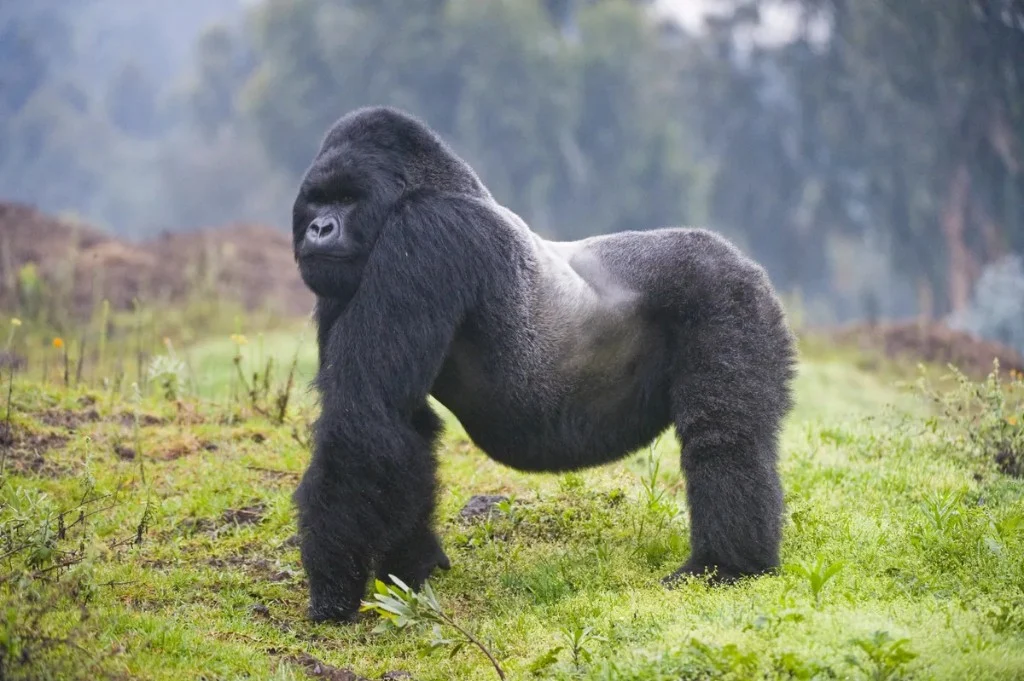
4. Mountain Gorillas Have Thick Fur
Unlike lowland gorillas, mountain gorillas evolved thick coats to survive cool montane climates. Dense fur protects them from moisture, cold, and fluctuating temperatures.
5. Adult Males Develop Silver Backs
Mature males develop silver-grey hair across their backs as they age, giving rise to the term silverback.
This signals maturity, dominance, and reproductive status.
6. Mountain Gorillas Live in Family Groups
Mountain gorillas are intensely social and live in stable family groups led by a dominant silverback.
Groups may include:
- Adult females
- Juveniles
- Infants
- Subordinate males
7. Group Leadership Is Highly Structured
The silverback makes major group decisions, including movement, feeding, conflict response, and protection.
8. They Are Mostly Gentle Animals
Despite their size, mountain gorillas are generally calm and peaceful when not threatened.
Aggression is often defensive rather than predatory.
9. Chest Beating Is Communication
Chest beating is a communication display rather than automatic aggression. It may communicate strength, identity, warning, or confidence.
10. Mountain Gorillas Spend Most Time on the Ground
Although capable climbers, adults spend much of their time on the forest floor using knuckle-walking locomotion.
11. They Build New Nests Daily
Mountain gorillas build fresh nests each evening for sleeping. These may be constructed on the ground or in vegetation.
12. They Are Herbivores
Their diet consists primarily of vegetation including leaves, stems, shoots, roots, bark, and wild plants.
13. They Rarely Drink Standing Water
Most hydration comes from moisture-rich vegetation rather than direct water drinking.
14. Mountain Gorillas Have Distinct Personalities
Researchers observe clear personality differences between individuals, including playful, dominant, cautious, curious, and nurturing traits.
15. Baby Gorillas Behave Like Human Toddlers
Young gorillas play, wrestle, tumble, cling to mothers, and explore their environment in surprisingly familiar ways.
16. Mothers Are Intensely Protective
Maternal care is central to infant survival. Infants rely heavily on mothers for warmth, transport, nutrition, and safety.
17. Gestation Lasts Around 8.5 Months
Female mountain gorillas carry pregnancies for approximately 8.5 months, similar to humans.
18. Usually One Baby Is Born
Single births are normal. Twins are rare.
19. Juveniles Learn Through Play
Play helps young gorillas develop social competence, strength, coordination, and conflict understanding.
20. Mountain Gorillas Communicate with Vocalizations
Communication includes:
- Grunts
- Barks
- Hoots
- Screams
- Roars
21. They Show Emotion
Mountain gorillas demonstrate grief, comfort, affection, curiosity, frustration, and playfulness.
22. They Recognize Social Hierarchy
Dominance and social relationships influence interactions, access, and behavioural expectations.
23. Silverbacks Protect Their Groups
Silverbacks defend family members from threats, mediate disputes, and stabilize social structure.
24. Mountain Gorillas Can Live for Decades
Life expectancy in the wild is commonly 35–40 years.
25. They Are Endangered
Despite recovery progress, mountain gorillas remain endangered due to habitat pressure, disease risk, and human-related threats.
26. Conservation Has Improved Their Numbers
Mountain gorillas are among the rare conservation success stories where great ape populations have increased through coordinated protection.
27. Disease Is a Major Threat
Because of genetic similarity to humans, disease transmission remains a serious concern.
28. Tourism Supports Conservation
Responsible gorilla tourism generates funding for habitat protection, ranger support, veterinary work, and community conservation.
29. Gorilla Trekking Is Highly Regulated
Strict rules reduce stress and disease risk while preserving ethical wildlife encounters. Permit rules and costs are outlined in our gorilla permit guide, with practical planning in the main Uganda gorilla trekking resource.
30. Mountain Gorillas Exist in Only a Few Places
Wild mountain gorillas survive only in select protected forests across Uganda, Rwanda, and DR Congo — including Bwindi and Mgahinga in Uganda. Our habitat & range page explains altitude, forest type, and seasonal conditions.
Mountain Gorilla Size Facts
Adult silverbacks can weigh over 200 kilograms. Females are considerably smaller. Arm span and chest development contribute to their imposing appearance.
Mountain Gorilla Intelligence Facts
Mountain gorillas demonstrate social learning, memory, emotional processing, problem solving, and situational awareness.
Mountain Gorilla Behaviour Facts
- Strong family bonds
- Cooperative living
- Juvenile play behaviour
- Conflict mediation
- Protective parenting
- Hierarchical structure
Conservation Facts
- Protected by national park systems
- Monitored by conservation organizations
- Tourism directly supports protection
- Population has recovered compared with historic lows