Understanding mountain gorilla behaviour provides insight into how they survive, interact, reproduce, communicate, and maintain stable social groups in dense forest habitat. Most travellers observe these behaviours during gorilla trekking in Uganda — pair this page with where to see mountain gorillas and our safari experiences hub for trip planning.
Mountain Gorillas Are Highly Social Animals
Mountain gorillas rarely live solitary lives. Their survival depends heavily on cohesive group living.
Social living supports:
- Protection
- Infant survival
- Learning
- Communication
- Reproductive structure
- Emotional bonding
Group Structure
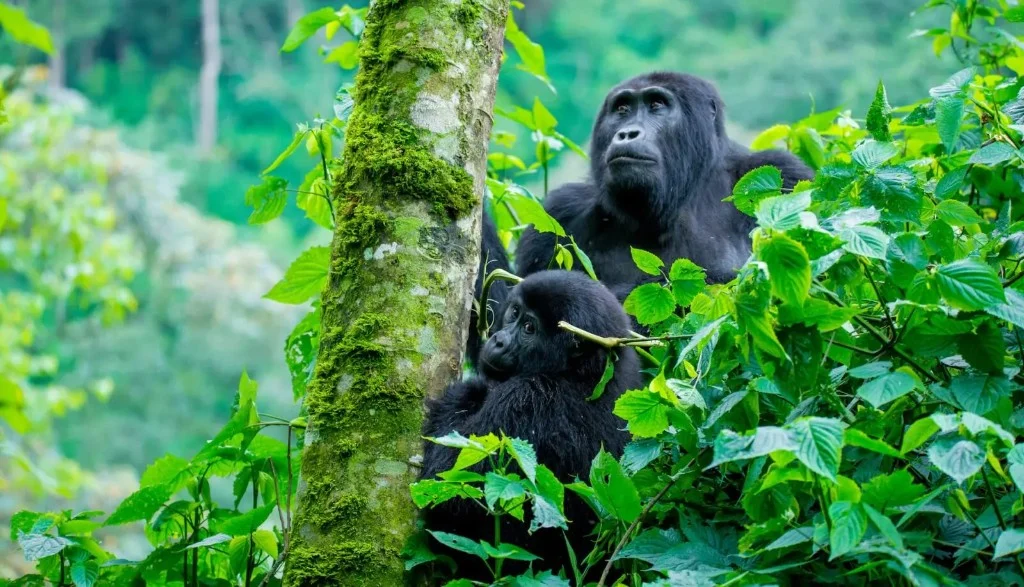
Mountain gorillas live in organized family groups often referred to as troops or groups.
A typical group may include:
- One dominant silverback
- Several adult females
- Juveniles
- Infants
- Occasional subordinate males
Group size varies considerably depending on demographics and habitat conditions.
The Role of the Silverback
The dominant silverback is central to group stability and survival.
Key responsibilities include:
- Protection from threats
- Decision-making
- Movement leadership
- Conflict mediation
- Social cohesion
- Breeding leadership
Leadership Behaviour
Silverbacks determine when the group moves, where it feeds, and where it rests. They respond to danger and manage social tension.
Protective Behaviour
When threatened, silverbacks may display intimidating behaviour to protect group members.
Female Behaviour
Adult females play crucial roles in family structure, infant care, and social bonding.
Female behaviour often includes:
- Maternal care
- Social grooming
- Conflict avoidance
- Infant protection
- Feeding coordination
Infant Behaviour
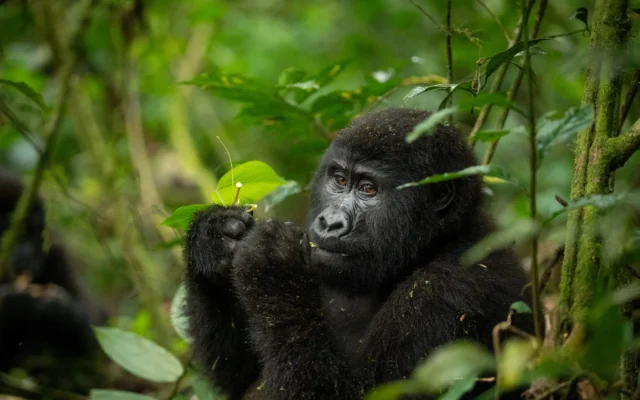
Baby mountain gorillas are highly dependent on maternal care and exhibit playful, exploratory behaviour.
Common infant behaviours include:
- Clinging to mothers
- Play wrestling
- Climbing
- Curiosity-driven exploration
- Vocal dependence communication
Juvenile Behaviour
Juveniles are energetic, playful, and socially experimental. Their interactions help develop coordination, hierarchy understanding, and communication skills.
Play Behaviour
Play is a major part of mountain gorilla development and social life.
Observed play activities include:
- Chasing
- Wrestling
- Mock fighting
- Climbing
- Tumbling
- Object interaction
Play supports physical and social development.
Communication
Mountain gorillas communicate through multiple channels including vocal, visual, physical, and postural signals.
Vocal Communication
- Grunts
- Hoots
- Barks
- Screams
- Roars
- Whines
Different sounds convey reassurance, warning, distress, attention, or social intent.
Body Language
Body posture communicates mood, dominance, submission, and readiness.
Facial Expression
Facial cues contribute to communication and emotional signaling.
Chest Beating
Chest beating is one of the most recognizable gorilla behaviours.
Functions include:
- Display of strength
- Warning communication
- Identity signaling
- Social assertion
Chest beating does not automatically indicate imminent attack.
Aggression and Conflict
Mountain gorillas are generally peaceful, but aggression can occur in specific contexts.
Triggers
- Threat perception
- Territorial tension
- Male competition
- Infant risk
- Human disturbance
Conflict Resolution
Not all conflict becomes violent. Social mediation and dominance recognition often reduce escalation.
Daily Routine
Mountain gorillas follow structured daily activity cycles.
Morning
Wake, social adjustment, feeding initiation.
Midday
Feeding, movement, resting, grooming.
Afternoon
Additional feeding and group movement.
Evening
Nest construction and settlement.
Nesting Behaviour
Mountain gorillas construct new sleeping nests each evening.
Nests may be:
- Ground nests
- Vegetation-supported nests
Nesting behaviour reflects environmental adaptation and safety needs.
Grooming Behaviour
Grooming strengthens social bonds, reduces tension, and reinforces affiliation.
Parenting Behaviour
Maternal Care
Mothers provide nutrition, transport, protection, warmth, and social learning.
Silverback Parenting
Silverbacks may show tolerance, protection, and indirect infant support through group stability.
Emotional Behaviour
Mountain gorillas display emotional complexity.
Observed states may include:
- Curiosity
- Playfulness
- Affection
- Frustration
- Comforting behaviour
- Grief-like responses
Intelligence and Learning
Mountain gorillas demonstrate advanced cognitive capacity.
Capabilities include:
- Memory
- Social learning
- Environmental awareness
- Communication flexibility
- Behavioural adaptation
Movement Behaviour
Mountain gorillas primarily move via knuckle-walking, though climbing remains important especially for younger individuals.
Habitat Influence on Behaviour
Dense forest environments shape mountain gorilla social organization and communication.
Habitat influences:
- Visibility
- Movement spacing
- Feeding behaviour
- Protection strategies
- Communication patterns
Behaviour During Gorilla Trekking Encounters
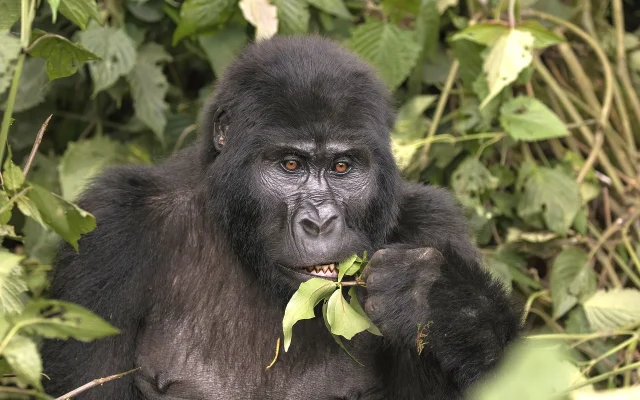
Habituated gorillas may continue normal activities during gorilla trekking encounters in Bwindi or Mgahinga. Read gorilla permit rules and best time to see guidance before you book.
Visitors may observe:
- Feeding
- Resting
- Play
- Social interaction
- Movement
Behaviour Myths
Myth: Gorillas Are Naturally Aggressive
Reality: They are generally calm unless threatened.
Myth: Chest Beating Means Attack
Reality: It is often communication or display behaviour.
Myth: Gorillas Are Solitary
Reality: Mountain gorillas are highly social.
Interesting Behaviour Facts
- Juveniles play extensively
- Silverbacks mediate social order
- Families sleep in newly built nests
- Communication is multi-layered
- Behaviour varies by age and role