This guide explores the most compelling golden monkey facts, from taxonomy and appearance to social behaviour, conservation, and why they have become a favourite add-on to gorilla trekking in Uganda. In Uganda, encounters happen exclusively during golden monkey tracking at Mgahinga Gorilla National Park — see our where to see golden monkeys guide for destination detail.
Golden Monkey Quick Facts
- Scientific name: Cercopithecus mitis kandti
- Endangered subspecies of blue monkey
- Endemic to the Albertine Rift
- Found in Uganda only at Mgahinga
- Distinctive golden-orange fur and long tail
- Lives in large social troops
- Feeds heavily on bamboo
- Global population estimated at 2,000–4,000
- Tracking available with habituated troops
- Pairs naturally with gorilla trekking itineraries
1. Golden Monkeys Are Albertine Rift Endemics
Golden monkeys occur nowhere else on Earth outside the central Albertine Rift. Their range is split between the Virunga Massif — shared by Uganda, Rwanda, and the Democratic Republic of Congo — and a separate remnant population in Rwanda’s Gishwati forest. This extreme geographic restriction is a defining fact of their biology and conservation status.
2. They Are a Subspecies of Blue Monkey
Taxonomists classify the golden monkey as Cercopithecus mitis kandti, a subspecies of the widespread blue monkey (Cercopithecus mitis). Some researchers argue it may warrant full species status given its distinct colouration, vocal repertoire, and bamboo-specialised ecology — but all agree it is evolutionarily and geographically unique.
3. Appearance Is Instantly Recognisable
Compared with other forest monkeys, golden monkeys are spectacularly coloured. Bright golden fur blends with orange tones along the back and flanks, while the face retains darker blue-grey features typical of the blue monkey group. A long, expressive tail helps balance rapid canopy movement — a visual highlight for photographers on Mgahinga trekking safaris.
4. Adults Are Medium-Sized Primates
Golden monkeys are not large animals. Adults typically weigh between four and seven kilograms, with males slightly heavier than females. Their compact build and arboreal agility let them leap between bamboo stems far more easily than ground-dwelling primates like gorillas.
5. Troops Can Be Very Large
Golden monkeys live in sizeable social groups, sometimes numbering a hundred individuals or more under a dominant alpha male. Large troop size creates constant movement, vocal exchange, and playful juvenile behaviour — one reason tracking encounters feel so animated compared with the quieter atmosphere of a gorilla visit.
6. Uganda Hosts Only One Golden Monkey Population
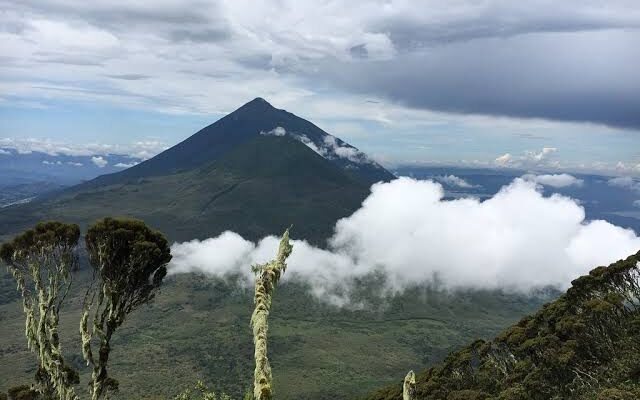
Within Uganda, golden monkeys survive only in Mgahinga Gorilla National Park at the southwestern tip of the Virunga volcanoes. They do not occur in Bwindi or any other Ugandan forest — making Mgahinga the sole gateway for Ugandan golden monkey tourism.
7. Bamboo Defines Their World
Golden monkeys are strongly associated with high-altitude bamboo forest between roughly 2,100 and 3,550 metres above sea level. Bamboo shoots and leaves dominate their diet, and their daily movements follow the seasonal availability of this critical food source within montane habitat.
8. They Are Classified as Endangered
The IUCN lists golden monkeys as Endangered. Habitat loss, fragmentation, and human disturbance across the Albertine Rift have reduced their range dramatically since the mid-twentieth century. Coordinated regional conservation — including Uganda Wildlife Authority protection at Mgahinga — is essential to their survival.
9. Population Estimates Are Cautious
Scientists estimate roughly 2,000 to 4,000 golden monkeys remain globally, with the majority in the Virunga Massif. Numbers fluctuate with survey methods and habitat quality, but the overall picture is clear: this is a small, vulnerable population requiring active management.
10. Habituation Makes Responsible Tourism Possible
Wild golden monkeys must be gradually habituated before tourism can occur safely and ethically. Mgahinga now offers tracking with fully habituated troops and experiential visits with semi-habituated groups — giving visitors regulated access while funding conservation and research.
11. Tracking Is Less Strenuous Than Gorilla Trekking
Because golden monkeys do not build fresh night nests each day, rangers can often locate troops more quickly than gorilla families. Treks are generally shorter and less steep, which is why many travellers schedule golden monkey tracking the morning after a demanding mountain gorilla trek at the same park.
12. Golden Monkeys Are Vocal and Expressive
Troops communicate through a range of calls, chirps, and alarm vocalisations. Combined with grooming, play, and rapid group movement, their behaviour offers a lively contrast to the slower, ground-based observation typical of gorilla encounters.
13. Lifespan and Reproduction
Golden monkeys live roughly fifteen to twenty years in the wild. Females give birth to a single infant after a gestation of around five months. Slow reproduction in a small population reinforces why habitat protection and low-disturbance tourism matter so much.
14. They Share Mgahinga With Mountain Gorillas
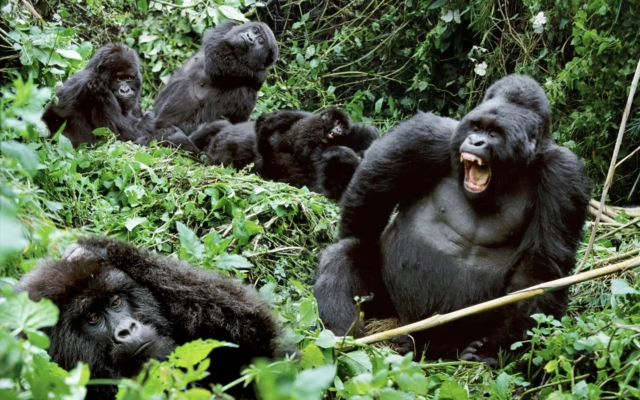
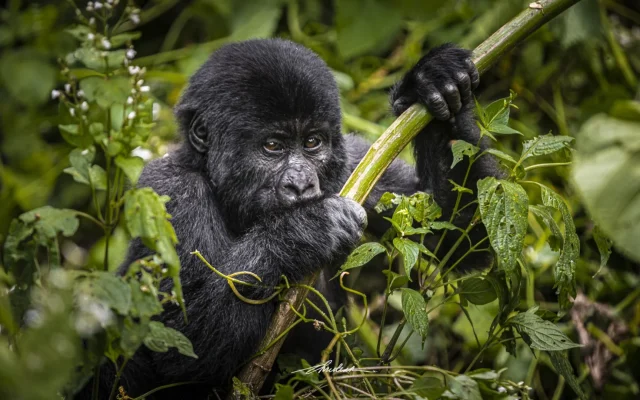
Mgahinga is one of the few parks in Africa where visitors can trek both golden monkeys and mountain gorillas within the same protected area. That combination — rare primates, volcanic scenery, and Batwa cultural heritage — makes southwestern Uganda one of East Africa’s richest primate destinations.
15. Tourism Supports Their Future
Permit revenue from golden monkey tracking contributes to ranger patrols, habitat management, community benefit programmes, and ongoing research in the Virunga ecosystem. Choosing a regulated trek through a reputable operator directly supports the park systems that keep this endangered monkey in the wild.