Golden monkey behaviour is energetic, cooperative, and highly visual — a sharp contrast to the grounded calm of mountain gorilla encounters. Understanding how troops organise, communicate, and move through bamboo habitat deepens every tracking experience at Mgahinga Gorilla National Park.
Social Structure — Large Troops Led by an Alpha Male
Golden monkeys live in sizeable multi-male, multi-female troops that can exceed a hundred individuals. A dominant alpha male leads the group, directing movement and responding to threats. Females form the core of social life, raising young cooperatively within the troop while maintaining grooming networks that reinforce bonds.
Subgroup Dynamics
Although troops are large, golden monkeys often forage in spread-out subgroups within vocal range. Individuals cluster around productive bamboo patches, then coalesce when moving to new feeding areas. This fission–fusion pattern creates the swirling, fast-paced observation that trekkers remember long after leaving the forest.
Canopy Agility
Golden monkeys are arboreal specialists. They leap between bamboo stems, run along branches, and hang briefly to reach shoots — displaying balance and speed that photographers find both challenging and rewarding. Juveniles in particular test their limits through play chases high in the canopy.
Communication and Vocalisations
Troops maintain contact through chirps, trills, and alarm calls. Vocalisations coordinate movement, warn of predators or disturbances, and regulate social interactions. Combined with facial expressions and body posture, the communication system is sophisticated enough to support complex group living in dense forest.
Play Behaviour
Young golden monkeys wrestle, chase, and mock-leap in the bamboo — behaviour that builds motor skills and social relationships. Play peaks when food is abundant and the troop is resting between feeding bouts. Visitors often find juveniles the most entertaining part of the encounter.
Grooming and Affiliation
Adults groom one another to remove parasites, reduce tension, and strengthen alliances. Grooming clusters form during midday rest periods, offering observers a quieter window into social bonds before the troop resumes active foraging.
Response to Visitors
Habituated troops tolerate regulated human presence at respectful distance. Unlike gorillas, golden monkeys rarely sit still — they may pass overhead, feed nearby, or dart through bamboo just metres away while rangers manage positioning. Guides enforce park rules to minimise stress and disease risk.
Daily Activity Pattern
A typical day follows a rhythm:
- Morning: intensive feeding on bamboo shoots and leaves
- Midday: rest, grooming, and juvenile play
- Afternoon: movement to new food patches and continued foraging
- Evening: settling into sleeping sites within the troop’s range
Tracking departures in the morning often align with peak feeding activity — ideal for observation and photography.
Reproduction and Infant Care
Females give birth to a single infant after roughly five months of gestation. Mothers carry and nurse young for extended periods, keeping infants close while moving through canopy. Other females may show interest in infants, but maternal care remains central. Slow reproduction in an endangered population underscores the cost of any habitat loss or disturbance.
Male Roles Beyond the Alpha
Subordinate males remain within or near the troop, contributing to territorial defence and predator awareness. The alpha male’s leadership is most visible during group movement and when responding to unusual sounds — including the arrival of trekking parties guided by rangers who know each troop’s habits.
Predators and Defence
Leopards and large raptors pose natural threats in montane forest. Troops respond to danger with alarm calls and rapid retreat into dense bamboo. Collective vigilance — many eyes at different canopy levels — is a key survival strategy for relatively small primates.
Experiential Tourism and Research Behaviour
Mgahinga’s golden monkey experiential programme allows longer observation of semi-habituated troops alongside researchers. Visitors see how behaviour is recorded, how habituation progresses, and why data on feeding, ranging, and social structure underpin conservation decisions.
Behaviour Compared With Gorilla Trekking
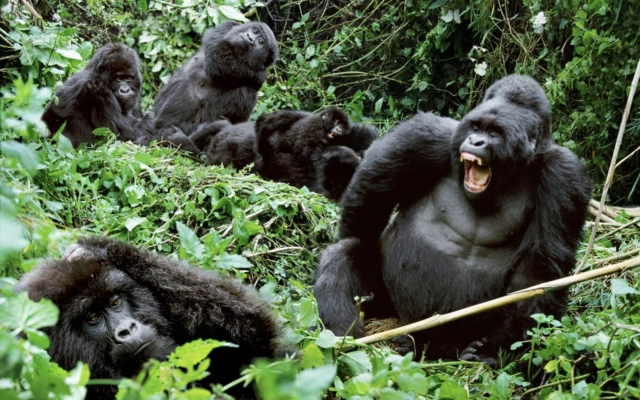
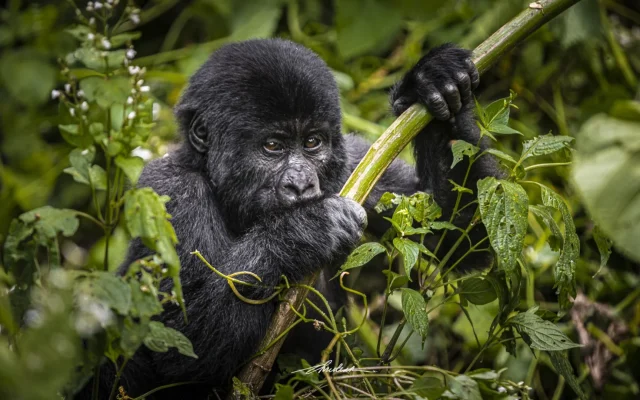
Where gorilla trekking offers intimate ground-level observation of a calm great ape family, golden monkey tracking is dynamic and vertical — monkeys overhead, bamboo rustling, the troop in constant motion. Combining both at Mgahinga gives travellers two distinct primate behaviours in one park.
Ethical Observation
Park rules mirror gorilla protocols in key respects: maintain distance, avoid flash photography, do not eat near animals, and follow ranger instructions. Because monkeys are more mobile, guides actively position groups to prevent crowding and minimise pursuit through vegetation.
Why Behaviour Matters for Safari Planning
Knowing what to expect — movement, sound, canopy height — helps you pack, choose camera gear, and set realistic goals. Read golden monkey facts, plan season via best time to visit, and browse safari experiences to weave behaviour-rich tracking into a full southwestern Uganda primate circuit.
Interpreter Insight on the Trail
Mgahinga rangers read troop behaviour in real time — adjusting pace when juveniles scatter, pausing when the alpha male signals alarm, and positioning visitors when feeding clusters form in open bamboo. Their interpretation transforms a fast-moving forest walk into a structured wildlife lesson and is one reason repeat primate travellers often rank golden monkeys among the most entertaining treks in the Virunga region.