The oribi is the antelope for travellers who appreciate finesse over spectacle. One of Africa's smallest and most elegant savannah species, Ourebia ourebi moves across golden grasslands with gazelle-like grace — fine legs, alert ears, and white facial markings that catch dawn light on game drives in Murchison Falls, Kidepo Valley, and Lake Mburo national parks.
Unlike herd antelopes that fill the frame in hundreds, oribi are usually seen in pairs — a territorial male with one or more females on open plains where short grass meets taller cover. For guides, they are a reliable savannah indicator; for photographers, among the most photogenic small mammals on a Uganda bush circuit; for ecologists, a species whose stotting leaps, alarm whistles, and fire-adapted grazing tell a complete grassland story in miniature.
What Is an Oribi?
The oribi belongs to the family Bovidae and the antelope tribe Neotragini — a group of small antelopes adapted to open and lightly bushed country across sub-Saharan Africa. It is the sole species in the genus Ourebia, with several regional subspecies recognised by coat shade and size.
- Kingdom: Animalia
- Phylum: Chordata
- Class: Mammalia
- Order: Artiodactyla
- Family: Bovidae
- Genus: Ourebia
- Species: Ourebia ourebi
Physical Characteristics
Size and Appearance
Oribi stand roughly 50 to 67 centimetres at the shoulder and weigh between 12 and 22 kilograms — slender enough to be mistaken for a young impala at distance, but distinguished by finer proportions, a long neck, and distinctive facial markings.
Coat and Markings
The coat is yellowish tan to reddish brown above, with white on the throat, belly, and inner legs. A white line runs above the eye; a bare dark patch sits beneath each ear. These marks help field identification when mixed antelope species graze the same plain.
Horns
Only males grow horns — short, straight, and ringed at the base, typically under 20 centimetres. Females are hornless. Horns support territorial display more than dramatic combat.
Grace and Speed
Oribi are built for sudden acceleration and stiff-legged stotting leaps when predators close. Their escape strategy combines freezing in tall cover, sharp alarm whistles, and explosive flight — behaviour famous among African field guides.
Where Oribi Live in Uganda
Oribi inhabit open grassland and wooded savannah with a mosaic of short grazing grass and taller hiding cover — not deep forest, not bare desert. In Uganda, the best tourism access is through three savannah national parks.
Murchison Falls National Park
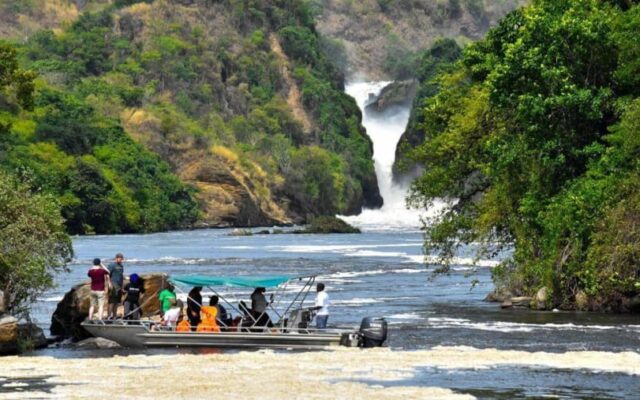
The north bank's Borassus palm grasslands and Buligi circuit are Uganda's premier oribi country — widespread pairs alongside giraffe, buffalo, and hartebeest on classic game drives.
Kidepo Valley National Park
Remote Narus Valley grasslands offer spectacular oribi viewing in a rugged, uncrowded setting — ideal for experienced safari travellers.
Lake Mburo National Park
Compact acacia hills make oribi one of the most accessible species on short savannah add-ons from Kampala or en route to western Uganda.
Habitat and Ecosystem
Oribi thrive where fire, rainfall, and herbivory maintain a grass-height mosaic. They return quickly to burned plains to feed on fresh shoots — one of the few mammals that clearly benefits from savannah fire ecology. Mineral licks anchor territories within daily travel range.
Read our dedicated habitat guide for grassland ecology and park-sector detail.
Social Structure
Oribi are typically solitary or paired — a male defending roughly 25 to 100 hectares with scent marking and displays. Small groups of up to six may form temporarily on rich grazing after rains. This intimate social scale contrasts sharply with the lekking herds of Uganda kob on Queen Elizabeth's Kasenyi Plains.
Diet
Oribi are primarily grazers — grasses can constitute up to 90 percent of the diet, with browse increasing only in drought. Preferred genera include Hyparrhenia, Themeda, and Pennisetum. Post-fire regrowth and mineral licks are important landscape features.
Behaviour Highlights
Diurnal and alert, oribi feed at dawn and dusk, rest through midday heat, and maintain territories year-round. When threatened, they freeze, whistle, stot, and flee — a sequence guides love to interpret. See our behaviour guide for full detail.
Reproduction
After roughly six to seven months of gestation, females bear a single calf, often when grass quality peaks. Calves hide in tall grass while mothers graze nearby — vulnerable to leopards and jackals.
Predators
Leopards are the signature oribi predator in Uganda's parks, stalking from riverine and acacia cover. Lions, hyenas, pythons, and eagles also take oribi, especially calves. Alert posture on a plain often signals predator presence before visitors see the hunter.
Conservation Status
The IUCN lists oribi as Least Concern globally, with an estimated 750,000 individuals across Africa — but populations are declining outside protected areas due to agriculture and livestock competition. Uganda's national parks remain reliable strongholds for safari viewing.
Why Oribi Matter
Ecologically, oribi support mesopredator food webs and participate in post-fire grassland succession. Aesthetically, they reward attentive safari travellers with elegance larger species cannot offer. For Uganda tourism, they represent the savannah detail that complements gorilla trekking — proof that the country's wildlife story extends across every trophic level.
Seeing Oribi on Safari
Oribi are among the most reliable small antelopes on Murchison, Kidepo, and Lake Mburo game drives — especially at dawn on open plains. Pair this overview with our where to see oribi, best time to visit, and safari experiences guides.
Quick Facts
| Scientific name | Ourebia ourebi |
|---|---|
| Best Uganda parks | Murchison, Kidepo, Lake Mburo |
| IUCN | Least Concern (declining outside parks) |