Explore this species across our habitat guide, where to see page, and safari planning resources — centred on Murchison Falls and Kidepo Valley.
From taxonomy and global conservation status to field identification and daily life on the savannah, Nubian giraffes combine biological significance with outstanding safari visibility. On a morning game drive north of the Nile in Murchison Falls, groups feeding along acacia woodland edges are tall, calm, and endlessly photogenic — a cornerstone encounter on Uganda's northern circuit.
This guide covers the most important Nubian giraffe facts, including the relationship with Rothschild's giraffe, Uganda's recovering populations, and what makes these browsers among Africa's most compelling game-drive subjects.
Nubian Giraffe Quick Facts
| Scientific name | Giraffa camelopardalis camelopardalis |
|---|---|
| IUCN status | Critically Endangered (global) |
| Gestation | 14–16 months; single calf |
| Natural Uganda range | Murchison Falls and Kidepo Valley |
1. The Nubian Giraffe Is the Nominate Northern Giraffe Subspecies
Described by Linnaeus in 1758, Giraffa camelopardalis camelopardalis is the name-bearing subspecies of the northern giraffe. Modern genetic work by the Giraffe Conservation Foundation has reorganised giraffe taxonomy into four species; within the northern giraffe, Nubian giraffes represent a distinct lineage critical to global biodiversity. Uganda's herds are not a peripheral population — they are central to the subspecies' survival in the wild.
2. Uganda's Giraffes Are Nubian — Including "Rothschild's"
Populations historically labelled Rothschild's giraffe (G. c. rothschildi) are now recognised genetically as Nubian giraffes. The pale, white-stockinged animals of Murchison and Kidepo are the Rothschild's ecotype within the Nubian taxon. Field guides and tourism literature still use both names; scientifically they are one subspecies. Our Rothschild's giraffe guide covers the same Uganda populations from the ecotype perspective.
3. Nubian Giraffes Are the Tallest Land Mammals
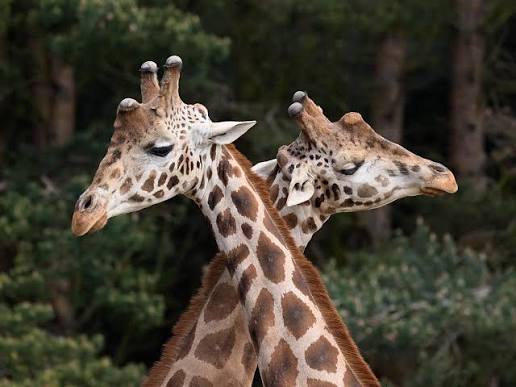
Adult males reach 5.5 to 6 metres — taller than a two-storey building. Females are somewhat smaller but still dominate the savannah skyline. Height is a finely tuned adaptation for accessing browse layers beyond the reach of buffalo, antelope, and other herbivores. On game drives, framing a full-body portrait against open sky remains one of Uganda's signature photographic compositions.
4. Coat Pattern Is the Key Field Mark
Uganda's Nubian giraffes display:
- Large, rectangular orange-brown patches on a cream background
- Softer patch edges than Masai giraffes
- Unmarked lower legs — the famous white stockings of the Rothschild's ecotype
- Unique coat patterns usable for individual identification in GCF monitoring programmes
Rangers in Murchison and Kidepo use these marks daily. Once learned, identification becomes intuitive on every drive.
5. Globally Critically Endangered — Locally Recovering
The IUCN lists the Nubian giraffe as Critically Endangered, with severe decline across Ethiopia and South Sudan. Uganda is the exception: UWA and GCF partnership has grown national numbers from fewer than 300 around 2010 to more than 2,400 today. Murchison Falls National Park alone holds the majority — arguably the most important single site for the subspecies anywhere in Africa. Details on our conservation page.
6. Giraffes Have Seven Neck Vertebrae
Despite a neck exceeding two metres, giraffes share seven cervical vertebrae with humans and all other mammals — each enormously elongated. Powerful cardiovascular adaptations — thick-walled heart, specialised valves, and a rete mirabile blood-vessel network — prevent dangerous pressure changes when the head is raised or lowered to browse or drink.
7. The Tongue Is a Specialized Feeding Tool
A dark, muscular, prehensile tongue up to 50 centimetres long wraps around acacia twigs and strips leaves with precision. Thick saliva and tough mouth tissues protect against thorns. Watching a Nubian giraffe feed at close range on the Buligi circuit reveals mechanics that explain their dominance of the high browse layer.
8. Calves Are Born Already Towering
After 14 to 16 months' gestation, a female gives birth to a single calf roughly 1.8 metres tall that can walk within an hour. Calves face lion and hyena predation in early months — nursery groups of mothers and young are a common, heartwarming sight on Uganda drives during calving peaks in the dry season.
9. Males Engage in "Necking" Contests
Adult males establish dominance by swinging necks and heads against rivals — behaviour called necking. Encounters range from gentle rubbing to powerful blows audible across the savannah. Witnessing necking is a memorable highlight, always observed at respectful distance under guide supervision.
10. Giraffes Do Not Need to Drink Daily
Moisture from leaves and shoots sustains giraffes through extended periods without drinking. When they visit water — at the Nile, Narus River, or seasonal pools — the awkward splay-legged posture creates one of safari's more unusual photographic opportunities.
11. Loose Fission-Fusion Social Groups
Unlike elephants or lions with stable family units, Nubian giraffes form fluid groups. Individuals join and leave freely. You may see solitary males, mixed groups of females and juveniles, or nursery clusters — often within a single morning on Murchison's northern bank. More on our behaviour page.
12. Only Two Natural Populations in Uganda
Of Uganda's five Nubian giraffe populations, only Murchison Falls (north of the Nile) and Kidepo Valley occur naturally within historic range. Reintroductions to the southern bank, Lake Mburo National Park, and Pian Upe Wildlife Reserve expand security but Murchison and Kidepo remain the flagship safari destinations. See where to see Nubian giraffes.
13. Excellent Vision and Sentinel Behaviour
Eyes positioned on the sides of the head give giraffes a wide field of view — useful for detecting lions across open savannah. Their height benefits other herbivores that respond to giraffe alarm postures. Watch for the ripple of raised heads when one individual senses danger.
14. Lifespan and Survival
Wild Nubian giraffes may live 20 to 25 years, depending on habitat security, calf predation, disease, and human-related threats. Protected populations within Uganda's national park system generally fare far better than fragmented herds in less secure landscapes elsewhere in Africa.
15. Why Nubian Giraffes Are a Uganda Safari Favourite
They are tall enough to photograph against clean sky, calm enough to observe at length from a vehicle, and common enough on Murchison's northern bank to reward even a two-day itinerary. For many first-time visitors, the giraffe encounter on the Buligi circuit is the moment the savannah safari truly comes alive — combining Critically Endangered gravitas with accessible, world-class game-drive viewing.