Explore this species across our facts guide, diet page, and where to see guide — with prime encounters on Murchison Falls game drives.
Nubian giraffe behaviour rewards patient observation on Uganda's open savannah. These are calm, towering browsers whose social interactions, daily rhythms, and occasional male contests unfold visibly from a safari vehicle — making them among the most satisfying mammals to watch on a northern game drive, and a highlight equal to elephant or lion for many photographers.
Understanding how Nubian giraffes organise their days, communicate, and respond to vehicles and predators deepens every encounter on the Buligi circuit or Kidepo's Narus Valley.
Social Structure: Fission-Fusion Groups
Unlike elephants with matriarchal families or lions with stable prides, Nubian giraffes form fission-fusion societies. Individuals associate in loose, temporary groups that change composition hour by hour.
Common group types on Uganda game drives include:
- Nursery groups — mothers with calves and juveniles, especially visible in dry-season calving peaks
- Mixed groups — females, subadults, and young of both sexes browsing acacia edges
- Solitary adult males — larger bulls moving independently between feeding areas
- Bachelor clusters — young males practising social skills and low-intensity sparring
Group sizes typically range from one to ten animals, though larger aggregations occur where browse is concentrated — especially on the Buligi circuit during June–September.
Daily Activity Rhythm
Dawn and Early Morning
Giraffes leave overnight resting areas in woodland and move to feeding grounds. Prime game-drive time — animals are active, light is warm, and groups are often visible on open plains north of the Nile.
Midday
Heat reduces movement. Giraffes stand in scattered shade, ruminate, or browse intermittently. They remain visible but less dynamic — ideal for portrait photography of stationary subjects against acacia backdrops.
Late Afternoon
A second activity peak as temperatures fall. Giraffes feed actively before drifting toward woodland edges for the night. Golden-hour light on Murchison's northern bank is exceptional for photography.
Communication
Giraffes communicate through posture, movement, and low-frequency vocalisations humans often cannot hear.
- Neck posture — raised neck signals alertness; lowered head during feeding signals calm
- Ear position — pinned ears may indicate irritation or threat assessment
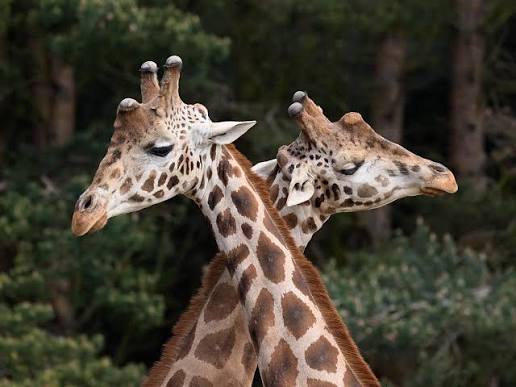
- Ossicones — horn-like structures used in male sparring and social signalling
- Infrasound — research suggests giraffes produce low-frequency hums at night for group cohesion
Watch how a group responds when one individual detects a lion — the ripple of raised heads across a nursery cluster is a classic savannah moment on Murchison drives.
Male Necking and Dominance
The behaviour most associated with male giraffes is necking — swinging the neck and head against a rival to establish dominance and mating access.
Necking exists on a spectrum:
- Low-intensity rubbing — social bonding between familiar males
- Moderate sparring — testing strength without serious injury
- Combat necking — powerful blows audible across the savannah
Necking is most common when females are in oestrus. It is occasionally witnessed on game drives — always at respectful distance under UWA guide supervision.
Mother-Calf Behaviour
Calves stay close to mothers for months, learning browse species and social cues. Mothers are protective and may position themselves between calves and vehicles if approach is too fast. Guides who slow down and keep engines quiet are rewarded with extended nursery-group viewing — among the most popular giraffe behaviour for family safaris.
Response to Vehicles
Habituated Nubian giraffes in Murchison and Kidepo generally tolerate vehicles on established tracks. Sudden movements, loud engines, or off-road approach may cause groups to walk away. Ethical game driving — staying on tracks, maintaining distance, and allowing animals an exit route — produces better, longer sightings and aligns with UWA regulations.
Predator Awareness
Adult giraffes have few natural predators; lions target calves and occasionally sick adults. Giraffes may deliver powerful kicks capable of killing a lion. Their height provides early warning of danger — useful to other herbivores sharing the savannah. In Kidepo, where lion and cheetah occur, watch for alert postures before predators appear on the plain.
Behaviour and Photography
Behavioural knowledge improves images:
- Feeding giraffes are stationary — ideal for sharp portraits
- Walking groups offer dynamic compositions against open sky
- Nursery clusters add emotional depth to family safari albums
- Necking males deliver action shots — rare but extraordinary
Plan dawn and dusk drives via our best time to see guide and pair with safari experiences that allow unhurried time on the Buligi circuit.
Research and Monitoring
The Giraffe Conservation Foundation uses individual coat-pattern identification to track survival, reproduction, and movement in Murchison — similar to cheetah spot profiling. Tourist photographs shared with permission can occasionally assist monitoring. This science underpins Uganda's National Giraffe Conservation Strategy and explains why conservation and tourism are tightly linked for Nubian giraffes.