Mountain reedbuck behaviour is built for broken highland terrain where hiding in grass and bounding uphill beat open-plain flight. These antelopes do not form large herds; they move in small groups or pairs across slope meadows, whistle sharply when alarmed, and retreat to rock cover with stiff-legged jumps. Territorial males advertise from vantage points on Rwenzori foothills and Mount Elgon ridges — behaviour that rewards hikers and game-drive naturalists who work dawn hours on grassland–rock ecotones. Explore facts, diet, and where to see mountain reedbuck.
Daily Activity Pattern
Mountain reedbuck are active mainly at dawn and late afternoon, resting in taller grass or on shaded rock ledges through midday heat. Nocturnal grazing occurs but is less pronounced than in wetland bohor reedbuck. Much of the daylight budget goes to vigilance — animals alternate feeding bites with scanning for leopard and other slope predators.
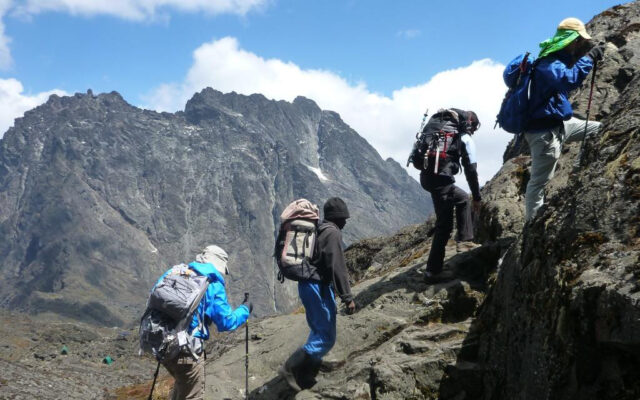
On Rwenzori foothill walks and Mount Elgon approach trails, the most animated behaviour appears in cool morning light: pairs stepping onto meadow edges, males whistling from rocks, or alarmed animals bounding uphill before vanishing behind boulders.
Social Structure
Mountain reedbuck are semi-gregarious with small, flexible groups rather than large aggregations.
- Typical groups: Two to six animals — pairs, family units (female with young), or bachelor groups of young males
- Solitary animals: Occasional, especially subadult males between dispersal and territory acquisition
- Dry season: Animals may concentrate nearer reliable streams on foothill meadows without forming the huge wetland gatherings bohor reedbuck sometimes produce
- Home ranges: Overlap between females; males defend slope territories during breeding periods
Daughters often remain near maternal ranges; young males disperse when horns develop, joining bachelor pairs on territory margins until mature at two to three years.
Territorial Males
Adult males defend rocky slope territories marked by whistling from prominent rocks and occasional horn rubbing on vegetation. Territories are smaller than bohor reedbuck wetland domains but fiercely advertised acoustically — a shrill whistle carries across misty foothill meadows where visual contact between rivals is limited by terrain.
During wet seasons when grass quality peaks, territorial defence intensifies. Males may tolerate brief overlap with females feeding across range boundaries but chase rival males with head-low displays and horn contact.
The Whistling Alarm
Like all reedbucks, mountain reedbuck force a shrill whistle through the nostrils when alarmed — one of the signature sounds of Uganda's highland mornings. The call serves multiple roles:
- Alarm signal when predators, hikers, or vehicles surprise the animal
- Territorial advertisement between males on neighbouring slopes
- Contact call between companions in patchy cover
One to three whistles often precede a stiff-legged bound uphill toward rock refuge. On Rwenzori day walks from Nyakalengija or Ruboni, learning this sound transforms how you experience montane soundscapes — reedbuck may be heard long before they are seen.
Stotting and Uphill Escape
When flight is necessary, mountain reedbuck perform a stiff-legged bounding run — stotting uphill rather than across open plains. The strategy exploits terrain predators struggle to follow: rocky scree, steep grass banks, and boulder fields above meadow lawns.
Alarmed animals may pause on a ridge to whistle again before dropping behind cover — a behaviour that gives photographers brief windows if disturbance is minimised.
Hiding Strategy
Mountain reedbuck prefer crypsis in slope grass over marathon escape. When threat is distant, they stand motionless with ears forward; when closer, they crouch or slip into tussocks beside rocks. Grey coat tone matches montane grass stems — animals are easy to overlook if guides rush forest trails without scanning meadow rims.
Unlike Uganda kob on open plains, reedbuck bet on concealment plus uphill flight — which makes them specialist sightings for elevation-literate routing.
Scent Marking and Horning
Males rub short horns and foreheads on shrubs, soil mounds, and grass tufts — horning behaviour that deposits scent from facial glands. Inguinal glands produce a strong individual odour reinforced by a greasy coat. On damp foothill mornings, scent trails along territory boundaries may guide experienced trackers, though visual whistle displays remain the primary field clue.
Mating and Reproduction
Breeding peaks in rainy periods when montane grass quality supports females and calves. Courtship involves male approach with lowered head, brief chasing of receptive females, and copulation followed by immediate return to grazing. Fights between males use horn locking on slopes — occasionally serious on steep terrain where footing fails.
Females produce a single calf after roughly seven to eight months' gestation. Calves lie hidden in grass and rock cover for several weeks; mothers visit to nurse while maintaining distance from the hiding site. Suckling is brief but frequent. Weaning completes around eight to nine months.
Maternal Behaviour
Hiding calves on slopes demands vigilance — mothers feed nearby but freeze when hikers approach too closely. Repeated disturbance on popular trails can stress breeding females; staying on designated paths and giving alarmed animals uphill escape room protects maternal behaviour.
Predator Response
Leopards are the primary mammalian predator on Rwenzori foothills and Mount Elgon slopes where reedbuck occur. Spotted hyenas and African wild dogs take reedbuck in Kidepo Valley where rocky slopes meet savannah. Martial eagles and other raptors may take young on exposed meadows.
First defence is stillness; flight comes when danger closes. Whistles alert companions — valuable in patchy cover where isolated animals would be more vulnerable.
Behaviour on Uganda Highland Safaris
Expect subtlety. Mountain reedbuck may allow brief observation on meadow edges at dawn, then whistle and bound uphill. Guides who include foothill grassland — not only forest interior — produce better encounters than primate-focused trail routing alone.
On Kidepo kopje drives, distinguish mountain reedbuck on upper slopes from bohor reedbuck in Narus Valley meadows — elevation and coat grey tone separate them faster than horn shape alone.
Comparison With Klipspringer and Bushbuck
Klipspringer occupy sheer rock and monogamous pair territories on kopje summits. Bushbuck use thicker forest–grass ecotones. Mountain reedbuck sit between — slope meadows with rock escape routes, small groups, and reedbuck whistling. All three may appear on eastern highland itineraries but require different scanning techniques.
Ethical Viewing
Do not chase whistling animals uphill through cover; repeated alarm stresses mothers with hidden calves. Keep distance on narrow ridge trails and never block escape routes toward rock refugia. Responsible behaviour protects the same montane habitat reedbuck behaviour depends on.
Plan dawn foothill sessions using our best time to see mountain reedbuck and safari experiences guides.