Where to see l’hoest’s monkey — expert Uganda safari guide from local planners who know permits, parks, and realistic routing.
Seeing L'Hoest's monkey in Uganda means walking the Albertine Rift's greatest forests — Bwindi Impenetrable National Park, Mgahinga Gorilla National Park, and the western margins of Kibale National Park. No dedicated tracking permit exists; encounters reward forest time on gorilla treks, chimpanzee walks, and guided trails where rangers know resident troops. This guide ranks parks, sectors, and practical tips for glimpsing the white-bearded Allochrocebus lhoesti — with links to best time to see and safari experiences.
Uganda's L'Hoest's Monkey Range Summary
Unlike savannah species visible from game-drive vehicles, L'Hoest's monkeys require foot access to montane forest. Uganda's three core areas differ in encounter style, complementary primates, and itinerary fit:
- Bwindi — highest encounter reports on gorilla trekking trails; multi-sector forest
- Mgahinga — volcanic forest combining gorillas, golden monkeys, and L'Hoest's margins
- Kibale margins — western forest on chimp circuits; pairs with Bigodi wetland walks
Bwindi Impenetrable National Park
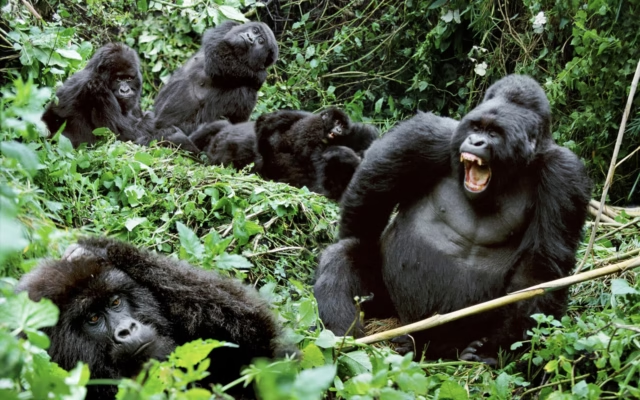
Bwindi is the priority destination for L'Hoest's monkey hopefuls. The park's four gorilla trekking sectors — Buhoma, Ruhija, Rushaga, and Nkuringo — each protect montane forest with resident monkey troops. Trekking routes to habituated mountain gorilla families cross natural forest corridors where ground-foraging monkeys pause on mossy logs or dart across muddy tracks.
Buhoma Sector
The northern gateway town of Buhoma offers mature lodge infrastructure and classic ridge-and-gully forest structure. Gorilla treks here regularly produce incidental primate diversity — L'Hoest's, red-tailed monkeys, and blue monkeys appear on various trail approaches. Optional community forest walks on park margins extend forest hours beyond permit trekking.
Ruhija Sector
Eastern Bwindi at higher elevation — cooler, misty, and rich in Albertine bird endemics. Primate diversity remains high; L'Hoest's encounters are reported on trekking routes and birding walks. Ruhija suits travellers combining gorillas with birding in Uganda who want slower forest pacing.
Rushaga and Nkuringo Sectors
Southern Bwindi sectors access steep forest on the Congo border flank. Gorilla families here draw international trekkers; monkey sightings complement southern circuit itineraries linking to Mgahinga and Lake Mutanda. Terrain is demanding — fitness helps, but so does the reward of multi-primate forest days.
Mgahinga Gorilla National Park
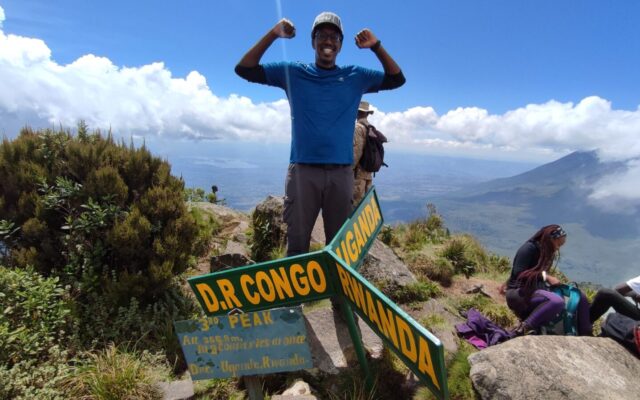
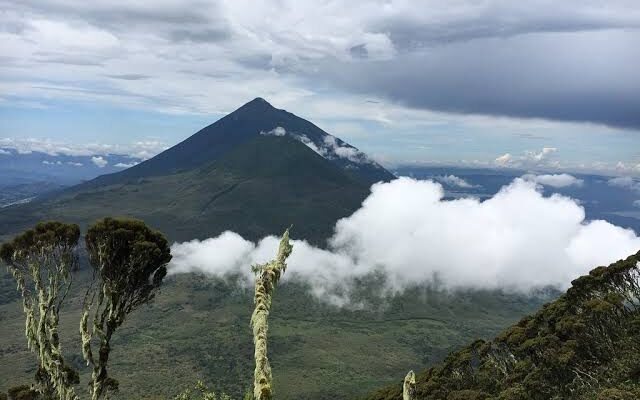
Mgahinga is Uganda's smallest national park — volcanic slopes of the Virunga Massif shared with Rwanda and DRC. Habituated golden monkeys draw dedicated tracking permits; L'Hoest's monkeys occupy mixed montane forest and ecotones below bamboo zones. Gorilla trekking, golden monkey tracking, and volcanic day hikes each add forest exposure where L'Hoest's troops may appear.
Combining Mgahinga Primate Experiences
A two- to three-day Mgahinga stay can stack gorilla permits, golden monkey tracking, and optional forest walks — maximising cumulative hours in suitable habitat without long road transfers. Kisoro town serves as the logistics hub for lodges and UWA briefing points.
Kibale National Park Margins
Kibale is synonymous with chimpanzees, but western and higher-altitude forest margins carry Albertine Rift influence where L'Hoest's monkeys occur. Standard chimp trekking routes through Kanyanchu and alternative walk programmes pass through forest structure supporting terrestrial guenons. Pair Kibale with Bigodi Wetland Sanctuary for primate and bird diversity on the park fringe — red-tailed monkeys are common at Bigodi; L'Hoest's records are sparser but the combined day deepens forest time.
What L'Hoest's Encounters Look Like
Expect brief, quiet views — a troop crossing a trail, adults freezing with white beards catching sidelight, infants peering from vines before the group upslopes into cover. Encounters rarely exceed a few minutes unless animals are feeding calmly and trekkers hold distance with ranger guidance. This is not golden-monkey habituation; manage expectations accordingly.
Trail Tips for Better Sightings
- Start gorilla and chimp treks at dawn — overlap morning foraging peaks
- Keep voices low; pause when guides signal rustling ground layers
- Do not pursue fleeing troops off-trail
- Tell guides in advance you hope for L'Hoest's — experienced rangers know sector patterns
- Add optional forest walks or birding days beyond minimum permit treks
- Carry binoculars even on primate treks — monkeys often appear mid-distance first
Identification in the Field
Confirm L'Hoest's by the white beard and ruff on a dark body — not by tail colour alone. Red-tailed monkeys show chestnut tails and white nose spots; blue monkeys are greyer with less beard development. When in doubt, ask your ranger — misidentification is common in fleeting views.
Itinerary Combinations
Classic southwestern circuits maximise L'Hoest's habitat exposure:
- Bwindi gorillas + Kibale chimps — 7–10 days; two forest pillars
- Bwindi + Mgahinga — gorillas, golden monkeys, volcanic forest
- Kibale + Queen Elizabeth — chimps then savannah; add forest margin days before plains
See Queen Elizabeth National Park for savannah extensions after primate forest — L'Hoest's do not occur there, but the combination balances Uganda's biodiversity.
Lodges and Access
Forest lodges at Buhoma, Rushaga, Nkuringo, Ruhija, Kibale's Kanyanchu area, and Kisoro for Mgahinga place you inside or adjacent to habitat. Road transfers from Entebbe are long — fly-in options via Kihihi or Kisoro airstrips save time on primate-focused trips. Access detail lives in travel guides linked from safari experiences.
What Uganda Cannot Offer
There is no habituated L'Hoest's monkey tracking programme comparable to golden monkeys or gorillas. Travellers seeking guaranteed close primate contact should prioritise those permitted experiences and treat L'Hoest's as a fortunate forest bonus — the correct mindset for shy Albertine Rift endemics.
Regional Alternatives
Rwanda's Nyungwe Forest and DRC's Albertine parks hold L'Hoest's populations, but Uganda's Bwindi–Kibale–Mgahinga triangle remains the most accessible combination for international visitors already planning gorilla and chimp permits. Single-country itineraries simplify logistics and maximise forest days per visa.
Next Steps for Planners
After choosing parks, read best time to see L'Hoest's monkey for seasonal trail conditions, then browse safari experiences and Uganda safari packages for routed examples. Communicate primate interests to your operator — extra forest time transforms shy monkey hopes into realistic encounter probability across Albertine Rift trails.