L’hoest’s monkey habitat — expert Uganda safari guide from local planners who know permits, parks, and realistic routing.
Understanding L'Hoest's monkey habitat explains its shy behaviour, terrestrial foraging, Vulnerable conservation status, and why Bwindi Impenetrable National Park and Mgahinga Gorilla National Park matter so intensely to Albertine Rift primate protection. This species is not a habitat generalist — it survives in cool, structurally complex montane and submontane forest where dense understory, fruiting trees, and quiet forest tracks create the conditions troops require. Explore linked pages on behaviour, diet, and where to see L'Hoest's monkey for field viewing context.
Where Do L'Hoest's Monkeys Live?
Wild L'Hoest's monkeys occupy a broken range along the Albertine Rift and adjacent Congo Basin foothills — eastern DRC, Rwanda, Burundi, and southwestern Uganda. No populations exist outside this western arc. Within Uganda, confirmed protected habitat includes Bwindi's montane forest matrix, Mgahinga's volcanic forest slopes, and the western margins of Kibale National Park where Albertine influence meets Guinea-Congo rainforest species.
Habitat continuity across international borders means national park protection in Uganda contributes to a regional metapopulation — monkeys do not recognise survey lines, and gene flow depends on forest corridors that remain under pressure from agriculture and settlement outside park boundaries.
Albertine Rift Context
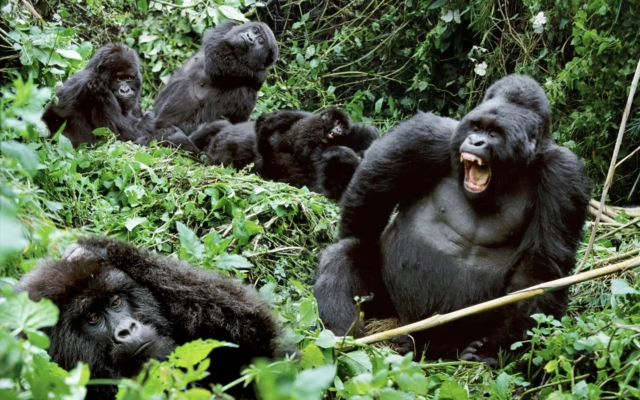
The Albertine Rift is one of Africa's most biodiverse and threatened ecoregions — a chain of mountains, rift valleys, and ancient forest blocks along the western edge of the East African Plateau. L'Hoest's monkeys share this landscape with mountain gorillas, golden monkeys, endemic antelopes, and hundreds of plant species found nowhere else. Protecting L'Hoest's forest protects a much wider web of rift-endemic life that defines Uganda's southwestern safari identity.
Elevation and Climate
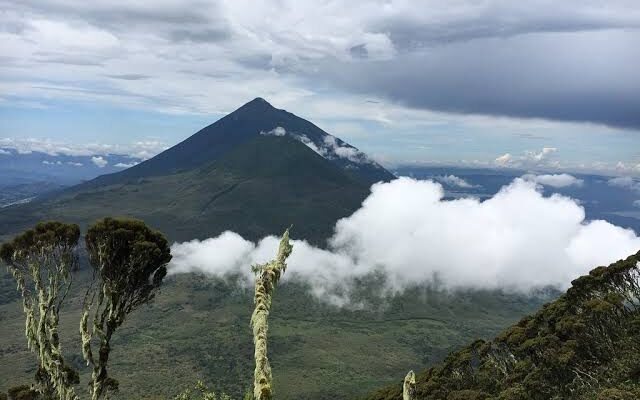
L'Hoest's monkeys occupy a broad elevational band within forest systems, generally from roughly 900 to 2,500 metres above sea level depending on local topography and forest continuity. At higher elevations — particularly Bwindi and Mgahinga — temperatures are cool, rainfall is high, mist is frequent, and humidity saturates understory vegetation. These conditions support mossy logs, dense vine tangles, and year-round leaf cover that suit a shy, ground-foraging monkey.
Seasonal rainfall pulses influence fruit availability and indirectly shape troop ranging patterns. Dry seasons compress some activity to predictable morning windows; wet seasons spread foraging across longer days but thicken mud on trails trekkers use for gorilla and chimp access.
Forest Structure and Strata
Montane forest habitat is vertically layered — emergent trees, main canopy, subcanopy, shrub layer, and herbaceous ground cover. L'Hoest's monkeys use all strata but distinguish themselves by substantial ground-layer foraging. Fruiting trees in canopy draw troops upward, yet much feeding occurs on fallen fruit, herbaceous shoots, and invertebrates in leaf litter — explaining why trail crossings are among the most common tourist sightings.
Understory Density
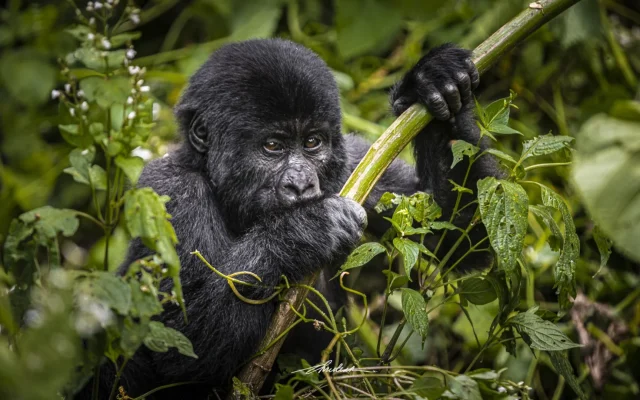
Bwindi's "impenetrable" reputation reflects tangled understory — saplings, shrubs, and vines that limit visibility but provide escape cover within metres. For L'Hoest's monkeys, dense understory is defensive infrastructure: a troop that drops from view into a vine wall can vanish from human observers in seconds. Guides learn to pause at rustling ground layers rather than pushing through — the difference between a photograph and a missed flash of white beard.
Bwindi Impenetrable National Park
Bwindi is Uganda's premier L'Hoest's monkey stronghold — a UNESCO World Heritage Site protecting roughly 320 square kilometres of montane forest across steep ridges from about 1,160 to 2,607 metres. Multiple gorilla trekking sectors — Buhoma, Ruhija, Rushaga, Nkuringo — each hold forest structure suitable for resident troops. Incidental monkey encounters during gorilla trekking are regularly reported, especially on trails where understory opens into natural corridors.
Why Bwindi Habitat Matters
- Largest contiguous montane forest block in the Albertine Rift eastern arc
- Shared trails with mountain gorilla tourism fund ranger patrols reducing snares
- Vertical relief creates microhabitats from ridge tops to stream gullies
- International research presence supports long-term primate monitoring
Mgahinga Gorilla National Park
Mgahinga protects volcanic forest on the slopes of Muhavura, Gahinga, and Sabinyo — Uganda's smallest national park and a critical Albertine Rift fragment. Bamboo zones dominate golden monkey habitat higher on slopes; L'Hoest's monkeys tend toward mixed montane forest and forest–grassland ecotones at lower elevations. The park's compact size makes every hectare valuable; habitat loss outside boundaries directly threatens troop viability.
Kibale National Park Margins
Kibale is famous for chimpanzees and Guinea-Congo rainforest species, but its western and higher sectors carry Albertine Rift influence where L'Hoest's monkeys occur alongside red-tailed monkeys, grey-cheeked mangabeys, and chimpanzees. Forest structure here is somewhat more open than Bwindi's steepest slopes, yet fruiting figs, Prunus relatives, and herbaceous clearings still support terrestrial foraging bouts visible on chimp trekking approaches.
Water, Streams, and Microhabitats
Permanent streams and seepage zones punctuate montane forest — not open water dependence like savannah antelope, but structural features that shape tree species composition and fruiting phenology. Troops often forage along stream margins where herbaceous growth is lush and invertebrate prey concentrates. Trekkers descending muddy gullies on gorilla routes should watch ground layers on both sides — L'Hoest's monkeys use the same natural pathways humans follow.
Habitat Threats
Fragmentation is the overarching threat — forest converted to farmland, settlement, and tea plantations at park edges reduces corridor connectivity and increases snare encounter rates on ground-foraging monkeys. Climate change may shift montane forest zones upslope over decades, compressing suitable habitat for species already range-restricted. Inside parks, illegal snaring for bushmeat remains the most immediate mortality source for terrestrial cercopithecines.
Ecological Interactions
L'Hoest's habitat overlaps competitors and allies — red-tailed monkeys share fruits; chimpanzees occasionally prey on monkeys; leopard hunt troops at dawn and dusk. Figs and other keystone fruiters synchronise frugivore communities; when figs fruit, multiple primate species converge, increasing both feeding opportunity and predation risk for cautious L'Hoest's troops.
Conservation Habitat Priorities
Maintaining intact forest without internal logging roads, reducing edge snaring, and securing community buffer-zone agreements are habitat priorities as important as species-specific programmes. Tourism that funds Uganda Wildlife Authority patrols directly protects the ground layer L'Hoest's monkeys depend on. Read our conservation page for threat detail and how visitors contribute.
Planning Forest Time for Habitat Encounters
Maximising L'Hoest's sightings means choosing parks with confirmed habitat — Bwindi first, Mgahinga and Kibale margins second — and scheduling multiple forest days across a single itinerary. Birding walks, optional forest hikes after gorilla treks, and chimp circuits at Kibale all add hours in suitable structure. See best time to see L'Hoest's monkey and safari experiences for routed examples through Albertine Rift forest.