L’hoest’s monkey — Uganda safari guide for travelers planning wildlife encounters.
L'Hoest's monkey is one of the Albertine Rift's most elegant forest primates — a shy, ground-oriented monkey whose dark coat and striking white beard make it unmistakable when it finally crosses a forest gap. Endemic to the rift's western arc, Allochrocebus lhoesti survives in fragmented montane forests from eastern Democratic Republic of Congo through Rwanda, Burundi, and southwestern Uganda. For safari travellers focused on gorillas and chimpanzees, this Vulnerable cercopithecine is the quiet bonus of a well-planned forest itinerary: patient walking, soft voices, and the reward of a white-ruffed adult melting back into understory shade.
In Uganda, L'Hoest's monkeys occur in the cool, humid forests of Bwindi Impenetrable National Park, the volcanic slopes of Mgahinga Gorilla National Park, and the western margins of Kibale National Park — three of the country's flagship primate destinations. Unlike habituated golden monkeys at Mgahinga, L'Hoest's troops are not tracked on dedicated permits. Encounters come incidentally on gorilla trekking trails, chimpanzee walks, and guided forest routes where rangers know which sectors hold resident groups.
What Is L'Hoest's Monkey?
L'Hoest's monkey — also called the mountain monkey — is a medium-sized Old World primate in the genus Allochrocebus. It was long classified within Cercopithecus alongside blue monkeys and allies, but molecular work placed it in a distinct Albertine Rift lineage sharing ancestry with sun-tailed and preuss's monkeys. The species honours Belgian zoologist Emile L'Hoest, who contributed early Central African primate collections.
- Kingdom: Animalia
- Phylum: Chordata
- Class: Mammalia
- Order: Primates
- Family: Cercopithecidae
- Genus: Allochrocebus
- Species: Allochrocebus lhoesti
Across its range, L'Hoest's monkey is a forest specialist — not a savannah or gallery-woodland generalist. That narrow habitat fidelity explains both its Albertine Rift endemism and its Vulnerable conservation status.
Physical Characteristics
White Beard and Ruff
The signature field mark is a broad white beard and throat ruff contrasting with an otherwise dark, dense pelage. Pale cheek whiskers frame the face. Adult males often show the most dramatic ruff; females and juveniles share the pattern but sometimes with slightly less extensive white. In dim forest light, the beard is the feature that separates L'Hoest's from superficially similar dark forest monkeys at a glance.
Size and Build
Adults typically weigh four to seven kilograms, with males slightly heavier. Body length runs roughly forty to sixty-five centimetres, plus a long tail used for balance on branches and for expressive posture during social interaction. The build is compact — neither as slight as a galago nor as robust as a mangabey — suited to quick retreats into dense cover.
Terrestrial Tendency
Unlike many forest cercopithecines that feed predominantly in canopy, L'Hoest's monkeys spend substantial time foraging on the forest floor. Terrestrial habits increase vulnerability to snares but also create viewing opportunities when troops cross trekking trails at Bwindi and Kibale.
Where L'Hoest's Monkeys Live in Uganda
Uganda holds important populations along the Albertine Rift's eastern edge. Core protected areas include:
- Bwindi Impenetrable National Park — montane forest across multiple gorilla sectors; regular incidental sightings on trekking routes
- Mgahinga Gorilla National Park — volcanic forest margins sharing habitat with gorillas and golden monkeys
- Kibale National Park — western and higher-altitude forest margins where Albertine influence meets West African rainforest species
Community forest walks near Bigodi Wetland Sanctuary occasionally produce views of forest primates on the Kibale fringe, though L'Hoest's records are less frequent than red-tailed monkeys in that specific wetland corridor.
Habitat and Ecosystem
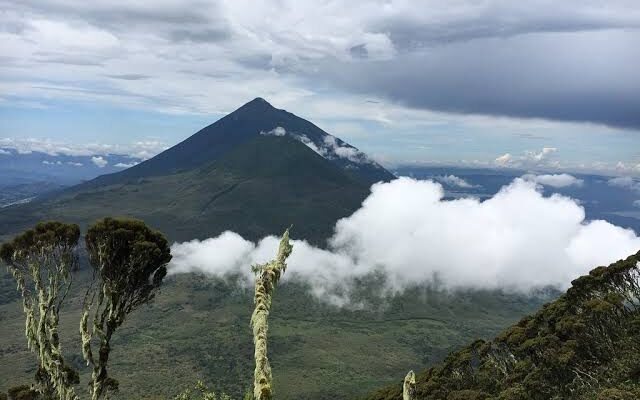
L'Hoest's monkeys inhabit montane and submontane forest generally between roughly 900 and 2,500 metres elevation — cool, moist, structurally complex woodland with dense understory and seasonal fruit pulses. Explore our habitat guide for Albertine Rift ecology, forest strata, and why Bwindi's impenetrable structure suits this shy species.
Social Structure
Troops typically follow a single-male, multi-female pattern, often numbering ten to twenty animals including juveniles and infants. Males defend access to females; subordinate males may form peripheral associations or transfer between groups. Cohesion is maintained through soft grunts and contact calls rather than the boisterous vocal displays of some guenons.
Diet
Omnivorous forest foraging defines daily life — fruits when available, leaves and shoots year-round, flowers in season, and invertebrates gleaned from bark and leaf litter. Ground feeding distinguishes L'Hoest's ecology from more arboreal neighbours. Read our diet page for seasonal fruiting calendars and foraging tactics.
Behaviour
Shyness is the species' defining temperament. Troops freeze at disturbance, retreat upslope into tangles, and resume foraging only when perceived threat passes. Rangers on mountain gorilla treks learn to pause when contact calls ripple through understory — often the first sign of L'Hoest's monkeys nearby. See behaviour for alarm responses, terrestrial movement, and photography etiquette.
Predators and Ecological Role
Leopard, crowned eagle, and larger forest raptors prey on monkeys in Bwindi and Kibale systems. As frugivores and folivores, L'Hoest's troops disperse seeds and prune vegetation — modest individually, significant collectively across intact forest blocks. Their presence signals functional understory and fruiting-tree layers.
Conservation Status
The IUCN classifies L'Hoest's monkey as Vulnerable. Habitat fragmentation, snaring for bushmeat, and forest edge agriculture threaten populations across the Albertine Rift. Uganda's protected-area network is a national stronghold. Details on conservation.
Best Time to See L'Hoest's Monkey
Encounters are possible year-round, but dry-season trekking — June to September and December to February — offers firmer trails and predictable morning activity. Dawn forest walks maximise sighting odds before troops settle into mid-day cover. Monthly guidance on best time to see L'Hoest's monkey.
Safari Experiences
No dedicated permit is required. Build forest days into gorilla, golden monkey, and chimpanzee circuits across southwestern Uganda. Browse L'Hoest's monkey safari experiences and Uganda safari packages for routed primate itineraries.
Quick Facts
| Uganda strongholds | Bwindi, Mgahinga, Kibale margins |
|---|---|
| Scientific name | Allochrocebus lhoesti |