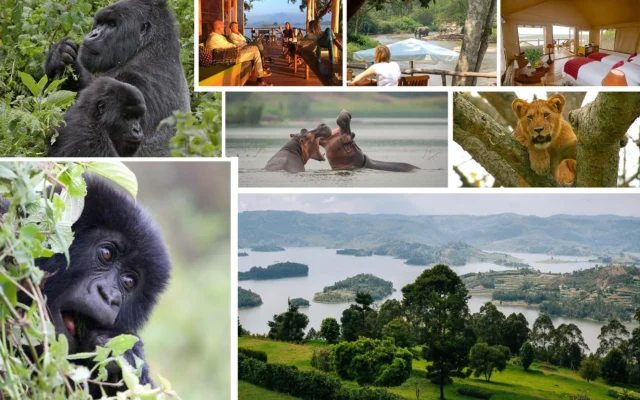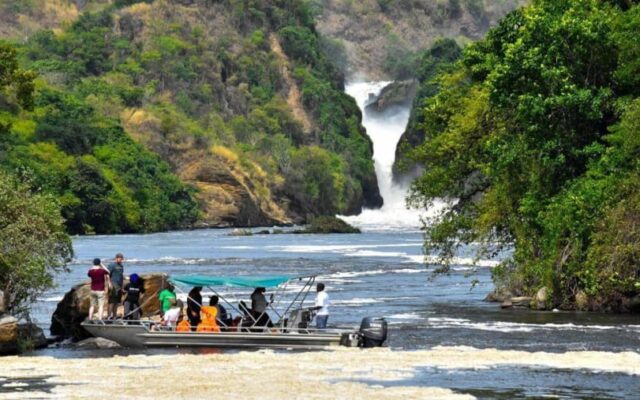
This detailed guide explores the most compelling hippopotamus facts, from anatomy and river adaptations to social behaviour, conservation status, and why Uganda’s boat safaris deliver such exceptional viewing. Most travellers encounter hippos on Murchison Falls Nile cruises, the Kazinga Channel, or Lake Mburo — see our where to see hippopotamuses guide for park comparisons.
Hippopotamus Quick Facts
| Scientific name | Hippopotamus amphibius |
|---|---|
| Common names | common hippopotamus, Nile hippopotamus, river hippopotamus |
| IUCN Red List status | Vulnerable |
| Uganda strongholds | Nile, Kazinga Channel, Lake Mburo |
1. Hippos Are Africa’s River Giants
The hippopotamus is one of the most physically imposing mammals on the continent. Its barrel-shaped body, short legs, and massive head create a silhouette instantly recognisable on any Uganda boat safari. Despite their bulk, hippos move quickly in water and can surprise observers with sudden charges when threatened.
2. Only Elephants and Rhinos Outweigh Them
While elephants are the largest land animals, hippos rank among the heaviest. Large bulls may exceed 3,000 kilograms. This weight is supported by dense bones and powerful limb muscles adapted for walking on soft river bottoms rather than sprinting across open plains.
3. The Name Means “River Horse”
“Hippopotamus” comes from Ancient Greek — hippos (horse) and potamos (river). Early observers noted how much time the animals spent in water. Modern genetics places hippos in the order Artiodactyla (even-toed ungulates), not among horses at all.
4. Hippos Are Related to Whales
Molecular studies show that hippos share a relatively recent common ancestor with cetaceans — whales and dolphins. This surprising relationship explains certain physiological traits, including aquatic lifestyle preferences and specialised skin adaptations.
5. They Cannot Swim — But They Do Not Need To
Contrary to popular belief, hippos do not swim in the conventional sense. They are so dense that they sink and walk along the riverbed. Propelled by powerful legs, they can trot underwater, leap, and push off the bottom to surface for air. Their eyes, ears, and nostrils are positioned on top of the skull to remain functional while the body stays submerged.
6. Hippos Can Hold Their Breath for Several Minutes
A resting hippo can stay underwater for around five minutes before surfacing. Nostrils and ears close automatically on submersion. This adaptation allows them to nap in shallow water with periodic reflexive breaths — a behaviour often seen on midday Kazinga Channel cruises.
7. Their Skin Is Thick but Fragile
Hippo skin may be up to 6 centimetres thick, yet it secretes a natural reddish substance sometimes called “blood sweat” that acts as sunscreen and antibiotic. Without water or mud, skin dries and cracks quickly — another reason hippos cluster in rivers during the hottest hours.
8. Hippos Have Enormous Mouths and Ivory Canines
A hippo’s gape can approach 150 degrees. Lower canine teeth may grow over 50 centimetres and are valued by poachers as ivory. Unlike elephants, hippo ivory comes from incisors and canines, not elongated tusks — but demand still fuels illegal trade.
9. They Are Mostly Herbivorous
Hippos feed almost entirely on short grasses, with minimal consumption of aquatic plants. Their grazing ecology is nocturnal and terrestrial, even though they appear inseparable from water by day.
10. Hippos Eat Up to 40 Kilograms of Grass per Night
After dusk, hippos travel along well-worn paths between water and grazing lawns, consuming large quantities of grass before returning to water by dawn. These trails become visible features of riverine habitat and are used by other species.
11. Pods Can Number Dozens of Individuals
Social groups — pods or bloats — typically include females, juveniles, and calves overseen by a territorial bull. On crowded waterways like the Kazinga Channel, aggregations may appear to blanket the shoreline.
12. Bulls Defend River Territories
Male hippos establish aquatic territories covering a stretch of river or lake edge. They advertise dominance through vocalisations, splash displays, and dung scattering along banks. Territorial defence is primarily aquatic; grazing on land is generally non-territorial.
13. Yawning Is Usually a Threat Display
That iconic wide-mouth yawn is not a sign of sleepiness. It exposes tusks and jaw strength as a warning to rivals and boats that approach too closely. Guides on Uganda boat safaris interpret yawning as a cue to maintain respectful distance.
14. Hippos Are Among Africa’s Deadliest Animals
Hippos kill more people in Africa than most large predators. They are especially dangerous on land when blocking paths to water or when mothers protect calves. Statistics vary by region, but experts consistently rank hippos among the top human-wildlife conflict species on the continent.
15. Calves Are Born in Water
Females give birth after about eight months of gestation, usually in shallow water. Newborns weigh roughly 30 to 50 kilograms and must surface quickly to breathe. Mothers are fiercely protective, and calves remain in the pod for years.
16. Hippos Vocalise Underwater
Honks, grunts, and wheezes carry both in air and underwater, helping pods coordinate in murky rivers. Submerged vocalisation is one reason hippos seem to “laugh” or “chuckle” during crowded midday gatherings.
17. They Shape River Ecosystems
Hippo dung enriches waterways with nutrients that support fish and insect communities. Grazing lawns maintained by nightly feeding benefit other herbivores. In this sense, hippos function as wetland ecosystem engineers.
18. Crocodiles Share Their Habitat but Rarely Prey on Adults
Nile crocodiles coexist with hippos on Uganda’s waterways. Adult hippos are generally too formidable for crocodiles, though calves may be vulnerable. The two species are often photographed together on Murchison Nile cruises.
19. Population Estimates Are Difficult
Counting hippos is challenging because animals submerge and aggregate in inaccessible swamps. Africa may support roughly 115,000 to 130,000 common hippos, with declines in several range countries. Uganda remains an important stronghold.
20. Uganda Offers World-Class Hippo Viewing
Few destinations match the reliability and density of hippo encounters in Queen Elizabeth and Murchison Falls. Boat-based viewing keeps visitors safer than foot approaches while delivering close observation of natural behaviour.
21. Hippos Are Vulnerable to Extinction Pressures
The IUCN lists Hippopotamus amphibius as Vulnerable. Habitat loss, illegal hunting, and human encroachment continue to reduce populations outside well-managed parks. Tourism revenue helps justify protected wetlands — explore threats on our conservation page.
22. Best Viewing Is Often at Midday
Unlike many safari species that are most active at dawn and dusk on land, hippos are conspicuous in water during midday heat. Scheduling a Nile or Kazinga boat cruise after a morning game drive is a proven itinerary pattern — detailed in our best time to see hippos guide.
23. Hippos Have Poor Eyesight but Keen Hearing
Their eyes are positioned for aquatic vigilance rather than long-range savannah scanning. They rely heavily on sound and scent, which explains sudden aggressive responses when surprised on land at night.
24. They Can Run Faster Than Many People Expect
On land, hippos can reach speeds around 30 km/h over short distances — far faster than their appearance suggests. This is a critical safety reason to avoid walking near hippo paths at night without armed rangers.
25. Responsible Tourism Supports Protection
Park fees, boat cruise tariffs, and guided Uganda safari packages fund rangers, anti-poaching patrols, and community programmes. Choosing licensed operators ensures hippo viewing remains both memorable and sustainable.