The defassa waterbuck is one of the most imposing antelopes on a Uganda savannah safari — shaggy, horned, and almost always found within sight of water. For travellers building a mental checklist of African wildlife, the bull standing sentinel on a Nile bank or Kazinga shoreline embodies the wetland savannah ecosystem as clearly as lion or hippo. Yet many visitors overlook that Uganda's waterbuck are not the same as the ring-marked common form photographed in Botswana or South Africa.
Scientifically recognised as Kobus defassa (or, in older lumped taxonomy, Kobus ellipsiprymnus defassa), the defassa waterbuck ranges across West and Central Africa into Uganda, western Kenya, and beyond. Solid white patches on either side of the rump — not a hollow white ring — are the field mark that separates defassa from common waterbuck east of the Gregory Rift. In Uganda's four savannah national parks, defassa is the waterbuck you will see.
What Is the Defassa Waterbuck?
The defassa waterbuck belongs to the family Bovidae and the reduncine tribe of water-associated grazing antelopes, alongside Uganda kob, reedbuck, and lechwe. It is the largest member of the genus Kobus in Uganda — heavier than kob, more tied to waterfront than topi, and more conspicuous than reedbuck in riverine settings.
- Kingdom: Animalia
- Phylum: Chordata
- Class: Mammalia
- Order: Artiodactyla
- Family: Bovidae
- Genus: Kobus
- Species: Kobus defassa
Defassa vs Common Waterbuck
East Africa hosts two waterbuck varieties that interbreed where ranges meet along the Rift:
- Defassa: Solid white rump patches; range west of the Rift through Uganda, DRC, and much of West Africa
- Common (ringed): White ring around dark rump; range east and south through Kenya, Tanzania, and southern Africa
Uganda safaris deliver defassa. Understanding the split matters for conservation too — defassa alone is Near Threatened with a declining trend, while common waterbuck remain Least Concern.
Physical Characteristics
Size and Build
Males reach roughly 120 to 127 centimetres at the shoulder and 200 to 260 kilograms. Females are smaller but still substantial — among the largest antelopes routinely seen on game drives. The robust frame supports long hours of grazing along productive waterfront bands.
Coat and Secretions
The shaggy coat varies from reddish brown to grizzled grey, darkening in older males. A cream throat bib and pale muzzle contrast with the body. Skin glands produce an oily, musky secretion — the "greasy kob" — that may waterproof the coat and deter some predators.
Horns
Males alone carry spiralling horns up to roughly a metre along the curve. Females lack horns. Horn size signals age and status among territorial bulls defending riverside territories.
Where Defassa Waterbuck Live in Uganda
Murchison Falls National Park
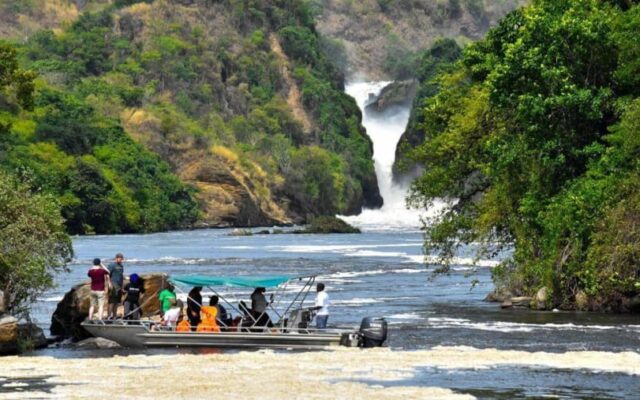
The Victoria Nile, Buligi tracks, and Lake Albert delta create premier defassa habitat — among the best on the continent for combined drive-and-boat viewing.
Queen Elizabeth National Park
Kazinga Channel margins, crater lakes, and Ishasha river lines hold reliable populations alongside hippo, buffalo, and elephant.
Kidepo Valley National Park
The Narus Valley's watercourses support defassa in a remote, semi-arid savannah matrix — lower density, exceptional wilderness character.
Lake Mburo National Park
Compact lake shores and wetlands offer accessible waterbuck on short western circuits ideal for primate–savannah combinations.
Habitat and Water Dependence
Defassa waterbuck cannot tolerate dehydration in heat. They inhabit moist savannah, riverine woodland, and floodplain margins within reach of permanent water — rarely wandering far into dry upland bush. This ecology concentrates them along safari routes that already follow rivers and channels.
Social Structure and Behaviour
Herds of females and young, bachelor groups of young males, and territorial bulls structure social life. Animals are sedentary compared to migratory species — the same loops produce repeat sightings. When alarmed, many flee into water rather than across open plain.
Diet
Predominantly grazers, defassa select fresh grasses and herbs near water. Seasonal rainfall shifts feeding grounds along expanded floodplains in wet months and contracted river strips in dry seasons.
Predators and Survival
Lion, leopard, spotted hyena, and crocodile hunt waterbuck, especially calves. Adults use horns in close defence. The species is not the primary lion prey on every plain — kob fill that role on Kasenyi — but waterfront ambush makes waterbuck vulnerable at crossings.
Conservation Status
Near Threatened globally, with an estimated 60,000 to 80,000 individuals and a decreasing trend. Uganda's protected parks shelter a meaningful share. Poaching, habitat loss, and riverside settlement remain threats inside and outside boundaries.
Defassa Waterbuck on Safari
No special permit is required beyond park entry. Dawn drives and afternoon boats deliver the best encounters. Photographers favour dry-season light on white rump patches; naturalists value wet-season calves and green floodplain backdrops.
Quick Facts
- Large wetland grazer — males to ~260 kg
- Solid white rump patches (defassa mark)
- Near Threatened — not Least Concern like common waterbuck
- Found in all four Uganda savannah national parks
- Spiral horns on males only
- Oily skin secretion — "greasy kob"
- Year-round viewing on river and channel circuits