Olive baboon facts — expert Uganda safari guide from local planners who know permits, parks, and realistic routing.

The olive baboon is one of Africa's most familiar large primates — powerful, intelligent, and instantly recognisable by its elongated muzzle, heavy frame, and grizzled olive-brown coat. In Uganda, Papio anubis is the country's most widespread baboon and a constant presence on safaris from Murchison Falls to Kibale and Queen Elizabeth. This guide covers essential biology, taxonomy, and field marks, with links to habitat, where to see olive baboons, and safari experiences across Uganda.
Africa's Anubis Baboon
Across sub-Saharan Africa, olive baboons occupy a broader range than any other baboon species. From the Sahel fringe through the Rift Valley to the acacia woodlands of East Africa, troops exploit habitats that many primates cannot. Uganda sits within this core distribution, and the species appears in nearly every major national park on a classic itinerary — often before visitors reach their flagship gorilla or chimpanzee trek.
What makes olive baboons distinctive is not rarity but accessibility. They are large enough to study without binoculars, social enough to reveal primate politics in minutes, and adaptable enough to thrive beside roads, lodges, and agricultural margins. For first-time safari travellers, baboons frequently deliver the most sustained primate-watching of the trip.
Scientific Classification
The olive baboon belongs to the genus Papio, family Cercopithecidae, order Primates. The species name anubis references the jackal-headed deity of ancient Egypt, whose baboon form appears in temple art — a cultural echo of the animal's long association with human societies along the Nile corridor.
Five baboon species are recognised today: olive, yellow, chacma, hamadryas, and Guinea baboons. Olive and yellow baboons hybridise extensively where ranges overlap in Kenya and Tanzania. Uganda's populations are typically pure Papio anubis, though local variation in coat tone and troop size occurs across the country's diverse parks.
Physical Description
Coat Colour and Markings
Adult olive baboons wear a grizzled olive-brown to grey dorsal coat, paler on the belly, inner limbs, and rump patch. The hairless face is dark grey to black, framed by a mane on some males. Infants are born with black fur that lightens during the first year. The long tail — often 40 to 60 centimetres — is carried with a slight downward hook at the tip during terrestrial travel, a useful field mark when distinguishing baboons from vervet monkeys at distance.
Sexual Dimorphism
Males are roughly twice the mass of females. Adult males weigh 20 to 37 kilograms and measure up to 70 centimetres at the shoulder; females weigh 11 to 15 kilograms. Males carry larger canine teeth — weapons in dominance fights and defence against predators. Females, though smaller, often wield greater long-term social power through stable matrilineal hierarchies and grooming alliances that can outlast individual male tenure.
Skull and Dentition
The elongated muzzle houses large cheek teeth suited to grinding grasses and roots alongside incisors for tearing fruit and flesh. Canine size in males is among the most dramatic sexual dimorphism in Uganda primates — a visual cue to ranking males within any troop.
Range and Distribution
Olive baboons range across roughly 25 African countries from Mali and Mauritania east to Ethiopia and Somalia, and south through Uganda, Kenya, Tanzania, and parts of the Congo basin. Population estimates exceed several hundred thousand individuals continent-wide.
In Uganda, the species occurs in Murchison Falls, Queen Elizabeth, Kidepo Valley, Lake Mburo, Kibale, Budongo, Bwindi margins, Semuliki, and multiple wildlife reserves. No other baboon species is resident in Uganda — olive baboons are the only Papio form visitors will encounter.
Senses and Cognition
Olive baboons possess acute colour vision, sharp hearing, and an excellent sense of smell — faculties that support foraging, predator detection, and social communication. Field studies across Africa document tool use, cooperative hunting, and complex social learning. In Uganda parks, troops quickly learn vehicle patterns, lodge feeding schedules, and crop-raid routes — evidence of behavioural flexibility that both fascinates tourists and complicates conservation at forest edges.
Reproduction and Lifespan
Females reach sexual maturity around four to five years; males somewhat later. Gestation lasts roughly six months, producing a single infant that clings to the mother's belly before riding jockey-style on her back. Interbirth intervals average 18 to 24 months when conditions are good. Wild olive baboons may live 20 to 30 years, with females often outliving males due to lower dispersal risk and stronger social support networks.
Ecological Role
As omnivores, olive baboons influence plant communities through seed dispersal and grass consumption, and animal communities through opportunistic predation on hares, nestling birds, and small reptiles. They are also important prey for leopard, lion, and hyena — a link in Uganda's savannah and woodland food webs that keeps predator populations fed and troop vigilance high.
IUCN Conservation Status
The olive baboon is classified Least Concern by the IUCN, with a large, widespread, and stable population. Uganda's baboons are locally abundant inside protected areas but face persecution as crop pests at park boundaries — a human–wildlife interface challenge rather than a species-level extinction risk. See our conservation page for conflict mitigation context.
How Olive Baboons Compare to Other Uganda Primates
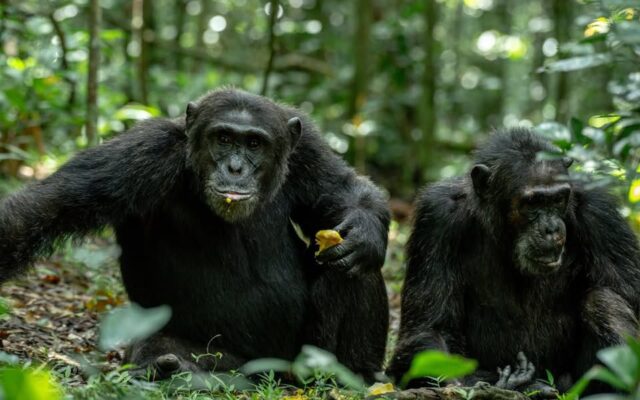
- Common chimpanzee: Great ape; forest specialist; requires trekking permits at Kibale and Budongo
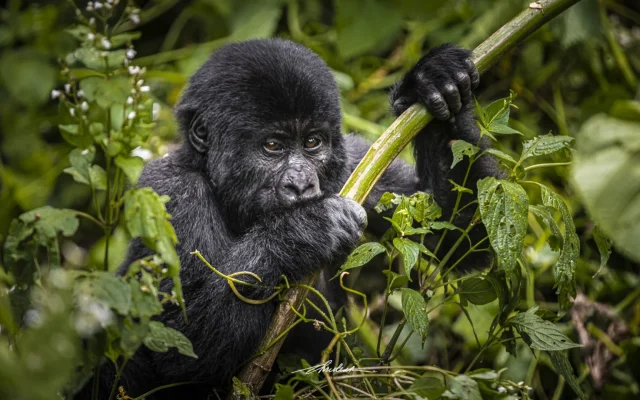
- Mountain gorilla: Great ape; montane forest; permit-limited trekking at Bwindi and Mgahinga
- Red-tailed monkey: Smaller forest guenon; arboreal; common in Kibale canopy
- Vervet monkey: Smaller, greener-grey; more arboreal; black face with white brow band
- Olive baboon: Largest common monkey on savannah drives; terrestrial; no permit required
Why Safari Travellers Notice Baboons
Baboons are impossible to ignore on Uganda roads. They cross game-drive tracks in disciplined lines, sit on embankments watching vehicles pass, and occasionally test open windows for food — behaviour that demands visitor discipline but rewards observers who watch troop dynamics rather than treating baboons as scenery. A five-minute stop at a Murchison troop can reveal grooming networks, infant play, and sentinel posting that textbooks describe but photographs rarely capture.
Quick Reference Facts
- Scientific name: Papio anubis
- Common names: Olive baboon, Anubis baboon
- Male weight: 20–37 kg
- Female weight: 11–15 kg
- Troop size: 15–150+ individuals
- Gestation: ~6 months
- Lifespan: 20–30 years in the wild
- IUCN: Least Concern
- Uganda status: Most widespread baboon; common in all major parks