The olive baboon diet is among the most flexible of any African primate — a true omnivorous menu spanning grasses, roots, fruits, seeds, insects, small vertebrates, and human crops at forest margins. This dietary breadth keeps Papio anubis thriving from Murchison Falls savannah to Kibale forest edges and explains the species' bold presence on roadsides and lodge perimeters. Connect this guide to habitat, foraging behaviour, and where to see olive baboons.
Omnivory as an Ecological Strategy
Specialist primates depend on narrow food sources — gorillas on herbaceous vegetation, colobus on leaves. Olive baboons occupy the opposite extreme. Troops switch between grazing, browsing, digging, hunting, and raiding as seasons change, exploiting whatever calories are available within a day's march. This generalism is why baboons survive in semi-arid Kidepo, moist Kibale, and everything between while more specialised monkeys remain restricted to particular forest layers.
For safari observers, diet shapes daily rhythm. Morning grass grazing on open plains gives way to midday shade and social grooming, then afternoon fruit foraging in woodland and insect hunting in termite mounds. A troop followed across one day in Queen Elizabeth or Murchison reveals a foraging portfolio that mirrors the park's own habitat mosaic.
Grasses and Ground Foraging
Olive baboons graze extensively on savannah grasses — behaviour that surprises visitors who expect monkeys to eat only fruit. They kneel to crop short green blades, dig for underground storage organs, and strip seed heads during dry months when grass quality declines. In Murchison's Borassus grassland and Queen Elizabeth's Kasenyi plains, grass consumption peaks after fire and early rains when regrowth is tender and nutritious.
Ground foraging keeps troops terrestrial for much of the day, exposing them to leopard ambush but allowing efficient bulk feeding. The posture — sitting, kneeling, or walking while cropping — is distinctive and photogenic on open game drives.
Fruits, Seeds, and Woodland Browse
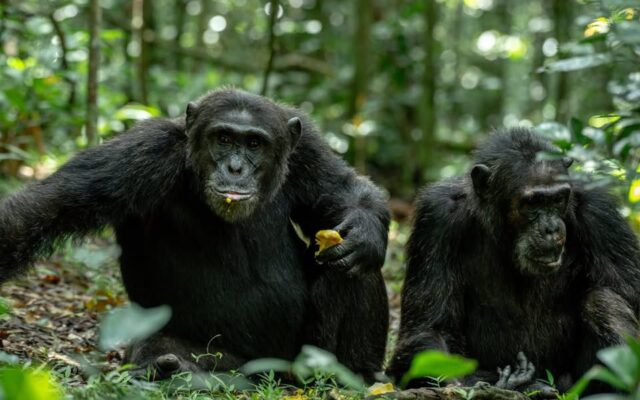
Forest-edge and riverine habitats supply figs, berries, pods, and acacia gum that supplement grass diets. At Kibale and Budongo, baboons compete with chimpanzees and red-tailed monkeys for fruiting trees — a overlap that intensifies in fruiting season when calories concentrate in discrete canopy patches. Baboons climb adequately to reach lower branches but often wait beneath trees for fallen fruit or chase smaller monkeys from drops.
Seed dispersal through faeces is an ecological service baboons provide, though their net effect on any plant species depends on whether seeds survive digestion and germinate away from parent trees.
Insects and Animal Protein
Olive baboons actively hunt insects — termites, grasshoppers, beetles, and ants — by flipping rocks, probing soil, and picking through dung. Cooperative termite fishing with stripped stems has been documented in some populations, though Uganda observations vary by troop and habitat.
Small vertebrates supplement protein intake. Hares, nestling birds, lizards, and young ungulates are taken opportunistically. Chimpanzees hunt colobus cooperatively in Kibale; baboons hunt at smaller scale but with similar opportunistic intent. Occasional lamb or chicken raids at village edges drive human conflict — a diet-driven behaviour with serious conservation consequences outside park boundaries.
Seasonal Diet Shifts in Uganda
Uganda's bimodal rainfall creates two annual peaks of grass and fruit abundance, with leaner intervals between. Baboons expand home range during scarcity and contract toward reliable water and fruit patches during drought. Dry seasons — June to September and December to February — push troops toward river corridors in Murchison and Kazinga margins in Queen Elizabeth, where visitors often see concentrated roadside foraging.
Wet seasons increase insect availability and herbaceous growth but thicken vegetation that conceals predators. Troops balance feeding gain against vigilance cost — a trade-off visible in how spread out or tight formations become across months.
Water and Hydration
Baboons drink at rivers, lakes, and springs daily when water is accessible. Murchison's Nile, Queen Elizabeth's crater lakes, and Kibale's forest streams anchor dry-season movements. Troops may visit waterholes in disciplined sequences — dominant individuals first, juveniles learning social rules at the margins — mirroring hierarchy in other social domains.
Crop Raiding and Human Foods
At forest–farm interfaces near Kibale and Budongo, maize, banana, sweet potato, and cassava draw baboons into conflict with farmers. Troops learn raid routes, timing guards' schedules, and exploit harvest storage — cognitive skills that parallel their foraging intelligence in natural habitats. Conservation programmes employ trenches, chilli barriers, and community revenue sharing to reduce losses while keeping troops inside park cores where tourism revenue benefits neighbours.
Tourist feeding at lodges and picnic sites is equally problematic. Baboons that associate humans with food become aggressive, lose natural foraging skill, and risk removal or killing. Never feed baboons — observe from vehicles and secure all food waste.
Diet and Troop Size
Rich habitat supports larger troops. Murchison and Kibale corridor troops numbering fifty to one hundred individuals reflect abundant mixed food sources within manageable daily ranges. Smaller troops in marginal habitat split from larger groups or fail to recruit juveniles during lean years. Diet quality thus shapes not only individual health but social structure itself.
Ecological Role
As grazers, browsers, seed dispersers, and occasional predators, olive baboons influence multiple trophic levels. Grass consumption competes with ungulates; fruit foraging overlaps with birds and other primates; predation on nestlings affects ground-nesting species. No single role dominates — the baboon's ecological footprint is the sum of flexible omnivory across Uganda's varied parks.
Field Tips for Safari Observers
- Watch for kneeling grass grazers on open plains in Murchison and Queen Elizabeth
- Forest-road fruit foraging peaks in afternoon at Kibale approaches
- Termite mound digging is common on dry-season tracks
- Never offer food — habituation endangers troops and visitors
- Combine diet observation with behaviour and best time guides
Planning Your Visit
Diet-driven activity peaks at dawn and late afternoon across all major parks. Build baboon-rich days into olive baboon safaris and broader Uganda safari packages linking Murchison, Queen Elizabeth, and Kibale on one primate-and-savannah circuit.