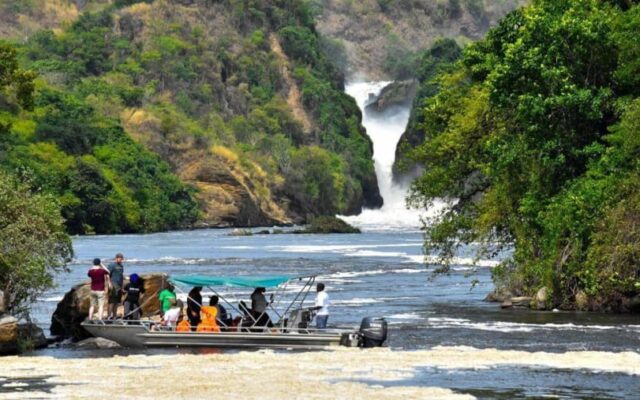
This guide explores the most compelling Nile crocodile facts, from prehistoric anatomy and crushing bite force to behaviour on Uganda’s boat-safari waterways. Most travelers first encounter them during a Victoria Nile launch in Murchison Falls National Park or a Kazinga Channel cruise in Queen Elizabeth National Park — see our where to see Nile crocodiles guide for park-by-park comparisons.
Nile Crocodile Quick Facts
| Scientific name | Crocodylus niloticus |
|---|---|
| IUCN status | Least Concern (global); local declines in some river systems |
| Uganda highlights | Victoria Nile, Kazinga Channel |
| Best viewing | boat safaris on sunny banks and river mouths |
1. Nile Crocodiles Are Africa’s Largest Freshwater Predator
The Nile crocodile is the dominant reptilian predator across much of Africa’s freshwater network. Its armoured dorsal scutes, muscular tail, and forward-set eyes make it superbly adapted to life at the waterline — the exact vantage point Uganda’s boat safaris follow.
2. They Belong to an Ancient Lineage
Crocodilians appeared more than 80 million years ago and have changed remarkably little. The Nile crocodile carries that evolutionary success into modern wetlands, outlasting dinosaurs and countless mammalian competitors.
3. Adult Size Is Truly Impressive
Most adult males measure between 3.5 and 5 metres and weigh 225 to 750 kilograms. Record specimens have approached or exceeded 6 metres and one tonne. Along the Victoria Nile, visitors regularly photograph animals in the four-metre class — large enough to dominate any boat-safari frame.
4. Females Are Smaller but Formidable
Adult females typically reach around 2.5 to 3.5 metres. Despite smaller stature, they are powerful nest defenders and play a central role in reproductive success on sandy riverbanks.
5. Their Bite Force Is Extraordinary
Nile crocodiles possess one of the most powerful bites of any living animal. Specialized jaw muscles and interlocking teeth are designed to grip struggling prey. On boat safaris, the closed-mouth stillness of a basking crocodile belies that explosive capability.
6. Armoured Skin Is a Living Shield
Osteoderms — bony plates within the skin — reinforce the back and flanks. This armour helps deflect attacks from other crocodiles and provides protection in territorial disputes along crowded riverbanks.
7. They Are Cold-Blooded Engineers
As ectotherms, Nile crocodiles depend on external heat. Midday basking on sandbars and muddy banks is not laziness but thermoregulation — which is why afternoon Nile cruises often pass rows of motionless giants with jaws agape.
8. Gaping Mouths Aid Cooling
The “mouth open” posture seen on sunny banks helps release excess heat through the oral cavity. It can look menacing to first-time visitors, but guides on Kazinga and Murchison launches interpret it routinely as thermal behaviour.
9. Nile Crocodiles Are Excellent Swimmers
Powerful tails propel them swiftly underwater with minimal surface disturbance — a key advantage for ambush hunting. From a boat, you may see only a subtle ripple before a crocodile vanishes beneath the surface.
10. They Can “High Walk” on Land
Unlike many reptiles that drag the belly, Nile crocodiles can lift the body clear of the ground when walking — a behaviour called the high walk. On exposed sandbanks, this elevated gait looks almost dinosaurian.
11. Lifespan Can Span Decades
Wild Nile crocodiles may live 50 to 70 years or more when habitat quality and food supply remain stable. Large individuals on the Victoria Nile are often veteran territorial holders.
12. They Occur Across Much of Sub-Saharan Africa
From the Nile basin and East African lakes to southern river systems, Crocodylus niloticus is among the continent’s most widespread crocodilians — present in more than 25 countries when suitable water persists year-round.
13. Uganda’s Boat Safaris Are Among the Best Viewing Contexts
Unlike fleeting roadside glimpses, regulated launches on the Victoria Nile and Kazinga Channel allow sustained observation at respectful distance. Hippos, elephants, and waterbirds share the scene, but crocodiles often provide the most dramatic reptile moments.
14. They Are Apex Predators and Scavengers
Nile crocodiles hunt live prey and consume carrion. This dual role makes them critical to wetland nutrient cycling — explored further in our Nile crocodile diet guide.
15. Nesting Females Are Fiercely Protective
Females excavate nest chambers in sandy soil near water and guard eggs for weeks. Breeding activity peaks in parts of Uganda during drier months — a detail that influences best time to see crocodiles on channel cruises.
16. Temperature Determines Hatchling Sex
Like other crocodilians, Nile crocodiles exhibit temperature-dependent sex determination. Warmer nest temperatures tend to produce more males; cooler conditions favour females — a delicate balance tied to sandbank microclimate.
17. Hatchlings Face Heavy Predation
Despite maternal guarding, young crocodiles are vulnerable to fish, birds, and larger crocodiles. Survival rates are low, which is why mature adults are the individuals most commonly seen on boat safaris.
18. They Communicate in Subtle Ways
Hissing, jaw slapping, bubble blowing, and infrasonic vibrations convey territorial warnings and courtship signals — behaviours our behaviour guide explores in depth.
19. Human Conflict Is a Conservation Concern
Although globally secure, Nile crocodiles are involved in human-wildlife conflict near fishing communities and livestock watering points. Protected parks concentrate safer tourism viewing away from high-risk zones.
20. Victoria Nile Populations Have Declined Historically
Scientific surveys in Murchison Falls National Park document lower crocodile abundance today than in the 1960s — a reminder that even Least Concern species need vigilant habitat protection. Read more on our conservation page.
21. Boat Tourism Supports Park Stewardship
Launch fees and park entry revenue fund ranger patrols, anti-poaching, and community programmes. Choosing licensed operators on Nile crocodile safari itineraries directly supports the waterways these reptiles depend on.
22. Photography Rewards Patience
Telephoto lenses, polarizing filters, and shooting from stable boat decks capture scale and texture beautifully. Early afternoon light on Kazinga’s western banks often gilds crocodile armour with warm tones.
23. They Are Not “Man-Eaters” by Nature
Media portrayals exaggerate aggression. Nile crocodiles are opportunistic predators that avoid unnecessary risk. Boat-safari rules — staying seated, no dangling limbs — keep encounters safe and respectful.
24. Crocodiles and Hippos Share Space — Cautiously
On the Kazinga Channel, Africa’s densest hippo concentrations coexist with crocodiles. Hippos are not crocodile prey as adults, but calves and carcasses attract attention — dynamic interactions guides narrate on every cruise.
25. Planning Your Uganda Crocodile Encounter
Combine Murchison’s Nile launch with Queen Elizabeth’s channel cruise on a single itinerary for contrasting river and lake-edge ecology. Browse Uganda safari packages or request a quote to slot boat safaris into your route.