Nile crocodile conservation — expert Uganda safari guide from local planners who know permits, parks, and realistic routing.
Globally, the Nile crocodile is listed as Least Concern on the IUCN Red List — yet local populations tell a more nuanced story. Research along the Victoria Nile in Murchison Falls National Park documents declining abundance compared with historical surveys from the 1960s. Conservation therefore matters at watershed scale, even for a species that remains widespread across Africa.
Global Conservation Status
Crocodylus niloticus persists across more than 25 African countries when suitable freshwater habitat remains. Legal protection, CITES regulation of skin trade, and tourism revenue in flagship parks have supported recovery in many regions after twentieth-century overharvest for leather.
Least Concern does not mean invulnerable. Local extirpations, genetic isolation, and conflict-related culling continue in unprotected stretches.
Uganda’s Conservation Context
Uganda’s most visible Nile crocodile populations live inside Murchison Falls and Queen Elizabeth national parks — Ramsar-linked wetlands and UNESCO-recognized landscapes where commercial hunting is prohibited and tourism is regulated by Uganda Wildlife Authority.
Boat launch fees, park entry tariffs, and concession agreements fund:
- Ranger patrols and anti-poaching
- Community revenue-sharing programmes
- Habitat monitoring and research permits
- Visitor safety infrastructure on waterways
Historical Decline on the Victoria Nile
A 12-month survey (2013–2014) along Murchison’s Victoria Nile recorded clear diurnal and seasonal fluctuations in sightings, with peaks in June–August and January–March. Despite healthy encounter rates for tourists, authors concluded abundance had declined relative to 1960s baselines — a cautionary benchmark for long-term river management.
Implications include:
- Need for continued nest-site protection on sandbanks
- Careful management of hydropower and extraction upstream
- Sustained anti-poaching even for “common” species
- Long-term monitoring using comparable survey methods
Major Threats
Habitat Loss and Hydrological Change
Dams, irrigation, and wetland drainage alter flow, sand deposition, and nesting substrates. Crocodiles need predictable banks; flooded or eroded shorelines reduce basking and nest success.
Human-Wildlife Conflict
Outside parks, crocodiles occasionally take livestock or, rarely, injure people at watering and fishing sites. Retaliatory killing remains a threat. Community education and safe water-access design are conservation priorities.
Illegal Harvest and Trade
Poaching for meat, teeth, or skins persists in some regions. International trade in wild specimens is regulated under CITES Appendix I/II frameworks depending on population and product — enforcement varies.
Pollution and Fisheries Pressure
Overfishing and water contamination reduce prey bases. Kazinga’s mixed fishing and tourism use requires balancing community livelihoods with ecological carrying capacity.
Climate Variability
Temperature-dependent sex determination links nest success to sand microclimate. Broader climate shifts may skew sex ratios or flood nest sites — long-horizon research topics with management implications.
Protected Areas as Strongholds
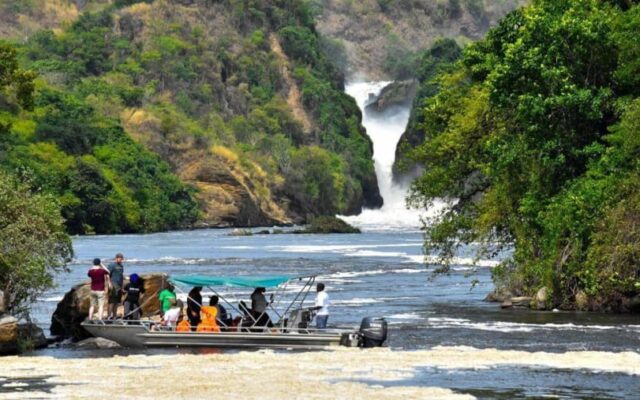
Murchison’s Victoria Nile and Queen Elizabeth’s Kazinga Channel function as de facto crocodile sanctuaries where boat tourism replaces extractive use. Sightings on every licensed launch demonstrate ecological presence while generating revenue that justifies protection politically.
Travelers choosing Nile crocodile safaris through licensed operators directly support this model.
Role of Boat Tourism
Responsible boat safaris:
- Maintain engine-off drift past basking animals
- Prohibit feeding and bank disembarkation at nest sites
- Keep passengers seated with limbs inside the vessel
- Employ UWA-certified guides who enforce park rules
When tourism is well managed, crocodiles habituate to predictable boat patterns without losing wild behaviour — the standard on Uganda’s flagship launches.
Research and Monitoring
Visual encounter surveys, transect counts from boats, and nest-site mapping provide trend data. Repeat surveys using consistent methods — as conducted in Murchison — are essential to detect decline before it becomes irreversible.
Community Engagement
Revenue sharing with parishes bordering Queen Elizabeth and Murchison builds tolerance for wildlife. When communities benefit from tourism, retaliatory killing often decreases. Conservation is therefore economic as well as ecological.
CITES and Legal Protection
Uganda protects crocodiles within national parks under wildlife legislation. International trade controls reduce large-scale commercial exploitation. Tourists should never purchase souvenirs made from crocodile products of uncertain origin.
Conservation Success Factors
- Stable protected-area funding
- Ranger presence on waterways
- Science-based hydrology management
- Conflict mitigation near park boundaries
- Tourism that values reptiles as flagship species
Why Crocodiles Matter Ecologically
As apex predators and scavengers, Nile crocodiles structure wetland food webs explored in our diet guide. Their presence indicates productive fisheries and mammal visitation — metrics of ecosystem health.
How Travelers Can Help
- Book through licensed Ugandan operators
- Follow guide safety instructions on boats
- Avoid purchasing illegal wildlife products
- Share ethical viewing practices on social media
- Combine parks to distribute tourism benefits — Murchison and Queen Elizabeth in one itinerary
Looking Ahead
Maintaining Uganda’s boat-safari crocodile experiences requires vigilance: hydrology that preserves sandbanks, funding for rangers, and tourism that treats reptiles as equals to mammals in itinerary design. Explore habitat protection, plan via Uganda safaris, or request a quote for conservation-aligned routes.