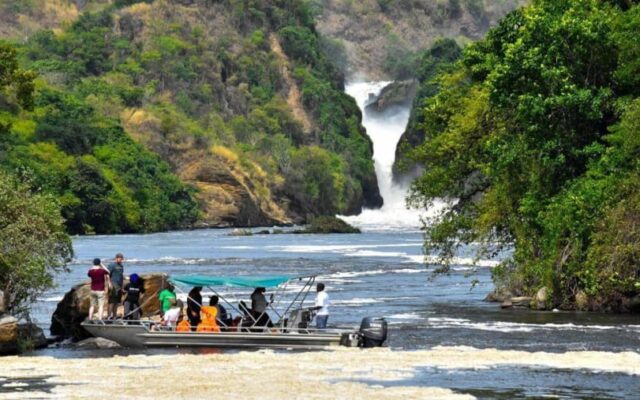
Nile crocodile behaviour combines long periods of apparent inactivity with bursts of speed and social signalling that reward careful observation. Uganda’s boat safaris — on the Victoria Nile in Murchison Falls National Park and the Kazinga Channel in Queen Elizabeth National Park — offer ideal platforms for interpreting what these reptiles are doing and why.
Daily Activity Rhythm
Crocodiles are most active thermally and behaviourally around dawn, dusk, and night. Midday often brings basking — the dominant activity recorded in Murchison surveys. Afternoon launches therefore showcase thermoregulation and social spacing more often than hunting, though submerged animals may still patrol beneath the hull’s drift.
Basking Behaviour
Basking is essential for digestion and metabolic function. Crocodiles orient the body to maximize sun exposure, sometimes with jaws agape for heat dissipation. On Kazinga’s open banks, multiple animals may lie parallel within metres of each other — each occupying a personal heat budget.
Guides read basking posture as a comfort signal: relaxed animals tolerate slow boat approaches; disturbed individuals slide into water with minimal splash.
Thermoregulation and Mouth Gaping
The open-mouth posture alarms first-time visitors but commonly reflects cooling, not aggression. Paired with river breeze and wet skin, gaping prevents overheating during intense equatorial sun — a behaviour you will photograph repeatedly on Nile cruises.
Territoriality
Large males defend stretches of riverbank and deep-water access. Dominance is established through size, vocalization, and physical display rather than constant fighting. Subordinate animals bask farther from prime sandbars or use peripheral sites — visible as size-graded spacing along a single bank.
Social Structure
Unlike mammals, crocodiles are not family-group animals in the primate sense, but they exhibit hierarchical social systems. Size and age determine access to basking sites and mating opportunities. Juveniles avoid adult territories until large enough to compete.
Communication
Nile crocodiles communicate through:
- Hissing and bellowing during territorial disputes
- Jaw slapping on water surface
- Sub-audible infrasound felt as vibration
- Postural displays — raised snout, inflated throat
- Bubble blowing and water displacement signals
On quiet drifts, passengers sometimes hear a deep rumble before a submerged animal surfaces — a memorable crocodile fact in live form.
The High Walk
When moving overland, Nile crocodiles can lift the body clear of the ground — the high walk. On exposed sandbars this gait looks primordial. Nesting females use deliberate land movement when selecting nest sites above the flood line.
Swimming and Submersion
Underwater swimming is efficient and stealthy. Eyes, ears, and nostrils align along the dorsal profile for minimal exposure. Boat guides identify “sleeping logs” by the symmetrical ripple of a submerged tail or the glint of an eye at water level.
Feeding Behaviour
Ambush hunting relies on patience. Crocodiles may hold position for hours facing prey trails. Death rolls — spinning to tear flesh — occur after large prey capture, usually away from tourist routes. Our diet guide covers prey types; behaviourally, the strike is the climax visitors seldom see but guides describe vividly.
Nesting and Parental Care
Females excavate nest holes in sandy soil between late year and early dry season in many Ugandan sites. They guard nests against monitor lizards, hyenas, and other crocodiles. Hatching triggers gentle mouth transport of young to water — one of the few tender behaviours in crocodilian life.
Murchison research noted visible nesting in the last quarter of the year and first quarter of the new year — timing relevant for travelers interested in reproductive ecology on seasonal visits.
Maternal Aggression
Approaching a nest-guarding female on foot would be extremely dangerous. Boat safaris maintain waterborne distance. Rangers prohibit disembarking on sensitive sandbanks during nesting peaks.
Interaction with Hippos
Hippos and crocodiles co-occur throughout Kazinga and the Victoria Nile. Adults generally coexist warily; hippo calves and carcasses attract crocodile interest. Guides narrate these dynamics daily — a behavioural layer unique to Uganda’s great boat routes.
Interaction with Birds
Egyptian plovers famously clean crocodile teeth in popular lore; true mutualism is debated, but birds and crocodiles routinely share shorelines. Skimmers, storks, and kingfishers fish metres from basking reptiles — interspecies tolerance shaped by differing prey and threat profiles.
Response to Boats
Habituated crocodiles on heavily cruised channels often ignore licensed launches if engines are cut and approach speeds are low. Sudden noise or passengers standing may trigger slide-entry escapes. Ethical operators train crews to minimize disturbance — behaviour management that protects both animals and viewing quality.
Seasonal Behaviour Shifts
Dry seasons concentrate animals and may intensify territorial defence near shrinking sandbars. Wet seasons disperse crocodiles across flooded vegetation. Sightings remain reliable year-round, but social spacing and basking density change — see where to see for park-specific patterns.
Behavioural Signs for Photographers
- Parallel basking — relaxed thermoregulation
- Raised head and inflated throat — possible territorial display
- Slow sink without splash — deliberate retreat
- Eyes only at surface — submerged patrol or hunt
- Open jaws on hot afternoons — cooling, not necessarily threat
Why Behaviour Matters for Safari Planning
Understanding crocodile behaviour transforms a checklist sighting into an interpretive experience. Uganda Safari Tours schedules launches when basking and bank wildlife are most active — typically afternoon on the Nile and Kazinga — and pairs them with guides who read reptile body language accurately.
Explore Nile crocodile safari experiences or request a quote to align boat timing with the behaviours you most want to observe.