Dik-dik habitat is the narrow band where open savannah meets impenetrable thorn — dry bushland, acacia woodland fringes, rocky kopje skirts, and lake margins with enough browse diversity to sustain a pair year-round yet dense enough cover to hide from diurnal predators. Understanding that edge ecology explains where Kirk's dik-dik appear on Uganda game drives and why they are absent from wide grassland plains. Explore related guides on dik-dik facts, behaviour, and best places to see dik-dik.
Bush-Edge Specialists
Kirk's dik-dik are not grassland antelopes and not deep-forest duikers. They inhabit dry thorn bush, semi-arid acacia savannah, Commiphora woodland, and rocky hill margins up to roughly 1,600 metres above sea level — landscapes where shrub cover is continuous enough for concealment yet patchy enough for selective browsing between stems.
They avoid wide open plains where cheetah and wild dog could run them down, and avoid closed-canopy forest where leopard ambush is total. The optimal dik-dik landscape is a textured margin — exactly what Kidepo's Narus Valley skirts and Lake Mburo's acacia hills provide at Uganda's range limits.
Thorn Scrub and Acacia Mosaic
Field ecology describes dik-dik as favouring dense thorn with feeding lanes — interstitial spaces between Acacia, Commiphora, and Salvadora shrubs where a 40-centimetre-tall browser can reach leaves without exposing the full body. Uniformly overgrazed grassland or uniformly tall impenetrable thicket both exclude dik-dik; the species needs heterogeneity at metre scale.
In Uganda's national parks, herbivory by larger ungulates, seasonal rainfall, and occasional fire maintain the shrub mosaic dik-dik depend on — often unnoticed by visitors focused on elephant or buffalo on open plains.
Arid-Country Adaptation
Kirk's dik-dik evolved for East Africa's dry bush belts where standing water is seasonal or distant. Their habitat preference tracks aridity tolerance: they thrive where browse moisture substitutes for drinking, and where thorn chemistry concentrates nutrients in leaves and pods.
Water-Independent Range
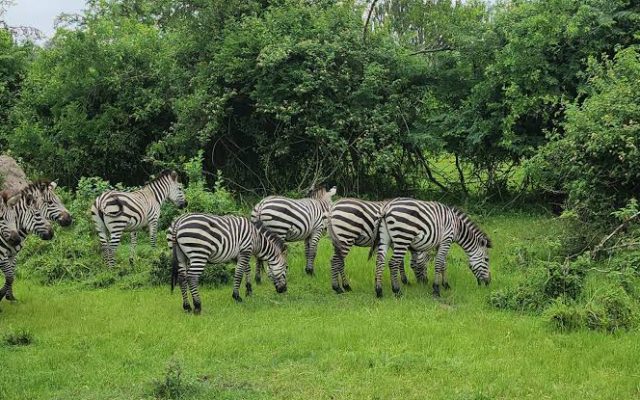
Because pairs rarely visit waterholes, their distribution maps onto thorn margins with reliable browse rather than river lines. In Kidepo Valley, dik-dik persist on dry Narus fringes while buffalo and zebra concentrate near water — a spatial separation visible from the game-drive vehicle when guides read habitat zones.
Rocky Kopje and Hill Margins
Rock outcrops and kopjes create microhabitats where thorn density increases in crevices and shade pockets. Dik-dik use kopje skirts in Lake Mburo for cover and browse, often detected as movement between boulders before the pair resolves into view. Leopard use the same structures — explaining why dik-dik alarm calls on kopje margins should prompt careful scanning.
Vegetation Types
Typical dik-dik habitat in Uganda includes:
- Acacia–Commiphora thorn bush on Kidepo Valley margins
- Dry woodland edges above Lake Mburo's lake basin
- Salvadora and Euphorbia fringes near seasonal drainage lines
- Scattered thorn on rocky hills with inter-shrub browse lanes
- Lake-fringe thickets where acacia meets seasonal wetland grass
Altitude and Climate
Across East Africa, Kirk's dik-dik occur from lowland semi-desert margins to moderate elevations. In Uganda they are primarily a lowland dry-bush species — Kidepo's hot valleys and Lake Mburo's 1,200–1,500 metre hills frame the national range. Rainfall bimodality in the southwest and a drier regime in the northeast both support thorn bush, but drought years stress browse quality and push pairs toward the most productive shrub patches within territories.
Territory Size and Habitat Quality
A dik-dik pair defends roughly 5 to 30 hectares — territory size shrinks when browse is rich and expands when thorn is sparse. High-quality habitat supports overlapping home ranges with minimal aggression because scent boundaries are respected; poor habitat increases territorial skirmishes and whistle alarms audible from the track.
Overlap With Other Herbivores
Dik-dik share bush margins with bushbuck, impala at woodland edges, and occasionally oribi where grass meets thorn. Browse competition with bushbuck is partial — bushbuck take taller shoots; dik-dik specialise on lower stems and flowers. Larger bulk grazers on adjacent plains indirectly benefit dik-dik by preventing thorn from closing into uniform woodland.
Park Ecosystems — Where Habitat Meets Tourism
Kidepo Valley National Park
Kidepo's Narus Valley floor is famous for open plains game, but Kirk's dik-dik concentrate on thorn margins flanking the valley — Kanangorok approaches, dry bush en route to southern sectors, and acacia skirts where leopard trails enter cover. Remote drives with low traffic suit the species' shy temperament.
Lake Mburo National Park
Lake Mburo's compact acacia hills, rocky ridges, and lake-fringe thickets create accessible dik-dik habitat minutes from the gate — ideal for short safaris and repeated dawn drives that improve cumulative sighting odds on bush circuits.
Uganda as Range Edge
Uganda represents the northwestern edge of Kirk's dik-dik distribution. Habitat suitability drops north and west beyond Kidepo; unsuitable forest dominates the southwest beyond Mburo's savannah envelope. This edge status makes every confirmed pair sighting biogeographically significant — not merely a cute mammal moment but evidence of arid bush continuity along the Kenya–Uganda borderlands.
Cover as a Habitat Requirement
Predator pressure shapes dik-dik habitat as much as browse nutrition. Margins with zero thorn expose pairs to raptors and coursing carnivores; margins with only impenetrable thicket limit feeding lanes. The optimal landscape offers stem density for hiding and inter-shrub space for movement — Uganda's better bush-edge drive sectors deliver that trade-off.
Seasonal Habitat Shifts
During wet seasons, grass growth between shrubs reduces visibility but increases flower and shoot availability — pairs may feed deeper inside thickets. Dry seasons thin understorey grass and improve sight lines at margins where guides spot pairs crossing tracks at dawn. Neither season eliminates dik-dik, but dry-month margin drives generally produce more photographs.
Habitat Threats
Outside parks, charcoal production, thorn clearance for cropland, and livestock overbrowsing reduce suitable mosaic habitat. Snaring along park boundaries targets dik-dik because they are small and follow predictable thicket lanes. Fence lines and new roads fragment territories — a disproportionate impact on a species whose entire life unfolds within hectares, not square kilometres.
Safari Viewing and Habitat Ethics
Stay on designated tracks, avoid driving into thorn thickets that may hide resting dik-dik or concealed predators, and resist pursuing pairs off-road for photographs. Responsible tourism supports the margin habitat dik-dik need and models behaviour rangers enforce in regulated parks.
Planning Your Visit
Pair this habitat guide with best time to see dik-dik and safari experiences to match seasons with the thorn-margin conditions that put pairs on track edges at dawn.