African fish eagle facts — expert Uganda safari guide from local planners who know permits, parks, and realistic routing.
The African fish eagle is among the most celebrated birds in Africa. Instantly recognisable by its white head, chestnut body, and piercing call, it is the national bird of Zambia and Zimbabwe and a defining symbol of freshwater wilderness. In Uganda, fish eagles are widespread along rivers, lakes, and wetlands — often the first raptor travellers spot from a boat. This guide covers essential behaviour, habitat, and where to see detail, plus boat-safari experiences on the Nile and Great Rift lakes.
What Is an African Fish Eagle?
The African fish eagle (Haliaeetus vocifer) is a large diurnal raptor of the sea-eagle family. The genus name means fish eagle; vocifer refers to its famously loud call. Found across sub-Saharan Africa wherever substantial freshwater exists, it is not a vagrant visitor but a resident cornerstone of lake and river ecosystems — and of the safari soundscape.
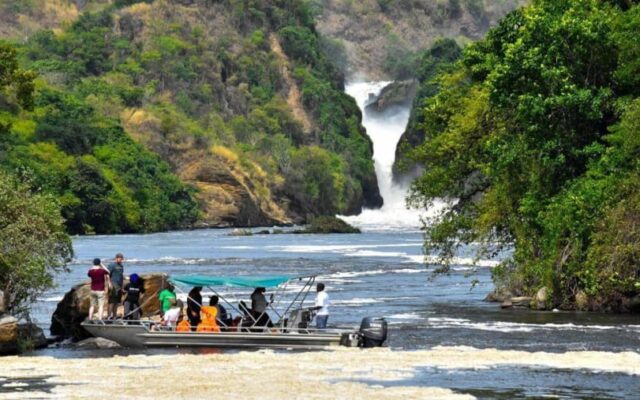
Unlike secretive forest raptors, fish eagles are bold, conspicuous, and closely tied to human safari routes. A Victoria Nile launch cruise or Kazinga Channel outing would feel incomplete without at least one white-headed silhouette on a dead tree.
Scientific Classification
- Kingdom: Animalia
- Phylum: Chordata
- Class: Aves
- Order: Accipitriformes
- Family: Accipitridae
- Genus: Haliaeetus
- Species: Haliaeetus vocifer
Physical Appearance
Adult plumage is unmistakable: a snow-white head and breast, rich chestnut belly, black wings, and a short white tail. The massive hooked bill is yellow with a black tip; eyes are brown; legs and feet are unfeathered and yellow. In flight the white head and tail flash against dark wings — a combination every safari guide learns to point out within minutes of leaving the jetty.
Size and Wingspan
Body length ranges from roughly 63 to 75 centimetres. Wingspan typically reaches 2.0 to 2.4 metres — impressive above a narrow channel but agile enough to weave through riverside woodland. Females are larger and heavier than males, a pattern common among birds of prey.
Weight
Males generally weigh 2.0 to 2.5 kilograms; females 3.2 to 3.6 kilograms. The extra bulk gives females greater incubation capacity and hunting power during the breeding season.
Juvenile Plumage
Young fish eagles wear mottled brown plumage for three to four years before acquiring adult colours. Juveniles are often mistaken for other large raptors until their proportions and behaviour at water's edge confirm the identity. Patient observation near nests reveals begging calls and clumsy early flight.
The Iconic Call
Few sounds define Africa like the fish eagle's ringing yelp — a carrying weee-ah, hyo-hyo-hyo that echoes across water at dawn. Pairs frequently duet, reinforcing territory and pair bonds. On a Murchison Nile cruise or Kazinga boat safari, the call often arrives before the bird itself.
National and Cultural Symbolism
The African fish eagle appears on the Zambian flag and coat of arms and holds the same status in Zimbabwe. It embodies wilderness, sovereignty, and the health of freshwater Africa. For safari travellers it performs a similar role — a instant shorthand for "wild Africa" before the first lion or elephant appears.
Distribution in Uganda
Uganda sits within the species' core East African range. Fish eagles occur on the Victoria Nile, Lake Albert, Lake Victoria, Lake George and Edward, the Kazinga Channel, Lake Mburo, and countless smaller dams and wetlands. Any itinerary with a water component is likely to produce multiple sightings.
How Fish Eagles Hunt
Hunting is primarily perch-based: the eagle watches from a snag, launches in a shallow powered glide, and snatches fish from just below the surface with talons armed with spiricules — tiny spines that grip slippery prey. Success requires patience; only about one strike in seven or eight yields a meal. Read the full hunting story on our behaviour page.
Diet Overview
Fish dominate the menu — tilapia, catfish, lungfish, and tigerfish are common — but the species is opportunistic. Waterbirds, carrion, reptiles, and stolen prey from other species all feature. See diet and feeding ecology for prey lists and kleptoparasitism.
Reproduction at a Glance
Pairs are monogamous and territorial. Nests are large stick platforms in tall riverside trees, reused and expanded over years. Clutches of one to three eggs hatch after roughly six weeks; chicks fledge at around ten weeks but remain dependent on parents for some time thereafter.
Lifespan
Wild fish eagles may live 15 to 24 years, with longer records in captivity. Territory quality, fish abundance, and wetland protection largely determine longevity.
Conservation Status
The IUCN lists the African fish eagle as Least Concern across its broad range. Local populations still depend on clean water and nesting trees — themes explored on our conservation page.
Quick Facts
| Scientific name | Haliaeetus vocifer |
|---|---|
| Wingspan | up to 2.4 metres |
| Primary food | fish |
| Hunting style | perch and swoop |
| Call | loud duetting yelp |
| IUCN | Least Concern |
| Best Uganda viewing | boat safaris on Nile and Rift lakes |