Where to see abyssinian ground hornbill — expert Uganda safari guide from local planners who know permits, parks, and realistic routing.
Seeing Abyssinian ground hornbills in Uganda means planning around two northern savannah parks — Murchison Falls National Park and Kidepo Valley National Park. Unlike forest hornbills that require guided walks in Kibale or Budongo, ground hornbills walk openly across game-drive tracks — often visible from standard safari vehicles without extra permits or specialist equipment. Compare habitat, best time to visit, and safari experiences when building your itinerary.
What Makes a Good Ground Hornbill Location?
Look for three features: open short-grass savannah, scattered acacia or fig roost trees, and low vehicle traffic that allows family groups to forage beside tracks. Ground hornbills avoid closed forest interiors and extreme desert — they need walking country with termite mounds, dung middens, and territory large enough for cooperative breeding groups.
Murchison Falls National Park
Uganda's largest protected area is among East Africa's premier ground hornbill strongholds. The north bank savannah — Buligi Peninsula, Albert track, Queen's circuit, and Nile delta approaches — provides textbook habitat: open grassland, scattered acacia, riverine margins, and abundant termite mounds.
- Buligi Peninsula: Mixed savannah and woodland — among the most reliable ground hornbill sectors on any Uganda drive
- Albert and Queen's tracks: Open plains where family groups walk tracks in formation
- Nile delta sector: Grassland margins with buffalo and kob — hornbills often forage near ungulate herds
- Paraa–Tangi approach roads: Early-morning transfers can produce roadside groups before main circuits begin
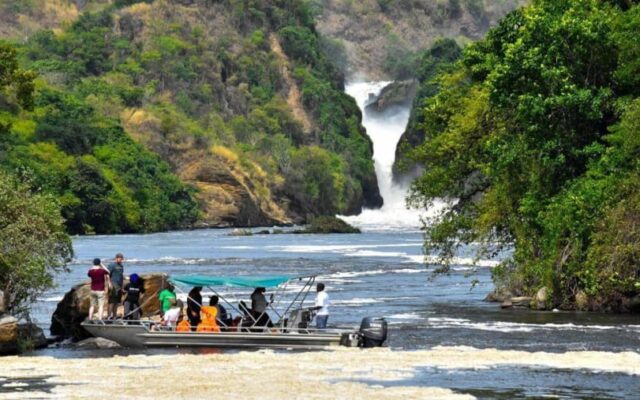
Murchison integrates ground hornbill viewing with Nile boat cruises, Rothschild's giraffe, lion drives, and the falls viewpoint — making it the default choice for first-time northern Uganda visitors. Guides familiar with territory booming often locate groups by sound before birds are visible.
Kidepo Valley National Park
Remote Kidepo protects a distinctive semi-arid savannah ecosystem in Uganda's far northeast. The Narus Plains — watered by seasonal streams and the Narus River — support ground hornbill family groups alongside ostrich, cheetah, and Jackson's hartebeest.
- Narus Valley game drives: Primary ground hornbill territory — open savannah with reliable water
- Apoka lodge circuits: Dawn drives across golden plains with Morungole Mountains backdrop
- Kanangorok hot springs route: Varied elevation and grassland mosaic in one long drive day
- Kidepo Valley floor: Drier country with scattered groups on open ground
Kidepo's remoteness and low vehicle density mean hornbill encounters often feel private — a single group walking the plains with dramatic inselberg scenery. Fly-in options to Kidepo airstrip shorten the long road transfer from Kampala.
Parks Where Ground Hornbills Do Not Occur
Forest parks — Bwindi, Kibale, Budongo, Semuliki — hold grey-cheeked and other canopy hornbills, not ground hornbills. Queen Elizabeth and Lake Mburo support savannah birds but lack reliable ground hornbill records compared with Murchison and Kidepo. Plan northern circuits specifically for Bucorvus abyssinicus.
Viewing Methods
Dawn Game Drives
The single most effective method. Ground hornbills descend from roost trees at first light, deliver booming territorial calls, and begin foraging across open plains — often beside vehicle tracks in good light.
Mid-Morning and Afternoon Drives
Groups continue walking foraging throughout the day, pausing at termite mounds and shade-resting under acacia at midday. Patient pacing beside a foraging group delivers extended observation without rushing the birds.
Audio Detection
Experienced guides identify territories by dawn booming before birds appear — a useful technique on Buligi and Narus circuits when grass height conceals walking birds.
Field Identification Tips
Separate Abyssinian ground hornbill from other large savannah birds by:
- Silhouette: Large black body, long decurved bill, slow walking gait — not soaring like raptors
- Facial skin: Vivid red or orange patch on adults — brighter in males
- Social unit: Family groups of two to nine birds walking together — not solitary like secretarybirds
- Call: Deep booming duets — unlike the shriek of grey crowned crane or fish eagle call
Photography Tips
Ground hornbills habituated to vehicles often tolerate close approach on tracks. Telephoto reach of 200–400 mm suits walking birds at eye level. Dawn and late afternoon deliver warm light on red facial skin. Avoid circling repeatedly — match the group's walking pace and let birds approach naturally.
Ethical Viewing
Never crowd birds off preferred foraging ground or block their path with repeated vehicle positioning. During breeding season, maintain extra distance from nest areas — disturbance can cause abandonment. Stay on designated tracks; off-road driving damages the grassland mosaic prey depend on.
Build Your Itinerary
Route through Uganda safari packages and our Abyssinian ground hornbill safari experiences page — telling your operator you want northern bank time at Murchison or Narus Plains drives at Kidepo. Combine with birding safaris and shoebill wetland extensions for a complete Uganda birding circuit.