Abyssinian ground hornbill habitat centres on open savannah and woodland grassland — the lightly bushed plains where family groups can walk long distances, hunt ground prey, and defend large territories with booming dawn calls. Understanding where ground hornbills live explains their concentration in Murchison Falls and Kidepo Valley and why forest parks such as Kibale or Bwindi do not support them. Connect this page to ground hornbill facts, behaviour, and where to see ground hornbills.
Open Savannah Specialists
Ground hornbills are not forest birds. They require open ground for walking foraging, clear sightlines for sentinel duty, and sufficient territory size to support cooperative breeding groups. Typical habitat includes short-grass savannah, acacia woodland margins, lightly bushed plains, and riverine grassland edges — always with roost trees nearby for night-time security.
They avoid closed forest interiors and extreme desert, occupying the productive middle ground where grassland meets scattered trees. This niche explains their abundance on Murchison's northern bank and Kidepo's Narus Plains — landscapes that mirror ideal ground hornbill country across the Sahel and East African savannah belt.
Territory Size and Habitat Quality
Each cooperative family group defends a territory that may span several hundred hectares — sometimes more in low-density areas. Territory quality depends on prey abundance (insects, reptiles, small vertebrates), roost tree availability, and freedom from persecution. Degraded savannah with heavy grazing pressure, crop conversion, or frequent poisoning events cannot sustain ground hornbill groups.
Protected areas such as Murchison Falls and Kidepo Valley provide the contiguous grassland mosaics and anti-poaching protection that ground hornbills require — making them reliable indicators of intact northern savannah ecosystems in Uganda.
Vegetation Types
Typical Abyssinian ground hornbill habitat includes:
- Short-grass savannah plains with scattered acacia and combretum trees
- Woodland grassland ecotones — open ground with browse cover at margins
- Riverine grassland along Nile corridors and seasonal watercourses
- Termite-mound studded plains where insect prey concentrates
- Roost trees — tall acacias, figs, or other emergents for night security
Ground hornbills use woodland edges for shade during midday heat but forage primarily on open ground where prey is visible and accessible.
Altitude and Climate in Uganda
Murchison Falls sits at roughly 600 to 1,200 metres above sea level across its northern and southern sectors. Kidepo Valley ranges from approximately 900 to 2,750 metres, though ground hornbills concentrate on the Narus Plains and lower valleys rather than high Morungole slopes. Both parks experience tropical savannah climates with bimodal rainfall — dry seasons (June–September, December–February) produce short grass and excellent visibility for game-drive viewing.
Murchison Falls National Park — Ground Hornbill Ecosystem
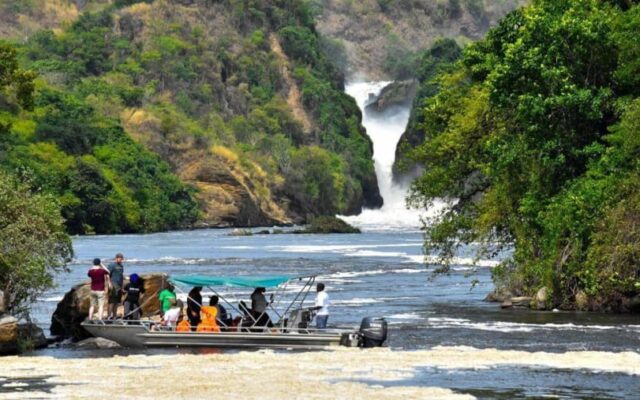
Murchison is Uganda's largest protected area and one of East Africa's premier ground hornbill strongholds. The northern bank savannah — Buligi Peninsula, Albert track, and Queen's circuit — provides textbook habitat: open grassland, scattered acacia, Nile corridor margins, and abundant termite mounds.
Key Habitat Zones
- Buligi Peninsula: Mixed savannah and woodland — among the most reliable ground hornbill sectors
- Albert and Queen's tracks: Open plains with regular family group patrols
- Nile delta margins: Grassland–wetland ecotone with diverse prey
- Rabongo Forest fringe: Woodland edge where groups transition between open ground and roost trees
Kidepo Valley National Park — Remote Savannah
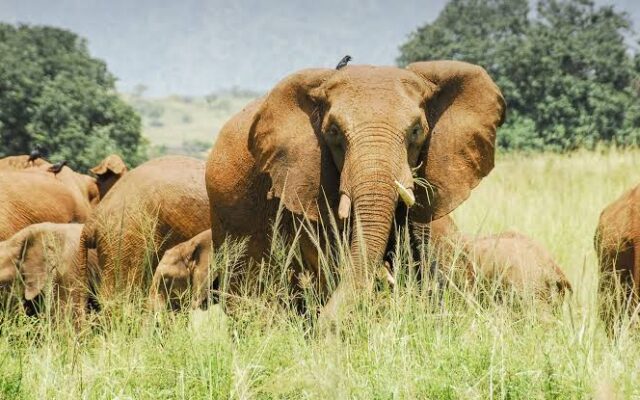
Kidepo Valley protects a distinctive semi-arid savannah ecosystem in Uganda's far northeast. The Narus Plains — watered by seasonal streams and the Narus River — support ground hornbill family groups alongside ostrich, cheetah, and Jackson's hartebeest. Kidepo's remoteness and low vehicle density mean hornbill encounters often feel private — a single group walking the golden plains with Morungole Mountains as backdrop.
Key Habitat Zones
- Narus Plains: Primary ground hornbill territory — open savannah with reliable water
- Kakine and Katurum circuits: Rolling grassland with scattered kopjes
- Kidepo Valley floor: Drier, more seasonal — groups range between valley and Narus
Prey Habitat and Foraging Ground
Ground hornbill distribution tracks prey availability. Termite mounds, dung middens, and grass tufts harbour insects, scorpions, and small reptiles. Seasonal rainfall flushes frogs and insects onto open ground — increasing foraging success. Family groups methodically work these microhabitats across their territory, pausing where prey density is highest.
Roosting Requirements
Despite their terrestrial lifestyle, ground hornbills roost in trees at night — tall acacias, figs, or other emergents that provide predator-safe elevation. Loss of large roost trees through charcoal cutting or land conversion can displace groups even when foraging habitat appears intact. Protected areas safeguard both foraging plains and roost woodland.
Habitat Threats
Outside protected areas, savannah conversion to agriculture, overgrazing, and settlement expansion reduce available territory. Persecution near farmland — ground hornbills occasionally take small domestic chicks — leads to deliberate killing. Secondary poisoning from pesticide use on prey items causes mortality in groups that range beyond park boundaries. Maintaining large, connected savannah blocks is essential for long-term population stability.
Safari Viewing and Habitat Ethics
Stay on designated tracks, keep distance from foraging groups, and never chase birds with a vehicle. Ground hornbills habituated to vehicles may approach closely — resist feeding or encouraging unnatural behaviour. Off-track driving damages the grassland mosaic and termite-mound structures prey depend on.
Planning Your Visit
For habitat-focused viewing, prioritise dawn drives on Murchison's northern bank or Kidepo's Narus Plains during dry seasons. Combine with our best time to see ground hornbills guide and build northern circuits via Uganda safari packages that link Murchison, Kidepo, and complementary birding at shoebill wetlands.