Secretary bird habitat is open country — short to medium grassland, lightly wooded savannah, and floodplain margins where a walking hunter can see prey at distance. Understanding where secretary birds live explains their distribution across Murchison Falls, Queen Elizabeth, and Kidepo Valley in Uganda. Connect this page to secretary bird facts, behaviour, and where to see secretary birds.
Open Savannah Specialists
Secretary birds are not forest raptors, nor are they wetland waders like storks. They require expansive visibility — grassland where rodents, insects, and reptiles can be detected while walking, with scattered trees for nesting and night roosts. This preference places them on the same plains as Uganda kob, buffalo, and lions rather than in closed canopy reserves.
Territory size varies with prey density, but pairs may defend grassland areas spanning several square kilometres. Within Uganda's parks, Buligi Peninsula, Kasenyi Plains, and Narus Valley exemplify the structural habitat secretary birds favour.
Grass Height and Fire
Short grass improves hunting efficiency — secretary birds cannot stomp what they cannot see. Natural fire, controlled burning, and wild herbivore grazing maintain the open mosaic the species needs. Dry-season grass height often produces the clearest game-drive views as birds stride across golden plains.
After rains, taller grass may reduce sighting distance but does not eliminate secretary birds from an area. Guides familiar with territory locations still find pairs along woodland edges and recently grazed patches.
Tree Requirements — Nests and Roosts
Despite their terrestrial habits, secretary birds depend on trees. Flat-topped acacias and other scattered savannah trees provide:
- Night roosts safe from ground predators
- Nest platforms built of sticks 5 to 15 metres above ground
- Elevated vantage points at dawn before descending to hunt
- Shade during midday heat on open plains
Parks lacking both open grassland and suitable nest trees cannot sustain breeding populations — which is why secretary birds are absent from Uganda's montane forests and dense lowland rainforest reserves.
Altitude and Climate in Uganda
Uganda's secretary bird habitats span roughly 700 to 1,200 metres elevation across northern and western savannah parks. Climate is tropical with bimodal rainfall. Seasonal grass growth influences prey availability more than temperature alone — insect outbreaks after rains and rodent peaks in dry months both shape foraging success.
Murchison Falls National Park — Northern Savannah
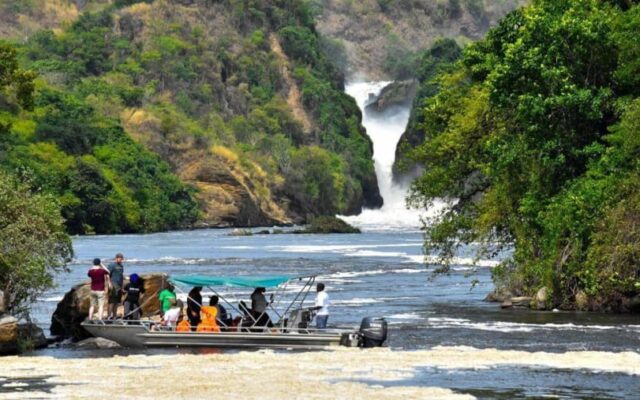
Murchison Falls National Park combines Borassus palm savannah, acacia woodland, and open Buligi Peninsula grassland. North-bank game drives cross textbook secretary bird country where birds walk alongside Rothschild's giraffe and buffalo herds.
Key Habitat Zones
- Buligi Peninsula: Open plains with scattered acacia — prime walking-hunt terrain
- Victoria Nile approaches: Grassland margins between riverine forest and open savannah
- Paraa sector plains: Territorial pairs visible from main game-drive loops
Queen Elizabeth National Park — Western Savannah
Queen Elizabeth National Park offers secretary bird habitat on Kasenyi Plains predator drives and in the Ishasha sector's fig-dotted grasslands sliding toward the DRC border. Open visibility on kob leks suits both lion viewing and distant secretary bird detection.
The park's mosaic of crater lakes, woodland corridors, and open plains creates multiple ecotones — secretary birds favour the open sectors rather than forested Kyambura approaches.
Kidepo Valley National Park — Remote Grasslands
Kidepo Valley National Park is Uganda's most dramatic open-country landscape — semi-arid Narus Valley grasslands framed by the Morungole range. Secretary birds walking the valley floor against mountain backdrops deliver some of the finest photographic opportunities in East Africa.
Kidepo's low tourist density and vast horizons suit travellers who prioritise open-plains wildlife. Multiple dawn drives increase odds as territorial pairs range widely.
Prey Habitat Overlap
Secretary bird habitat must support rodents, insects, lizards, and snakes. Grassland with termite mounds, rodent burrows, and seasonal insect swarms sustains territories. Pesticide use on farmland margins reduces prey — a threat when park boundaries abut cultivation.
Habitat Threats
Outside protected areas, conversion of savannah to cropland eliminates secretary bird range. Inside parks, invasive woody encroachment can reduce open grassland if fire regimes change. Power-line construction across flyways between roosts and feeding grounds adds collision risk — an increasing concern across Africa.
Safari Viewing and Habitat Ethics
Stay on designated tracks, maintain distance from nesting trees during breeding months, and never approach birds on foot to provoke stomping displays. Off-track driving damages the grassland mosaic secretary birds depend on. Responsible tourism revenue supports Uganda Wildlife Authority habitat management.
Planning Your Visit
For habitat-focused viewing, prioritise dawn drives in the dry season at Murchison, Queen Elizabeth, or Kidepo. Combine with our best time to see secretary birds guide and build northern circuits via Uganda safari packages.