Where to see forest elephant — expert Uganda safari guide from local planners who know permits, parks, and realistic routing.
Seeing a forest elephant in Uganda is unlike any savannah game-drive experience. These shy rainforest giants are not targeted on dedicated elephant safaris — instead, visitors encounter them, or more often their trails and dung, during gorilla trekking, chimpanzee tracking, and guided forest walks. This guide compares the three key parks — Bwindi, Kibale, and Semuliki — and explains what to expect.
How Forest Elephant Viewing Differs from Savannah Safaris
Uganda’s savannah elephants in Queen Elizabeth, Murchison Falls, and Kidepo are routinely observed from safari vehicles on open plains. Forest elephants require an entirely different approach:
- No game drives — forest parks do not offer vehicle-based elephant viewing
- On-foot trekking — encounters happen during walking safaris
- Signs over sightings — footprints, dung, and feeding damage are the norm
- Ranger-guided only — independent forest walking is not permitted
- Rare direct views — elephants typically retreat before visitors arrive
Adjusting expectations transforms forest elephant tracking from frustration into a detective experience — reading the forest for evidence of these hidden giants.
Best Places to See Forest Elephants in Uganda
1. Bwindi Impenetrable National Park
Bwindi is Uganda’s premier forest elephant site for species purity. DNA surveys classify Bwindi’s population of approximately 96 elephants as predominantly Loxodonta cyclotis — genuine forest elephants rather than hybrids.
Why Bwindi
- Pure forest elephant population
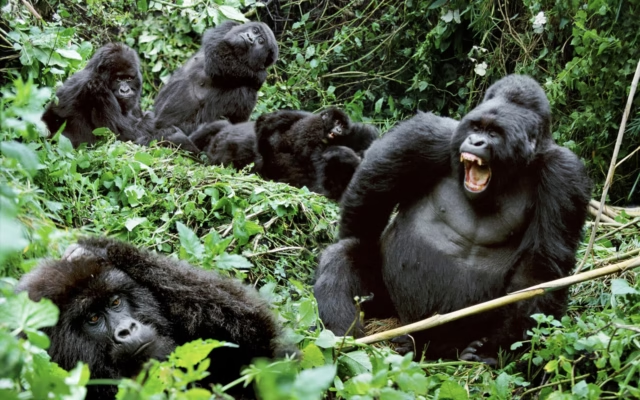
- Shared habitat with mountain gorillas
- Dense montane forest providing elephant refuge
- Active anti-poaching and research programmes
- Four gorilla trekking sectors with extensive trail networks
How to Encounter Elephants in Bwindi
During gorilla trekking in Buhoma, Ruhija, Rushaga, or Nkuringo sectors, rangers and trackers point out fresh elephant dung, footprints, and bark-stripped trees along trails. Direct elephant sightings are uncommon but do occur — particularly in less-frequented sectors and during early morning treks.
What to Look For
- Large round footprints on muddy trails
- Fresh dung piles with visible seeds
- Horizontally stripped bark on trees
- Pushed-over saplings at chest height
- Wide cleared paths through undergrowth
2. Kibale National Park
Kibale hosts Uganda’s largest elephant population — approximately 573 individuals — but genetic research reveals this is a hybrid zone where forest and savannah elephant ancestry intermixes. For visitors, Kibale offers the highest probability of encountering elephant signs on forest trails.
Why Kibale
- Largest elephant population in Uganda’s forest parks
- Extensive chimpanzee trekking trail network
- High elephant density (roughly 0.72 per km²)
- Chimp habituation experience passes through elephant zones
- Forest corridors connecting to Queen Elizabeth
How to Encounter Elephants in Kibale
Chimpanzee trekking and the chimpanzee habituation experience regularly pass through areas with fresh elephant activity. Kanyanchu, the main chimp trekking trailhead, lies within prime elephant habitat. Guides frequently pause to examine elephant dung and explain recent elephant movements.
Direct Sightings
Direct elephant sightings in Kibale are more frequent than in Bwindi due to the larger population, but still unpredictable. Early morning chimp treks and the full-day habituation experience offer the best chances. If elephants are encountered, rangers manage the situation carefully — safety protocols take priority over viewing.
3. Semuliki National Park
Semuliki is Uganda’s most distinctive forest elephant habitat — a lowland tropical forest extension of the Congo Basin biome at the base of the Albertine Rift. Forest elephants here inhabit an ecosystem found nowhere else in East Africa.
Why Semuliki
- Congo Basin forest connection via the Semliki River
- Central African species including forest elephants
- Lowland forest at 670–760 metres — different from Bwindi’s montane habitat
- Sempaya hot springs walk passes through elephant habitat
- Low visitor numbers mean less disturbance
How to Encounter Elephants in Semuliki
Guided nature walks and the trail to Sempaya hot springs pass through lowland forest where elephant signs are common. Semuliki’s elephants are connected to larger DRC populations, and the park’s remote character means elephants may be less habituated to human presence than in Kibale.
Comparing the Three Parks
| Feature | Bwindi | Kibale | Semuliki |
|---|---|---|---|
| Population estimate | ~96 (forest elephants) | ~573 (hybrid zone) | Not fully surveyed |
| Species identity | Predominantly L. cyclotis | Hybrid population | Forest elephants (Congo Basin) |
| Forest type | Montane | Mid-altitude rainforest | Lowland Congo Basin |
| Primary activity | Gorilla trekking | Chimpanzee trekking | Nature walks, hot springs |
| Elephant sign frequency | Moderate | High | Moderate |
| Direct sighting chance | Low | Low to moderate | Low |
Forest Elephants vs Savannah Elephants in Uganda
Travelers seeking elephant encounters in Uganda have two distinct experiences:
Forest Elephants
- Bwindi, Kibale, Semuliki
- On-foot forest trekking
- Shy, elusive, sign-based encounters
- Smaller, straight-tusked
- Combined with primate trekking
Savannah Elephants
- Queen Elizabeth, Murchison Falls, Kidepo
- Vehicle game drives
- Visible herds on open plains
- Larger, curved tusks
- Classic African safari experience
Many Uganda itineraries combine both — forest primate trekking in the southwest with savannah game drives across the rift valley.
Signs of Forest Elephants: A Field Guide
Learning to read elephant signs enriches every forest trek:
Footprints
Round impressions, 30–40 cm across, with five toenail marks. Forefoot and hindfoot overlap in walking prints. Size and depth indicate body mass and recency.
Dung
Large piles of fibrous balls. Fresh dung is dark, moist, and warm. Visible seeds indicate recent fruit feeding. Old dung dries grey and crumbles.
Feeding Damage
Horizontal bark strips, snapped saplings, uprooted seedlings, and broken branches at 1–2 metres height all indicate elephant feeding.
Trails
Wide paths through undergrowth with trampled vegetation and overhead broken branches — elephant highways through the forest.
Other Uganda Locations
Forest elephants or hybrids may occasionally occur in:
- Mgahinga Gorilla National Park — montane forest on the Virunga border
- Ishasha sector of Queen Elizabeth — forest-savannah transition zone
- Mount Elgon National Park — montane forest on the Kenya border
These locations are secondary to Bwindi, Kibale, and Semuliki for forest elephant interest.
Planning Your Forest Elephant Safari
The most effective itineraries combine forest parks where elephant signs are likely with expert guiding:
- Gorilla + forest: Bwindi trekking with elephant sign interpretation
- Chimp + forest: Kibale chimpanzee trekking through elephant habitat
- Primate circuit: Bwindi gorillas + Kibale chimps + Semuliki extension
- Forest + savannah: Primate parks combined with Queen Elizabeth game drives
Browse forest elephant safaris and Uganda safari packages for curated itineraries, or see best time to visit for seasonal planning.