Understanding forest elephant habitat explains their shy behaviour, frugivorous diet, conservation needs, and why they are encountered differently from savannah elephants on safari. Uganda’s rainforest parks — Bwindi, Kibale, and Semuliki — form the eastern frontier of this species’ range. Explore behaviour and where to see forest elephants for the full safari picture.
Where Do Forest Elephants Live?
African forest elephants inhabit the humid tropical forests of Central and West Africa, with their core range in the Congo Basin. Uganda’s western forest parks lie at the eastern margin of this distribution, connected to larger Democratic Republic of Congo populations through forest corridors across the Albertine Rift.
- Central Africa: Gabon, Cameroon, Republic of Congo, DRC, Central African Republic
- West Africa: remnant populations in Guinea, Liberia, Côte d’Ivoire, Ghana
- East Africa: Uganda (Bwindi, Kibale, Semuliki) and small populations in South Sudan
Forest vs Savannah Elephant Habitat
The habitat divide between Africa’s two elephant species is sharp and ecologically significant.
Forest Elephant Habitat
- Dense tropical and montane rainforest
- High humidity and rainfall year-round
- Closed canopy with thick understory
- Rich fruiting tree diversity
- Limited visibility and open space
Savannah Elephant Habitat
- Open grasslands, woodlands, and bush savannah
- Seasonal rainfall patterns
- Scattered trees and waterholes
- Grass and browse-dominated diet
- High visibility for game-drive viewing
In Uganda, this divide maps roughly onto geography: rainforest parks in the southwest and west versus savannah parks across the rift and north.
Bwindi Impenetrable National Park
Bwindi’s ancient montane and transitional forest is one of Uganda’s most important forest elephant habitats. This UNESCO World Heritage Site contains steep ridges, deep valleys, and exceptionally dense vegetation between roughly 1,160 and 2,607 metres elevation.
Key habitat features include:
- Montane and lowland forest mosaic
- High botanical diversity with abundant fruiting trees
- Steep terrain limiting human access
- Corridor connections toward DRC forests
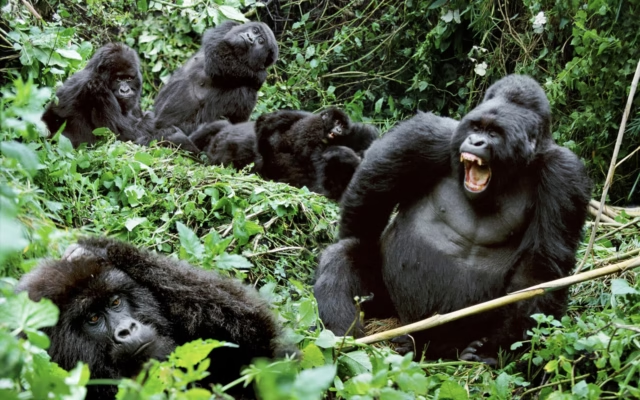
- Shared habitat with mountain gorillas and diverse primates
DNA surveys estimate approximately 96 forest elephants in Bwindi, predominantly classified as Loxodonta cyclotis. The park’s impenetrable character provides both refuge and concealment.
Kibale National Park
Kibale is Uganda’s primate capital — a 795-square-kilometre mosaic of tropical rainforest, woodland, and grassland corridors. Its elephant population, estimated at roughly 573 individuals, inhabits a complex landscape at the intersection of forest and savannah ecosystems.
Kibale habitat characteristics:
- Mid-altitude tropical rainforest (roughly 1,100–1,600 metres)
- High rainfall supporting year-round fruit production
- Forest corridors linking to Queen Elizabeth National Park
- Hybrid zone where forest and savannah elephant genetics intermix
- Extensive chimpanzee trekking trail network
Elephant density in Kibale is approximately 0.72 elephants per square kilometre — among the highest in Uganda’s forest parks.
Semuliki National Park
Semuliki represents a unique habitat within Uganda — an extension of the Congo Basin biome at the northern base of the Albertine Rift. Unlike Bwindi’s montane forest or Kibale’s mid-altitude rainforest, Semuliki is lowland tropical forest with Central African affinities.
Semuliki habitat features:
- Lowland moist forest (roughly 670–760 metres)
- Hot, humid climate with heavy rainfall
- Species found nowhere else in East Africa
- Semliki River connection to DRC’s Ituri Forest
- Sempaya hot springs and mineral-rich soils
Forest elephants in Semuliki inhabit a biome that bridges Uganda to the vast Congo Basin elephant populations.
Altitude and Climate
Forest elephant habitat in Uganda spans a considerable altitudinal range. Bwindi’s montane forest is cooler and mistier, while Semuliki’s lowland forest is hot and humid. Kibale occupies a middle zone. Across all three parks, high rainfall (1,200–2,000 mm annually) supports continuous vegetation growth and fruit production essential to elephant diet.
Vegetation Structure
Forest elephant habitat is defined by vertical complexity — emergent trees, canopy, understory, and forest floor — each layer offering different food resources. Elephants feed at all levels: fruits from canopy trees, bark and branches at trunk height, and herbs, roots, and mineral soil on the forest floor.
Key Plant Groups
- Fruit-bearing trees (Ficus, Uapaca, Chrysophyllum, and many more)
- Bamboo and woody shrubs in montane zones
- Lianas and climbers providing browse
- Forest grasses in glades and edges
- Mineral-rich soils at seepages and riverbanks
Home Range and Movement
Forest elephants maintain large home ranges within forest habitats, moving along established trails between feeding areas, mineral sources, and water. In Uganda’s relatively small forest parks, elephant movements may extend beyond park boundaries into community forests and agricultural margins — creating human-elephant interface challenges.
Corridors and Connectivity
Forest elephant survival depends on habitat connectivity. Corridors between Bwindi and Sarambwe in DRC, between Kibale and Queen Elizabeth, and across the Semliki Valley toward Ituri Forest allow genetic exchange and seasonal movement. Corridor protection is a conservation priority at the eastern range limit.
Threats to Forest Elephant Habitat
Across Africa, forest elephant habitat faces relentless pressure:
- Deforestation for agriculture, logging, and plantations
- Forest fragmentation isolating populations
- Human settlement along forest edges
- Illegal timber extraction opening access for poachers
- Climate change altering fruiting patterns and forest composition
Uganda’s national park system provides legal protection, but habitat quality at park boundaries remains vulnerable. Learn more on our conservation page.
Why Habitat Protection Matters
Forest elephants are not simply residents of rainforest — they are ecosystem engineers that shape the habitat itself. By dispersing seeds, creating trails, opening clearings, and cycling nutrients, they maintain the forest structures that countless other species depend on. Protecting forest elephant habitat protects the entire rainforest community.
Experiencing Forest Elephant Habitat on Safari
The best way to experience forest elephant habitat in Uganda is through guided activities in the parks themselves:
- Gorilla trekking through Bwindi’s montane forest
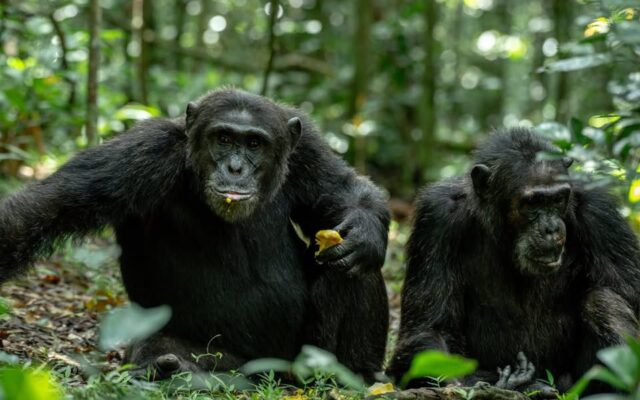
- Chimpanzee tracking in Kibale’s rainforest
- Guided nature walks and birding in Semuliki’s Congo Basin forest
Rangers and trackers interpret elephant signs along every trail, connecting visitors to the hidden presence of these forest giants.