Eland behaviour surprises visitors who judge temperament by size alone. These giants are generally calm, even approachable at distance on game drives, yet they explode into athletic flight when threatened — leaping obstacles and trotting for kilometres without the exhaustion that stops faster antelopes. Understanding herds, alarms, and breeding season adds depth to every Lake Mburo or Kidepo sighting. Link this guide to habitat, where to see eland, and safari experiences.
Non-Territorial Herd Life
Unlike impala males, which defend territories around female herds, eland bulls do not hold fixed property. Herds are loose, fluid associations that merge and split with season, forage, and breeding status. Groups may range from a handful of animals to several hundred on rich plains — though Uganda sightings more often involve tens to low hundreds.
There is no rigid hierarchy visible to casual observers, though older bulls may lead movements and dominate access to receptive females during the rut.
Daily Activity Pattern
Eland follow a classic savannah rhythm: feed heavily at dawn, rest and ruminate through midday heat, feed again in late afternoon, and remain alert through the night in open country. Midday finds herds in acacia shade in Lake Mburo or along Kidepo's drainage lines — still visible but less active.
Best Times to Observe Behaviour
- Dawn: Grazing, herd movement, predator checks
- Late afternoon: Second feeding peak; warm light for photography
- Midday: Resting, cud chewing, calves nursing in shade
Alarm and Communication
When disturbed, eland emit a loud, barking alarm call that carries across open savannah — often the first sign that something has spotted a predator before you have. Visual signals include raised heads, stiff posture, and orientation toward the threat. Flehmen response — curling the upper lip to sample scent — appears during breeding investigation.
Herds coordinate flight without the chaotic stampedes of wildebeest; animals fall into a steady trot that can maintain roughly 22 kilometres per hour over long distances.
Flight and Defence
Eland are not aggressive toward predators or vehicles. Defence is evasion: distance, endurance, and vertical leap. A standing jump of up to 2.5 metres clears obstacles that would stop buffalo or zebra. Lions rarely tackle healthy adult bulls; only coordinated pride hunts succeed, and even then prey selection favours younger or weaker animals.
Breeding Behaviour
Rutting intensity varies with rainfall and female condition, often peaking when nutrition is high after rains. Bulls test females, follow receptive cows, and engage rivals in horn-shoving contests — pushing matches rather than the high-impact horn clashes of kob. Dominant bulls may guard a female briefly during oestrus without establishing long-term territories.
Calving and Maternal Care
After roughly nine months' gestation, cows leave the herd briefly to drop a single calf in concealed grass or light woodland. Calves lie still for their first vulnerable weeks while mothers return to feed with the herd, nursing on reunion. This hiding strategy works best where grass cover and herd vigilance overlap.
Juvenile and Bachelor Groups
Young males eventually join bachelor groups that graze apart from nursery herds of females and calves. These groups are less wary than breeding aggregations and often provide relaxed viewing on open tracks. As bulls mature, they integrate into larger mixed herds or operate as solitary satellite males following female groups during the rut.
Social Tolerance on Game Drives
Eland in Lake Mburo are among the more tolerant large antelopes to vehicle presence on established tracks — not tame, but often continuing to graze while vehicles stop at respectful distance. Kidepo herds, encountering fewer vehicles, may be slightly more flighty. Guides who cut engines and avoid sudden movement are rewarded with longer observation windows.
Interaction With Other Species
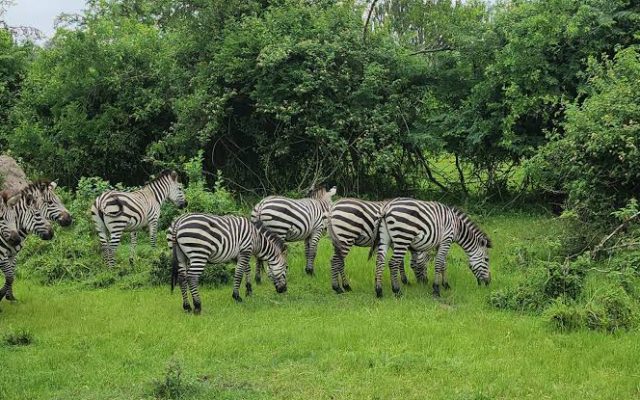
Eland routinely associate with zebra, impala, topi, and buffalo on Mburo plains — a mixed-species grazing advantage where many eyes watch for leopard and hyena. In Kidepo, they share Narus Valley grasslands with Jackson's hartebeest, oribi, and buffalo, with lion as the primary large predator.
Walking Safari Behaviour
Lake Mburo permits guided walking safaris with armed rangers — one of the few Ugandan parks where you may observe eland behaviour from ground level. On foot, the animals' scale is overwhelming; their calm withdrawal to a safe distance demonstrates how distance management replaces aggression.
Seasonal Behaviour Shifts
Dry seasons contract herds toward water and shade; wet seasons spread them across green hillsides. Calving peaks after rains bring nursery herds with visible calves — photogenic but deserving extra distance. Rutting bulls are more vocal and competitive; shoving matches near woodland edges are occasional highlights.
Viewing Ethics
Never crowd calving areas, chase fleeing herds, or drive off-road to intercept movement. Alarm barks mean the animal has surrendered its calm — repeated disturbance stresses animals and shortens sightings for everyone. Follow Uganda Wildlife Authority track rules and ranger instructions.
Deepen your field context with diet, facts, and best time to see eland before your game drives.