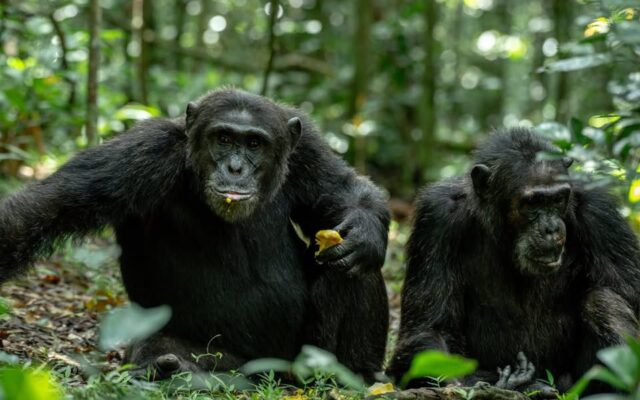
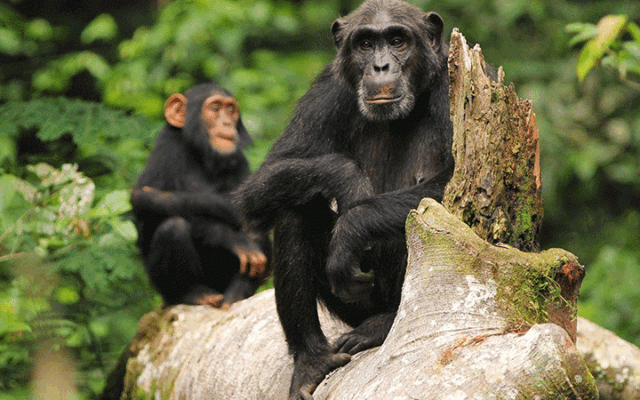
Common chimpanzee facts — expert Uganda safari guide from local planners who know permits, parks, and realistic routing.
Explore this species across our habitat guide, where to see page, and safari planning resources - plus parks such as linked destinations.
As one of humanity’s closest living relatives, chimpanzees provide unique insights into evolution, cognition, communication, cooperation, and social structure. Watching them in the wild often feels surprisingly familiar, from affectionate parenting and playful juveniles to strategic alliances and expressive communication.
This guide explores the most fascinating Eastern chimpanzee facts, covering biology, intelligence, behaviour, ecology, conservation, and incredible adaptations.
Quick Eastern Chimpanzee Facts
- Scientific name: Pan troglodytes schweinfurthii
- Subspecies of common chimpanzee
- One of humanity’s closest living relatives
- Share approximately 98–99% DNA with humans
- Among the most intelligent non-human animals
- Known for sophisticated tool use
- Live in highly complex social communities
- Found across East and Central Africa
- Uganda is a leading chimp trekking destination
- Chimpanzees are endangered
1. Eastern Chimpanzees Are One of Humanity’s Closest Relatives
Chimpanzees share roughly 98–99% of their DNA with humans, making them one of our closest living evolutionary relatives.
This genetic similarity explains behavioural parallels including:
- Emotional expression
- Problem solving
- Parenting behaviour
- Social politics
- Communication
- Learning
2. They Are a Subspecies of the Common Chimpanzee
The Eastern chimpanzee is not a separate species but a subspecies.
- Species: Pan troglodytes
- Subspecies: Pan troglodytes schweinfurthii
3. Chimpanzees Are Extremely Intelligent
Chimpanzees rank among the most intelligent animals on Earth.
Observed abilities include:
- Strategic planning
- Problem solving
- Tool innovation
- Memory
- Learning
- Social manipulation
- Communication flexibility
4. Chimpanzees Use Tools
Chimpanzees are among the few animals known for sophisticated tool use.
Examples include:
- Sticks for insect extraction
- Leaf sponges for water
- Object-assisted feeding
- Food manipulation tools
This is one of the most famous chimpanzee facts.
5. Eastern Chimpanzees Have Political Societies
Chimpanzee communities are politically complex.
Males often form alliances, compete for rank, negotiate dominance, and strategically manage relationships.
This social intelligence is astonishingly sophisticated.
6. They Live in Fission-Fusion Communities
Unlike stable troop structures seen in some primates, chimpanzees live in fission-fusion societies.
This means:
- Large communities split into smaller subgroups
- Subgroups change frequently
- Composition depends on food, social dynamics, and mating
7. Adult Males Are Larger Than Females
Chimpanzees show sexual dimorphism.
Adult males typically outweigh females and often dominate social competition.
8. Chimpanzees Are Powerful Despite Their Size
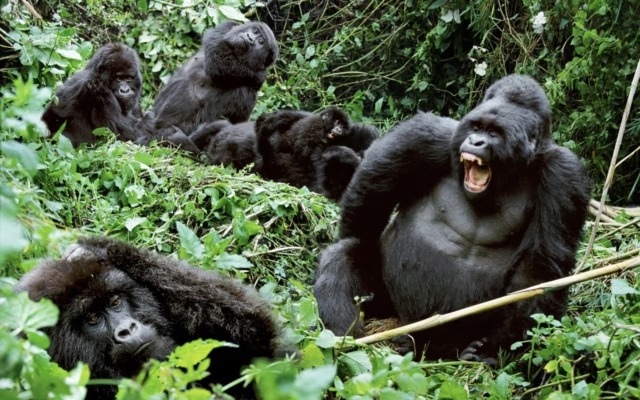
Though smaller than gorillas, chimpanzees are extremely strong and agile.
Their upper body strength and climbing ability are highly developed.
9. They Are Omnivores
Chimpanzees eat both plant and animal matter.
Diet includes:
- Fruit
- Leaves
- Seeds
- Flowers
- Insects
- Termites
- Ants
- Occasional animal protein
10. Fruit Is a Major Food Source
Fruit often forms a major component of chimpanzee diets and strongly influences movement patterns.
11. Chimpanzees Communicate with Vocal Calls
Chimpanzees use diverse vocal communication systems.
Common calls include:
- Pant-hoots
- Alarm calls
- Grunts
- Barks
- Screams
12. Facial Expressions Matter
Chimpanzees communicate emotion and intent through highly expressive facial behaviour.
13. Grooming Is Social Currency
Grooming is not merely hygienic—it strengthens alliances, builds trust, reduces tension, and reinforces hierarchy.
14. Chimpanzees Show Emotion
Observed emotional behaviours include:
- Playfulness
- Affection
- Curiosity
- Fear
- Distress
- Comforting behaviour
- Excitement
15. Infant Chimpanzees Depend on Mothers for Years
Chimpanzee infants remain dependent for long developmental periods, learning survival and social skills gradually.
16. Chimp Mothers Invest Heavily in Parenting
Maternal care includes:
- Nursing
- Protection
- Carrying
- Teaching
- Social exposure
17. Chimpanzees Learn by Observation
Young chimpanzees acquire knowledge through imitation, observation, experimentation, and social learning.
18. Eastern Chimpanzees Are Both Arboreal and Terrestrial
They spend time both in trees and on the ground.
Movement includes:
- Knuckle-walking
- Climbing
- Branch movement
- Jumping
19. Chimpanzees Build Sleeping Nests
Chimpanzees create nests for sleeping, often in trees.
Fresh nests are usually built regularly.
20. They Have Excellent Memory
Chimpanzees demonstrate strong memory abilities, including social recognition and environmental recall.
21. Territorial Behaviour Exists
Chimpanzee communities defend territory and may conduct patrol behaviours.
22. Social Hierarchy Is Important
Rank influences:
- Mating
- Resource access
- Conflict outcomes
- Alliance opportunities
23. Chimpanzees Can Be Strategic
They are capable of tactical social behaviour, timing interactions, managing alliances, and responding strategically.
24. They Are Highly Curious
Curiosity drives exploration, learning, object interaction, and environmental awareness.
25. Uganda Is One of Africa’s Best Chimpanzee Destinations
Top chimp trekking destinations include:
- Kibale National Park
- Budongo Forest
- Kyambura Gorge
- Kalinzu Forest
26. Kibale Is the Premier Chimp Destination
Kibale National Park is widely considered Uganda’s top chimpanzee trekking location.
27. Chimpanzees Are Endangered
Eastern chimpanzees face conservation threats despite protected populations.
28. Habitat Loss Is a Major Threat
Forest destruction remains one of the most serious threats to chimp survival.
29. Disease Is a Conservation Concern
Because chimpanzees are closely related to humans, disease transmission is a significant risk.
30. Chimpanzee Tourism Supports Conservation
Responsible tourism contributes to:
- Protection funding
- Research
- Community conservation
- Habitat preservation
31. Chimpanzees Are Great Apes, Not Monkeys
This is a common misconception.
Chimpanzees belong to the great ape family.
32. Chimpanzees Have Individual Personalities
Researchers observe clear personality differences among individuals.
33. Juveniles Are Highly Playful
Young chimpanzees wrestle, chase, climb, experiment, and socially test boundaries.
34. Chimpanzees Can Solve Problems
They show flexible problem-solving behaviour in both wild and research contexts.
35. They Use Touch for Communication
Tactile communication helps reinforce social relationships.
36. They Can Be Loud
Chimp communities may be extremely vocal, especially during excitement or territorial events.
37. They Travel Considerably
Chimpanzees move strategically through habitat in search of food and social opportunities.
38. Males Often Stay in Natal Communities
Male social structure differs from females in many chimp populations.
39. Chimpanzees Have Long Childhoods
Extended development supports advanced learning.
40. Seeing Chimpanzees in the Wild Is Extraordinary
Chimpanzee trekking is one of Africa’s most rewarding wildlife experiences.
Interesting Chimpanzee Fact Summary
- Use tools
- Highly intelligent
- Complex politics
- Omnivorous
- Emotional depth
- Fission-fusion social systems
- Advanced communication