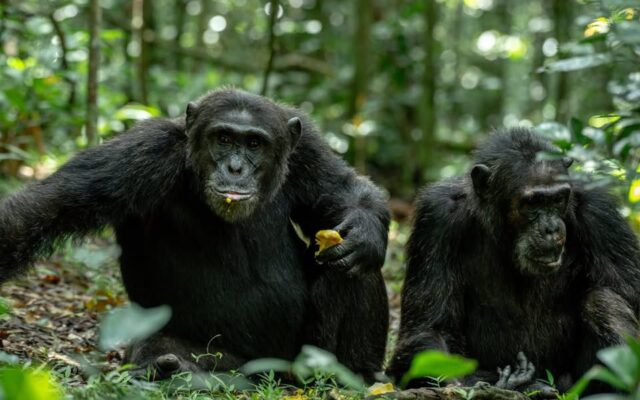
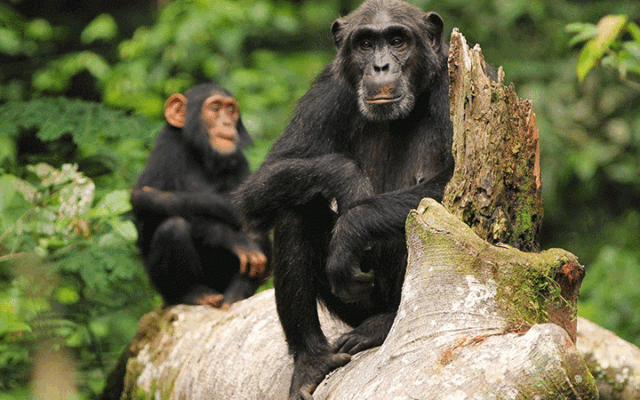
Common chimpanzee diet — expert Uganda safari guide from local planners who know permits, parks, and realistic routing.
Explore this species across our habitat guide, where to see page, and safari planning resources - plus parks such as linked destinations.
Their feeding behaviour reflects intelligence, planning, memory, and remarkable environmental awareness. What chimpanzees eat influences movement patterns, territorial behaviour, social interactions, habitat use, and even political relationships within communities.
Understanding Eastern chimpanzee diet helps explain why they are among the most behaviourally sophisticated wildlife species in Africa.
Are Eastern Chimpanzees Herbivores, Carnivores, or Omnivores?
Eastern chimpanzees are omnivores.
This means they consume both plant and animal matter.
Unlike strictly herbivorous primates, chimpanzees have a diverse and opportunistic diet.
Their dietary flexibility is one reason they are highly adaptable across different habitats.
What Do Eastern Chimpanzees Eat?
Chimpanzees consume a broad variety of foods.
Major food categories include:
- Fruit
- Leaves
- Flowers
- Seeds
- Bark
- Stems
- Roots
- Termites
- Ants
- Insects
- Honey
- Occasional animal prey
Diet composition varies by habitat and season.
Fruit: The Most Important Food Category
Fruit is often the most important dietary component for Eastern chimpanzees.
Chimpanzees actively search for ripe fruit and may travel significant distances to access preferred feeding trees.
Fruit provides:
- Energy
- Sugars
- Hydration
- Micronutrients
- Efficient calorie intake
Fruit availability strongly influences daily movement patterns.
Common Fruit Foods
Depending on habitat, chimpanzees consume various wild fruits.
Selection depends on:
- Ripeness
- Seasonality
- Competition
- Tree location
- Nutritional value
Leaves
Leaves form an important dietary supplement.
Chimpanzees consume leaves for:
- Fiber
- Nutrients
- Digestive support
- Dietary diversity
Young leaves are often preferred because they are easier to digest.
Flowers
Flowers may be consumed opportunistically depending on habitat availability.
Seeds
Seeds provide nutritional variation and are incorporated when accessible.
Bark
Bark can be eaten when other resources are limited or when specific nutritional needs arise.
Stems and Plant Material
Chimpanzees also consume various plant structures depending on food conditions.
Roots
Roots may be included in dietary behaviour where accessible.
Insect Consumption
Chimpanzees are well known for insect feeding behaviour.
Important insect foods include:
- Termites
- Ants
- Larvae
- Other small invertebrates
Termite Fishing
One of the most famous chimpanzee dietary behaviours is termite fishing.
This involves tool use.
Chimpanzees may:
- Select a suitable stick
- Modify it if necessary
- Insert it into termite structures
- Extract termites for feeding
This behaviour demonstrates intelligence and learned feeding strategy.
Ant Feeding
Chimpanzees also exploit ant resources using skilled extraction methods.
Honey Consumption
Where accessible, chimpanzees may seek honey as a high-energy food source.
Do Eastern Chimpanzees Eat Meat?
Yes.
Eastern chimpanzees occasionally consume animal protein.
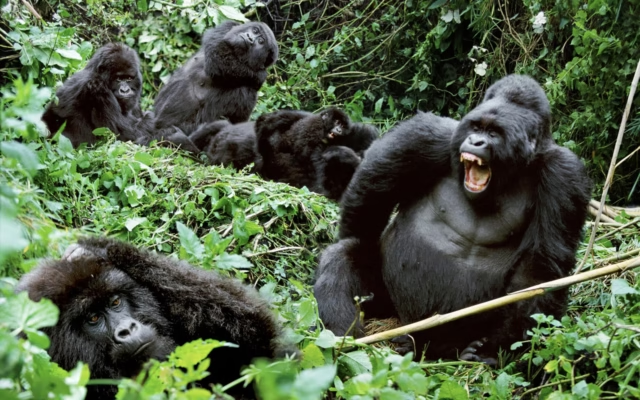
This makes them significantly different from mountain gorillas.
Although plant foods dominate overall intake, hunting behaviour is a known aspect of chimp ecology.
Hunting Behaviour
Chimpanzees are among the few primates known for coordinated hunting behaviour.
Observed hunting may involve:
- Group participation
- Pursuit
- Strategic positioning
- Social competition over prey
Potential Animal Foods
Animal prey may include:
- Small mammals
- Young monkeys
- Other opportunistically available prey
Such feeding is occasional rather than constant.
Why Meat Matters
Animal protein provides concentrated nutrition and may influence social interactions.
Food sharing after hunting can also reinforce social relationships.
Opportunistic Feeding
Chimpanzees are opportunistic feeders.
This means they adapt feeding behaviour according to circumstances.
Key influences include:
- Season
- Habitat
- Competition
- Food abundance
- Social context
Daily Feeding Behaviour
Chimpanzees spend significant portions of the day searching for and consuming food.
Typical feeding behaviour includes:
- Travel between food sources
- Climbing feeding trees
- Foraging
- Social feeding interactions
- Tool-assisted feeding
Feeding and Intelligence
Chimpanzee feeding reflects advanced cognition.
Skills involved include:
- Memory of food locations
- Seasonal knowledge
- Tool innovation
- Strategic timing
- Learning from others
Social Feeding Behaviour
Feeding is influenced by social relationships.
Factors include:
- Dominance hierarchy
- Competition
- Food sharing
- Alliance relationships
- Tolerance levels
Male Feeding Behaviour
Males may show different feeding dynamics due to hierarchy and competition.
Female Feeding Behaviour
Females balance feeding with maternal responsibilities and offspring care.
Infant Feeding Development
Infants begin life dependent on maternal milk.
Gradually they learn feeding behaviour through:
- Observation
- Experimentation
- Imitation
- Social learning
Juvenile Feeding Behaviour
Young chimpanzees learn diet complexity over time.
Habitat Influence on Diet
Diet differs depending on habitat.
Kibale National Park
Kibale’s rich tropical forest supports abundant fruit resources and diverse feeding opportunities.
Budongo Forest
Budongo’s mature forest structure supports strong chimp feeding ecology.
Kyambura Gorge
Smaller habitat creates unique food availability dynamics.
Seasonal Diet Variation
Chimpanzee diets shift with seasonal food availability.
Changes may involve:
- Fruit abundance fluctuations
- Greater insect use
- Plant fallback foods
- Movement pattern shifts
Hydration
Chimpanzees obtain hydration through:
- Fruit moisture
- Water access
- Leaf moisture
Tool Use in Feeding
Chimpanzees are famous for feeding-related tool use.
Examples:
- Termite fishing sticks
- Leaf sponges
- Food extraction tools
Diet and Conservation
Chimp survival depends heavily on habitat food systems.
Threats affecting diet include:
- Deforestation
- Habitat fragmentation
- Resource loss
- Human disturbance
Chimpanzee Diet vs Mountain Gorilla Diet
Chimpanzees
- Omnivorous
- Fruit-heavy
- Insect consumers
- Occasional hunters
- Tool-assisted feeding
Mountain Gorillas
- Mostly herbivorous
- Vegetation heavy
- Minimal animal matter
Interesting Diet Facts
- Chimpanzees use tools to obtain food
- Fruit strongly shapes movement
- They occasionally hunt
- Diet varies by season
- Young chimpanzees learn feeding behaviour socially