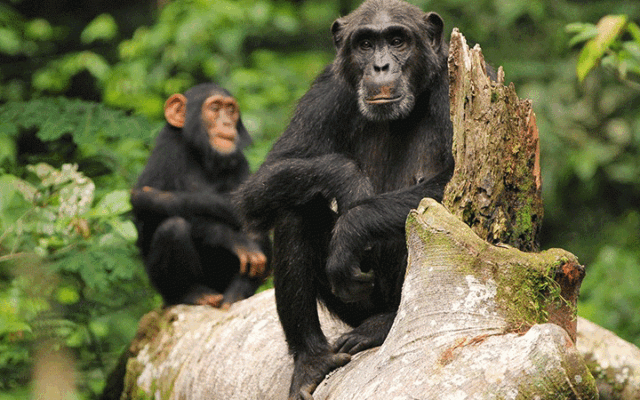
Common chimpanzee behaviour — expert Uganda safari guide from local planners who know permits, parks, and realistic routing.
Explore this species across our habitat guide, where to see page, and safari planning resources - plus parks such as linked destinations.
Unlike simpler social animals with rigid structures, chimpanzees operate within fluid, dynamic societies shaped by alliances, hierarchy, resource competition, communication, and learned behaviour. Their behavioural complexity is one of the main reasons chimpanzee trekking is considered one of Africa’s most extraordinary wildlife experiences.
This guide explores Eastern chimpanzee behaviour in depth, including social organization, communication, politics, intelligence, parenting, territoriality, aggression, cooperation, and daily routines.
Chimpanzees Are Highly Social Animals
Eastern chimpanzees are intensely social primates.
Social life influences:
- Survival
- Reproduction
- Protection
- Learning
- Food access
- Alliance building
- Conflict resolution
Chimpanzees do not live as isolated individuals under normal ecological conditions.
Community Structure
Chimpanzees live in communities rather than tightly fixed troops.
Communities may include:
- Adult males
- Adult females
- Subadults
- Juveniles
- Infants
Community size varies significantly depending on habitat and ecological conditions.
Fission-Fusion Social System
One of the defining characteristics of chimpanzee behaviour is the fission-fusion social structure.
This means larger communities regularly divide into smaller temporary subgroups, then reform later.
Subgroup composition changes depending on:
- Food availability
- Social relationships
- Mating opportunities
- Territorial needs
- Conflict dynamics
- Movement strategy
This flexible structure makes chimpanzee society highly dynamic.
Dominance Hierarchy
Hierarchy plays a major role in chimpanzee social behaviour.
Status influences:
- Mating access
- Food access
- Alliance opportunities
- Conflict outcomes
- Leadership influence
Alpha Male Behaviour
Adult males often compete for dominance positions.
Alpha status may involve:
- Physical strength
- Social alliances
- Strategic intelligence
- Conflict management
- Political positioning
Leadership is not always based purely on strength.
Chimpanzee Politics
Chimpanzee societies are famous for political behaviour.
Observed political behaviours include:
- Alliance formation
- Strategic grooming
- Rank negotiation
- Social manipulation
- Power competition
- Conflict timing
This makes chimpanzee social systems exceptionally sophisticated.
Female Behaviour
Adult females play vital social and reproductive roles.
Common female behaviours include:
- Maternal care
- Feeding coordination
- Social interaction
- Offspring protection
- Behavioural teaching
Infant Behaviour
Chimpanzee infants are highly dependent and behaviourally curious.
Common infant behaviours include:
- Clinging to mothers
- Observation-based learning
- Play initiation
- Exploratory interaction
- Vocal dependency
Juvenile Behaviour
Juveniles are energetic, experimental, and socially playful.
This developmental stage supports:
- Motor skill development
- Social learning
- Hierarchy awareness
- Risk testing
- Communication practice
Play Behaviour
Play is an essential part of chimpanzee behavioural development.
Play activities include:
- Chasing
- Wrestling
- Climbing
- Mock fighting
- Object manipulation
- Social experimentation
Play helps build physical and social competence.
Communication
Chimpanzees use complex communication systems.
Vocal Communication
Common vocalizations include:
- Pant-hoots
- Screams
- Grunts
- Barks
- Alarm calls
- Contact calls
These signals communicate excitement, location, warning, aggression, reassurance, and social intent.
Facial Communication
Facial expressions communicate emotional states and behavioural intention.
Body Language
Posture communicates dominance, submission, excitement, play, or aggression.
Tactile Communication
Touch reinforces relationships and reduces tension.
Grooming Behaviour
Grooming is one of the most important social behaviours in chimpanzee communities.
Functions include:
- Bond building
- Alliance reinforcement
- Tension reduction
- Hierarchy management
- Trust development
Grooming acts as social currency.
Intelligence and Problem Solving
Chimpanzees demonstrate extraordinary intelligence.
Observed capabilities include:
- Planning
- Problem solving
- Tool use
- Memory
- Social calculation
- Adaptive learning
Tool Use Behaviour
Chimpanzees are globally famous for tool use.
Observed examples:
- Termite fishing
- Leaf sponges
- Food extraction tools
- Object manipulation
Tool use demonstrates intelligence and cultural learning.
Learning Behaviour
Young chimpanzees learn through:
- Observation
- Imitation
- Experimentation
- Social practice
Territorial Behaviour
Chimpanzees defend territory.
Territorial behaviours include:
- Patrolling
- Vocal displays
- Boundary awareness
- Group movement coordination
Aggression
Chimpanzees can display aggression in specific contexts.
Triggers may include:
- Rank competition
- Resource competition
- Threat perception
- Territorial disputes
- Social tension
Conflict Resolution
Not all tension becomes violent.
Chimpanzees may resolve social tension through:
- Submission signals
- Grooming
- Avoidance
- Alliance intervention
Hunting Behaviour
Chimpanzees are among the few primates known for organized hunting behaviour.
Hunting behaviour may involve:
- Group coordination
- Pursuit
- Strategic positioning
- Food competition afterward
Food Sharing Behaviour
Food sharing can influence relationships and social standing.
Parenting Behaviour
Maternal Care
Chimpanzee mothers provide intensive care.
Responsibilities include:
- Nursing
- Protection
- Transport
- Teaching
- Behaviour modelling
Infant Learning
Much behavioural knowledge is acquired through maternal and social observation.
Emotional Behaviour
Chimpanzees display notable emotional complexity.
Observed emotional states include:
- Curiosity
- Excitement
- Affection
- Distress
- Fear
- Playfulness
- Comforting responses
Daily Routine
Chimpanzee daily behaviour typically follows ecological patterns.
Morning
- Wake-up activity
- Vocal communication
- Movement initiation
- Feeding
Midday
- Travel
- Foraging
- Social interaction
- Rest periods
Afternoon
- Continued feeding
- Movement
- Social activity
Evening
- Nest construction
- Settlement
- Reduced movement
Nesting Behaviour
Chimpanzees build sleeping nests regularly.
Nesting reflects:
- Habitat adaptation
- Comfort needs
- Safety behaviour
Behaviour During Chimp Trekking Encounters
Visitors may observe:
- Feeding
- Calling
- Movement
- Play
- Grooming
- Territorial displays
Behaviour Myths
Myth: Chimpanzees Are Gentle Like Humans
Reality: They are wild primates with complex behaviours and should always be respected.
Myth: Intelligence Means Predictability
Reality: Intelligence often increases behavioural complexity.
Myth: Chimpanzees Behave Like Monkeys
Reality: Their social systems are much more sophisticated.
Interesting Behaviour Facts
- Use political alliances
- Communicate vocally and socially
- Learn through observation
- Use tools
- Defend territory
- Build nests
- Show emotional complexity