Best time to visit Lake Opeta
Unlike gorilla trekking, where permit dates lock your calendar, Lake Opeta is flexible at the species level — shoebills, papyrus specialists, and Fox's weaver use the system across the year. The real planning questions are practical: How will seasonal flooding affect tracks and swamp access? Are you driving from Soroti, Mbale, or deeper in Karamoja Region? And are you chaining Opeta with Pian Upe Wildlife Reserve, Nyero Rock Paintings, or a long transfer toward Kidepo Valley National Park?
Time of day: mornings win on the wetland
For shoebill searching, Fox's weaver stakeouts, and general bird activity, morning is the clear preference on this Karamoja wetland lake. Temperatures on open floodplain are cooler, wind is often lighter, birds feed actively, and light is better for photography. Eastern Uganda guides consistently plan the first session for swamp edges — not a late slot squeezed after a half-day drive from Mount Elgon or a Pian Upe game run.
If Opeta sits between overnight stops, an early start from Soroti usually beats arriving after midday heat. Travelers on multi-day Karamoja loops should treat the wetland morning as a dedicated block rather than stacking it against an afternoon ten-hour push toward Kidepo.
Dry season vs rainy season
Uganda's broadly drier windows — roughly June to September and December to February — often simplify road access to Opeta margins and surrounding grassland tracks. Many birding operators highlight December through February when seasonal flooding has receded and water concentrates in channels where shoebills and waders hunt. Drier months also align with peak international travel, so eastern guides and Soroti accommodation fill earlier — book ahead if dates are fixed.
Rainy periods centered on March to May and October to November bring greener scenery, fewer competing visitors at times, and strong bird activity once showers pass. Trade-offs include muddy access roads, expanded floodplain that spreads birds across a wider area, and the need for waterproof footwear, rain jacket, dry bag, and flexible scheduling. Opeta can still be excellent in wet months — but build margin into the day and confirm track conditions with your operator rather than assuming dry-season timing from old trip reports.
Local weather near Opeta may not match what southwestern parks such as Queen Elizabeth or Bwindi experience the same week. Eastern lowland and Karamoja-edge forecasts deserve their own check.
Seasonal flooding and wildlife movement
Seasonal flooding is not only a logistics factor — it shapes ecology. In wet months, water spreads across Vossia swamp and papyrus, connecting Opeta functionally with marshes toward Lake Bisina and the wider Lake Kyoga basin. In dry months, the wetland can shrink to core channels and pools, concentrating fish and birds while drawing wildlife from drier Pian Upe country toward the only substantial refuge.
Birders often prefer searchable dry-season shallows for shoebill effort; ecologists value wet-season connectivity for breeding Fox's weaver and fish refugia. Choose season goals explicitly when planning with your guide — photography, endemic targets, and mammal fringe scanning do not all peak in the same month.
Migration and specialist birding months
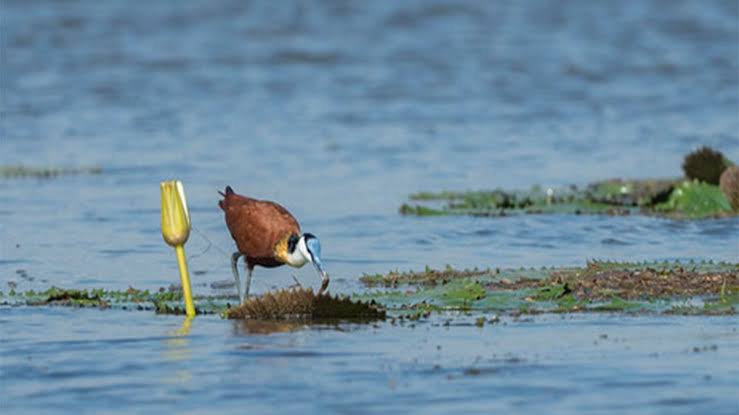
Resident shoebills, papyrus gonolek, and Fox's weaver are present throughout the year. Birders targeting Palearctic migrants and broader eastern lists often favor the wider October to March window, when additional waterbirds and raptors supplement residents. Exact mixes vary annually; combining Opeta with Lake Kyoga or Mabamba Swamp on different itinerary legs spreads wetland opportunity across seasons.
Serious listers on multi-week Uganda birding safaris frequently place Opeta after central forest sites or before northeastern savannah — season choice then becomes about road comfort across the whole route, not Opeta alone. A dry January Opeta morning paired with a February Kidepo drive behaves differently from a March Opeta attempt followed by Pian Upe tracks in rain.
Karamoja, Pian Upe, and Kidepo routing seasons
When Opeta anchors a Karamoja Region extension, heat and dust on overland days matter as much as swamp conditions. Dry-season months simplify multi-day routing from Opeta through Pian Upe toward Kidepo Valley National Park, though distances remain long and planning should stay conservative. Wet-season travel can green the landscape beautifully but slow gravel sections and raise river crossings on remote legs — confirm current conditions rather than relying on generic northeast Uganda advice.
Travelers approaching from Mount Elgon National Park or Mbale should remember Elgon rainfall can flood Opeta downstream days after local storms, even when Soroti skies look clear.
First stop or mid-loop on a safari?
Lake Opeta fits multiple itinerary positions. As an eastern Uganda opener after Jinja or Kampala, it delivers immediate wetland depth before longer drives north. Mid-loop, it breaks up savannah-heavy days around Pian Upe. As a targeted birding detour, it justifies an extra night in Soroti when Fox's weaver and shoebill are priority targets.
It is rarely a last-day airport add-on — unlike Mabamba Swamp near Entebbe. Build Opeta into the eastern segment where drive time supports the experience.
Month-by-month snapshot
January–February: Often drier, firmer access, concentrated wetland birding; popular for shoebill and Fox's weaver searches.
March–May: Rainier, lush, expanded flooding; flexible timing and waterproof gear essential.
June–August: Drier, strong general birding; good for combining Opeta with Pian Upe and Karamoja overland legs.
September: Transition month — workable, watch for early rains and rising water locally.
October–November: Second rainy peak possible; migrant interest rising for listers.
December: Holiday travel demand in eastern towns; book Soroti bases and guides early; excellent wetland windows when rains pause.
For wildlife ecology and species detail, pair this page with our Lake Opeta wildlife and bird watching guides.