Bird watching at Lake Opeta
If you are building a Uganda birding safari beyond the Lake Victoria circuit, Lake Opeta belongs on the shortlist. The Lake Opeta Wetland System is a Ramsar site and Important Bird Area — one of thirty-three IBAs in the country — where papyrus, Vossia swamp, wooded grassland, and seasonal floodplain support shoebills, endemic Fox's weaver, papyrus gonolek, papyrus yellow warbler, and more than 150 recorded species in the wider system. Unlike a quick Mabamba Swamp morning near Entebbe, Opeta rewards travelers who commit to eastern routing through Soroti, Lake Kyoga, and optional legs toward Pian Upe Wildlife Reserve or Kidepo Valley National Park.
Shoebill and swamp hunting ecology
Shoebill tracking at Lake Opeta is typically done on foot or by boat with a local guide who knows recent territories and water levels. Shoebills (Balaeniceps rex) stand in shallow channels hunting fish and lungfish, often motionless for long periods before a strike. Opeta's extensive swamp gives them room to feed away from the heaviest disturbance — which is why the site appears on specialist northeastern itineraries alongside more famous central sites.
Sightings remain wild, not guaranteed. Experienced guides position viewing parties without crowding or flushing birds — essential for ethical photography and breeding-season protection. Morning sessions usually outperform afternoon heat when wind and glare rise across open floodplain. If you have one wetland day on a Karamoja Region loop, schedule Opeta early and keep the afternoon flexible for road conditions after seasonal flooding.
Fox's weaver: Uganda's endemic prize
Fox's weaver (Ploceus spekeoides) is the listing reason many birders drive east. Uganda's only endemic bird species has been recorded breeding in Opeta's papyrus and swamp structure — a distinction you cannot replicate at Bwindi montane forests or Queen Elizabeth savannah loops. Colony locations shift with vegetation and water; local knowledge matters more than a static map pin.
Target Fox's weaver with a birding-focused guide, binoculars ready for canopy and reed-edge scanning, and enough time to work swamp margins after any shoebill effort. Casual visitors may still enjoy colorful kingfishers and weavers; serious listers should treat Opeta as a full-morning minimum, not a drive-by tick between highway milestones.
Papyrus specialists and wider wetland lists
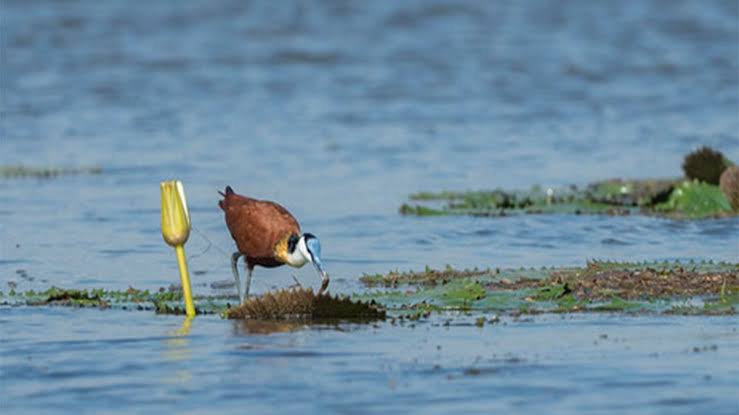
Beyond the two headline species, bird watching in Lake Opeta opens into classic East African wetland birding. Commonly sought birds include African jacana, malachite and pied kingfishers, African fish eagle, purple heron, goliath heron, squacco heron, black crake, long-toed lapwing, swamp flycatcher, papyrus gonolek, papyrus yellow warbler, white-winged swamp warbler, African pygmy goose, and pallid harrier in suitable seasons. Palearctic migrants supplement resident lists in many months — especially rewarding if you chain Opeta with Lake Bisina or Kyoga basin sites on the same eastern arc.
Exact day lists depend on water level, grassland fire history, guide effort, and whether you scan Hyparrhenia savanna edges after the core swamp loop. A guide who knows calls and papyrus stakeouts adds far more value than transport alone.
Season, flooding, and when to bird
Dry-season birding — broadly December through February and mid-year dry windows — often simplifies access when seasonal flooding has receded and tracks firm up. Many Opeta trip reports favor year-end dry periods when water concentrates shoebills and waders in shallower, searchable zones. Rainy months bring lush scenery and strong activity between showers, but muddy margins and shifting channels demand waterproof footwear and schedule flexibility.
Morning is the default best time: cooler temperatures, lighter wind on open water, active feeding, and softer light for photography. Mid-itinerary birders linking Nyero Rock Paintings or Mount Elgon should avoid stacking Opeta as an afternoon afterthought on a long transfer day.
Gear, pacing, and guide choice
Bring 8×42 binoculars as a practical default for swamp and grassland birding. A Uganda field guide or eBird checklist helps between sightings. Telephoto lenses suit shoebill and kingfisher photography; avoid pressuring guides to approach too closely. Pack rain jacket, sun protection, insect repellent, drinking water, and a dry bag — splash and sudden showers are normal on a Karamoja wetland lake outing.
Move slowly, listen more than you talk, and let the guide set pace through papyrus and seasonal flood channels. Rushing rarely adds species. Birders continuing north toward Pian Upe or Kidepo should confirm guide availability in advance because specialist eastern Uganda birding is not as commoditized as Entebbe day tours.
Building an eastern Uganda birding route
Opeta pairs naturally with Soroti as a logistics base, Lake Kyoga for additional waterbird habitat, and Nyero Rock Paintings for a non-bird cultural break. Longer circuits continue to Pian Upe for dry-country species, then Karamoja Region overland toward Kidepo Valley National Park — Opeta is the wetland opening chapter on a route Mabamba cannot substitute.
See also our Lake Opeta wildlife and ecology notes, best time to visit, and access from Soroti and eastern Uganda pages for route and season planning.