Secretary bird — Uganda safari guide for travelers planning wildlife encounters.
Explore this species across our habitat guide, where to see page, and safari planning resources — centred on Murchison Falls, Queen Elizabeth, and Kidepo Valley.
The secretary bird is one of the most extraordinary sights on an African savannah safari — a tall, crested raptor that hunts on foot across open grassland, delivering lightning-fast stomps to snakes, rodents, and insects. Unlike eagles that strike from the air, Sagittarius serpentarius walks with deliberate grace, its long legs covering kilometres of plain each day while a quill-like crest fans above an unmistakable profile.
For Uganda safari travellers, secretary birds reward the same dawn game drives that deliver lions, Uganda kob, and buffalo. Murchison Falls National Park, Queen Elizabeth National Park, and remote Kidepo Valley National Park all hold healthy populations on short-grass plains — often spotted at distance first, then approached for striking photographs as birds continue their terrestrial patrol.
What Is a Secretary Bird?
The secretary bird belongs to the order Accipitriformes but occupies its own family, Sagittariidae — a lineage distinct from hawks, eagles, and kites. European naturalists described the species in the eighteenth century from southern African specimens, though its range extends across sub-Saharan Africa wherever open savannah persists.
- Kingdom: Animalia
- Phylum: Chordata
- Class: Aves
- Order: Accipitriformes
- Family: Sagittariidae
- Genus: Sagittarius
- Species: Sagittarius serpentarius
The scientific name captures the bird's essence: serpentarius — the snake bearer — reflects centuries of observation of reptile hunting across African grasslands.
Physical Characteristics
Size and Stature
Adults stand roughly 1.2 to 1.5 metres tall — comparable to a child — with a wingspan approaching two metres. Body mass ranges from about 2.5 to 4.5 kilograms. The build is unlike any other raptor: elongated legs, a relatively small head, and a body shaped for walking endurance rather than aerial agility.
Crest and Plumage
A spray of 20 to 30 black quill feathers forms the famous crest, erectile during display and alert behaviour. The body is predominantly grey; flight feathers and thigh feathers are black; undertail coverts are white. Bare facial skin around the eyes is orange-red to yellow. The hooked beak is typical of raptors, but the legs dominate the silhouette.
Feet — The Hunting Weapon
Secretary bird feet are thick, muscular, and armed with sharp talons — adapted for delivering blows rather than grasping fish or snatching prey mid-air. The stomping technique can kill venomous snakes that would be hazardous for many predators.
Where Secretary Birds Live in Uganda
Uganda's northern and western savannah parks offer prime secretary bird habitat. Open grassland with scattered acacia — the classic East African savannah mosaic — supports walking hunts and tree-nesting requirements.
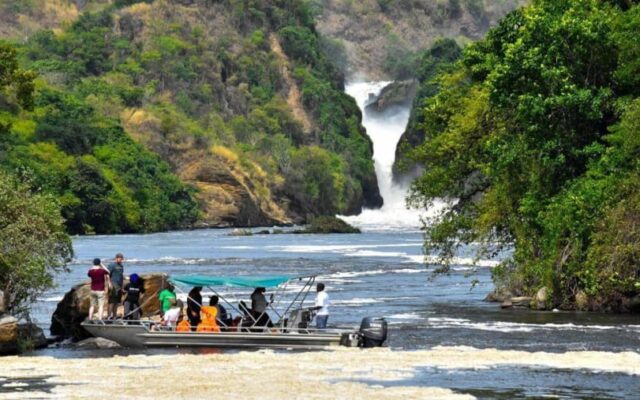
Murchison Falls National Park north-bank drives across Buligi and Victoria Nile approaches regularly produce secretary birds alongside Rothschild's giraffe and buffalo. Queen Elizabeth National Park offers sightings on Kasenyi Plains and in the Ishasha sector's fig-dotted grasslands. Kidepo Valley National Park — Uganda's most remote savannah — ranks among the finest destinations, with birds walking the Narus Valley floor against a backdrop of Morungole range mountains.
Habitat and Ecosystem
Secretary birds require open visibility. Short to medium grassland, lightly wooded savannah, and floodplain margins allow detection of insects, rodents, and reptiles on foot. Scattered trees provide nest platforms and night roosts. Explore our habitat guide for vegetation detail and territory ecology.
Hunting and Diet
Secretary birds are opportunistic carnivores. Snakes — including cobras and adders where present — feature prominently in folklore and field observation, but insects, locusts, rodents, lizards, and small birds form much of the daily intake. Family groups walking together can cover substantial distances during insect outbreaks. Read more on our diet page.
Behaviour
Diurnal and terrestrial, secretary birds spend most daylight hours on foot. Pairs maintain territories, perform mutual preening, and conduct spectacular aerial displays during courtship — soaring, diving, and calling with croaking and whistling notes. When prey is spotted, the transition from slow walk to rapid stomping is among the most dramatic behavioural sequences on a game drive. See our behaviour guide.
Conservation Status
The IUCN classifies the secretary bird as Endangered, with significant population declines documented across Africa. Habitat conversion to cropland, reduced prey from pesticide use, and collision with power lines threaten the species outside protected areas. Uganda's national parks remain essential strongholds. Details on our conservation page.
Best Time to See Secretary Birds
Secretary birds are visible year-round in Uganda's savannah parks. Dry seasons — roughly June to September and December to February — shorten grass and simplify spotting on open plains. Dawn game drives catch birds descending from roost trees to begin hunting. See best time to see secretary birds for monthly notes.
Safari Experiences
Secretary bird viewing requires no separate permit — sightings come on standard game drives in Murchison, Queen Elizabeth, and Kidepo. Birding-focused travellers should brief guides to scan plains systematically; Big Five itineraries often record secretary birds as memorable bonus sightings. Browse secretary bird safari experiences and Uganda safari packages.
Quick Facts
| Scientific name | Sagittarius serpentarius |
|---|---|
| Height | up to ~1.5 m; wingspan: up to ~2.2 m |
| Uganda strongholds | Murchison, Queen Elizabeth, Kidepo |
| IUCN | Endangered |
| Best viewing | dawn game drives on open savannah |