The vervet monkey is the primate most safari travellers meet before they ever reach a gorilla trailhead — a nimble, vocal Old World monkey whose black-masked face and silvery coat appear on woodland edges, lodge lawns, and game-drive tracks across Uganda's savannah parks. Scientifically known as Chlorocebus pygerythrus, the vervet belongs to a genus of adaptable African monkeys that thrive wherever acacia savannah meets riverine gallery forest. In Uganda, that means reliable encounters in Queen Elizabeth National Park, Murchison Falls National Park, and Lake Mburo National Park — often within minutes of leaving your lodge.
Unlike the great apes that demand permits and strenuous forest trekking, vervet viewing is spontaneous and democratic. A troop foraging beside Uganda kob on the Kasenyi Plains, juveniles wrestling in a fig tree above the Kazinga Channel, or a sentinel erupting into staccato alarm calls when a martial eagle passes overhead — these are the small dramas that colour every classic Uganda game drive. Understanding vervet society, vocalisations, and habitat preferences deepens appreciation of a species that is easy to overlook precisely because it is so common.
What Is a Vervet Monkey?
The vervet monkey is a medium-sized cercopithecid primate native to sub-Saharan Africa. European naturalists described the species in the eighteenth century from specimens collected in southern Africa, though its range extends across East Africa into Ethiopia and south through the continent. Several Chlorocebus species exist — including grivet, malbrouck, and tantalus monkeys — but the vervet proper, C. pygerythrus, is the form encountered throughout Uganda's savannah ecosystems.
- Kingdom: Animalia
- Phylum: Chordata
- Class: Mammalia
- Order: Primates
- Family: Cercopithecidae
- Genus: Chlorocebus
- Species: Chlorocebus pygerythrus
Vervets are diurnal, arboreal when feeding or resting, and terrestrial when moving between food patches or fleeing predators. Their versatility explains their abundance in protected areas and, increasingly, at the fringes of human settlement.
Physical Characteristics
Size and Build
Adult vervets weigh roughly 3.5 to 5.5 kilograms, with males slightly larger than females. Body length ranges from about 40 to 50 centimetres, with a tail often exceeding 60 centimetres that aids balance on thin branches. The build is light and athletic — designed for rapid climbing and sprinting across open ground.
Coat and Facial Markings
The coat is olive-grey to yellowish-green above, paler on the belly and inner limbs. The face is black with a distinctive white band of fur above the eyes and on the cheeks — the "mask" that makes vervets instantly recognisable on game drives. Hands and feet are black; the tail is dark-tipped.
Sexual Dimorphism
Males carry turquoise-blue skin on the scrotum and perineum — a striking field mark visible when animals sit or move on the ground. Canine teeth are larger in males, reflecting dominance competition within troops.
Where Vervet Monkeys Live in Uganda
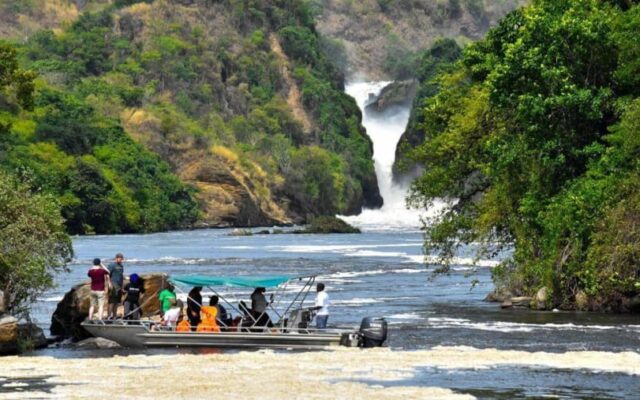
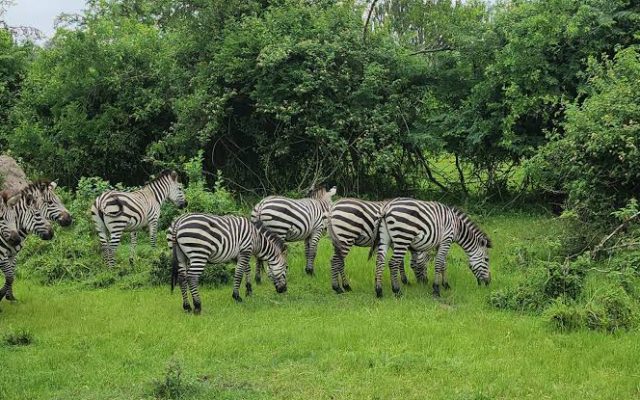
Vervets are widespread across Uganda's savannah protected areas. Queen Elizabeth National Park supports large populations along the Kazinga Channel, Kasenyi Plains, and Ishasha woodland margins. Murchison Falls National Park holds troops in Rabongo Forest, along the Nile, and on north-bank Borassus grassland edges. Lake Mburo National Park offers acacia-hill encounters often combined with impala and zebra on the same drive.
Lodge grounds throughout these parks frequently host semi-habituated troops accustomed to human presence — rewarding for photography but requiring sensible food storage and distance. See our where to see vervet monkeys guide for sector-by-sector detail.
Habitat and Ecosystem
Vervets favour woodland–savannah ecotones, riverine galleries, and acacia margins where trees provide sleeping sites and escape routes while open ground supplies grasses, herbs, and fallen fruit. Water proximity matters — troops drink daily when surface water is available. Explore our habitat guide for vegetation types and seasonal movement.
Social Structure and Troop Life
Vervet society centres on multi-male, multi-female troops typically numbering 20 to 50 individuals, though groups can exceed 70 where food is abundant. A dominance hierarchy among males shapes access to mates; females maintain matrilineal bonds across generations. Grooming reinforces alliances, reduces tension, and controls parasites — a constant background activity visible from safari vehicles.
Alarm Calls
Vervets possess one of the most sophisticated predator-alarm systems documented in non-human primates. Distinct vocalisations signal aerial predators (martial eagles, crowned eagles), terrestrial carnivores (leopard, python), and snakes — each triggering different escape responses in the troop. Guides who know vervet language sometimes locate leopards by following alarm choruses through woodland. Read more on our behaviour page.
Diet
Vervets are omnivorous generalists. They consume fruits, flowers, seeds, leaves, gum, insects, and occasionally bird eggs or small vertebrates. Seasonal shifts track fruiting figs, acacia pods, and grass seed availability. This dietary breadth supports large troops across varied savannah. Details on our diet page.
Predators and Ecological Role
Leopard, martial eagle, crowned eagle, python, and occasionally chimpanzee prey on vervets. As seed dispersers and insect predators, vervets influence woodland regeneration and invertebrate populations. Their alarm calls also benefit other prey species — a vervet chorus often alerts antelope herds to danger.
Conservation Status
The IUCN classifies vervet monkeys as Least Concern globally, with stable populations across much of sub-Saharan Africa. Uganda's protected savannah parks maintain healthy numbers, but crop-raiding at park boundaries and lodge food dependency pose local challenges. See our conservation page.
Best Time to See Vervet Monkeys
Vervets are visible year-round. Dry seasons — roughly June to September and December to February — simplify game-drive access and concentrate wildlife near water. Dawn and late afternoon align with peak foraging and social activity. See best time to see vervet monkeys for monthly notes.
Safari Experiences
Vervet encounters require no extra permits — they unfold on standard game drives, Kazinga Channel boat cruises, and Murchison Nile launches. Combine savannah primate viewing with chimpanzee trekking or mountain gorilla experiences for Uganda's full primate portfolio. Browse vervet monkey safari experiences and Uganda safari packages.
Quick Facts
| Scientific name | Chlorocebus pygerythrus |
|---|---|
| Signature field marks | Black face with white brow band; long dark-tipped tail |
| Troop size | Typically 20–50 individuals; multi-male groups |
| Famous for | Distinct alarm calls for leopard, eagle, and snake |
| Uganda strongholds | Queen Elizabeth, Murchison Falls, Lake Mburo |
| IUCN | Least Concern globally |
| Viewing | No permit required — standard game drives and lodge grounds |
| Often seen with | Uganda kob, buffalo, baboon, and woodland birds |