Explore this species across our facts guide, where to see page, and safari planning resources — plus parks such as Queen Elizabeth National Park.
Spotted hyena habitat spans a remarkable range of African ecosystems — from semi-arid bush and open grassland to montane forest edges and rocky kopjes. In Uganda, the species concentrates in savannah national parks where prey is abundant, den sites are available, and clan territories can be defended year-round. Understanding where hyenas live — and why they choose particular landscapes — helps safari planners target the right parks, seasons, and drive times.
Range Across Africa
Spotted hyenas occur throughout sub-Saharan Africa, absent only from the densest equatorial rainforests and the most extreme deserts. Their range extends from Senegal and Mali in West Africa eastward through the Sahel, across the East African savannah belt, and southward into Botswana, Namibia, and South Africa. Population densities vary enormously — from fewer than one hyena per 100 square kilometres in marginal habitat to more than 70 per 100 square kilometres in prey-rich areas such as Tanzania's Ngorongoro Crater.
Preferred Habitat Types
Spotted hyenas are habitat generalists within the savannah biome. They thrive in:
- Open grassland — ideal for cooperative hunting and long-distance whoop communication
- Acacia woodland and bush savannah — provides shade, den sites, and edge habitat for ambush hunting
- Floodplains and valley grasslands — concentrate prey during seasonal movements
- Rocky kopjes and escarpments — offer den cavities and vantage points
- Montane forest edges — peripheral habitat in parks such as Mgahinga, where hyenas occur at lower density
Hyenas avoid closed-canopy rainforest but will traverse woodland corridors and riverine thickets when moving between hunting grounds.
Territory and Clan Ranges
Each spotted hyena clan defends a communal territory whose size depends on prey density, clan size, and neighbouring competition. In prey-rich areas, clan territories may span 40–80 square kilometres. In marginal habitat, territories can exceed 1,000 square kilometres. Clan members patrol boundaries through scent marking — pasting sticky secretions from anal glands onto grass stems — and through vocal advertisement, particularly the long-distance whoop call.
Territorial boundaries are not rigid walls but zones of negotiation. Clans interact at borders, and individual hyenas — especially dispersing males — may cross into neighbouring territories under certain conditions.
Den Sites
Spotted hyenas give birth and rear cubs at communal den sites, typically abandoned aardvark burrows, rocky crevices, or holes dug into termite mounds. Den sites are often used for generations, with multiple females bringing cubs to the same location. In Uganda, den sites on the Kasenyi Plains of Queen Elizabeth National Park have been monitored for years by researchers from the Uganda Carnivore Program.
Dens are social hubs. Cubs of different mothers interact, play, and establish early dominance relationships long before they join adults on hunts. Den attendance is highest during the first three months of cub life, after which youngsters begin accompanying adults on foraging trips.
Uganda Habitat — Park by Park
Queen Elizabeth National Park
Queen Elizabeth offers Uganda's richest spotted hyena habitat. The Kasenyi Plains — open grassland east of the Kazinga Channel — support multiple clans with overlapping territories. Prey density is high thanks to large Uganda kob populations, and the park's varied mosaic of grassland, woodland, and volcanic crater lakes provides year-round resources. Night drives reveal hyena activity that daylight visitors miss entirely.
Murchison Falls National Park
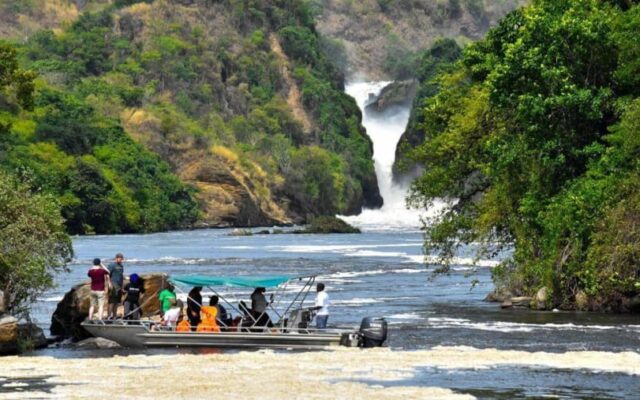
Murchison's northern savannah — particularly the Buligi Peninsula and open plains north of the Nile — hosts healthy hyena populations alongside lions, leopards, and buffalo. Riverine woodland along the Nile corridor provides den sites and hunting cover. Habitat here is drier and more open than Queen Elizabeth, favouring long-range hunting across grassland.
Kidepo Valley National Park
Remote Kidepo Valley in northeastern Uganda offers semi-arid savannah habitat with dramatic open plains between the Narus and Kidepo valleys. Hyena clans here are less studied than those in Queen Elizabeth but are regularly encountered on game drives, particularly in the Narus Valley where prey concentrates during the dry season.
Lake Mburo National Park
Lake Mburo's acacia woodland and open grassland support a smaller hyena population. Sightings occur but are less predictable than in Queen Elizabeth or Murchison. Hyenas here tend to be shy and nocturnal, reflecting both lower prey density and higher human activity near park boundaries.
Prey Availability and Habitat Quality
Habitat quality for spotted hyenas is defined primarily by prey biomass. Clans require sustained access to medium-to-large ungulates — antelope, zebra, warthog, and buffalo calves — to maintain reproductive output and territorial defence. Where prey declines due to poaching, habitat conversion, or livestock competition, hyena populations contract and clan sizes shrink.
In Uganda's protected areas, prey populations remain relatively healthy, supporting stable hyena clans. The coexistence of hyenas, lions, and leopards across shared habitat creates competitive dynamics that shape hunting behaviour, kill ownership, and daily movement patterns.
Seasonal Habitat Use
Spotted hyenas do not migrate, but they adjust habitat use seasonally. During the dry season, clans concentrate near permanent water sources and prey-rich grassland where ungulates gather. During wetter months, hyenas range more widely as prey disperses into longer grass. Den attendance patterns also shift — cubs born at the start of the dry season benefit from concentrated prey when they begin foraging with adults.
Threats to Habitat
Outside protected areas, spotted hyena habitat is fragmented by agricultural expansion, livestock grazing, and human settlement. Hyenas that prey on livestock face retaliatory killing, snaring, and poisoning. Inside Uganda's national parks, habitat remains largely intact, though encroachment pressure at park boundaries is an ongoing management concern. Conservation details are covered on our spotted hyena conservation page.