Mantled guereza facts — expert Uganda safari guide from local planners who know permits, parks, and realistic routing.
The mantled guereza is among the most visually arresting primates on any Uganda forest safari — a large colobus whose jet-black body is framed by a flowing white mantle, whiskered face, and extravagantly tufted tail. In Kibale National Park, Budongo Forest, and Bwindi Impenetrable National Park, guereza appear on the same trails where visitors track chimpanzees and gorillas, offering instant photographic reward without additional permits. This guide covers essential habitat, biology, and field marks of Colobus guereza, with links to where to see mantled guereza and safari experiences across western Uganda.
Uganda's Elegant Black-and-White Colobus
Across East Africa, mantled guereza inhabit rainforest from Ethiopia and Kenya south through Uganda, Rwanda, Tanzania, and parts of Central Africa. They are not the rarest primate on the continent, nor the largest, but their combination of bold patterning, calm demeanour, and accessibility on forest walks makes them a favourite of photographers and first-time primate visitors. In Uganda — where thirteen primate species share Kibale alone — the guereza still stands out as the definitive black-and-white colobus.
Visitors sometimes confuse guereza with red colobus, which also occur at Kibale and Bigodi. Red colobus wear reddish-brown coats and belong to a different genus. Mantled guereza are unmistakable: black with white mantle, white tail, and no thumb visible on the hand.
Scientific Classification
The mantled guereza belongs to the subfamily Colobinae — the leaf-eating monkeys that include Asian langurs and African colobus. Eight or more subspecies are recognised across the species' broad range. Uganda's western forests generally hold Colobus guereza occidentalis, the western guereza, though taxonomic boundaries shift with ongoing genetic research.
The genus name Colobus derives from Greek meaning "mutilated" — a reference to the absent thumb. The species epithet guereza reflects Abyssinian highland origins in early European descriptions.
Physical Description
Mantle and Tail
The defining feature is the mantle — long white hair extending from the shoulders along the flanks, often rippling as animals move through canopy. The tail equals or exceeds body length, ending in a dense white tuft used for balance during leaps between branches. Together, mantle and tail create a silhouette unlike any other Ugandan primate.
Face and Whiskers
The face is dark with a white brow band and long white whiskers that frame the cheeks. Eyes are forward-facing, suited to depth perception during arboreal travel. Expression appears serene — guereza lack the restless energy of smaller guenons.
Sexual Dimorphism
Males are modestly larger than females and carry slightly longer canines. Both sexes share the same black-and-white patterning. Longevity in the wild may reach fifteen years or more, though predation limits many individuals earlier.
Arboreal Anatomy
Guereza are built for life in the trees. Long forelimbs, reduced thumbs, and powerful hind legs support brachiation and leaping between branches. The multi-chambered stomach — essential for leaf digestion — adds abdominal bulk that distinguishes colobus from fruit-eating monkeys of similar size.
Ground travel is rare. Visitors should scan mid-storey and canopy levels rather than forest floor when searching for troops on Kibale or Budongo trails.
Range and Distribution
Mantled guereza range across equatorial Africa from eastern Nigeria and Cameroon east through the Albertine Rift and into Ethiopia. In Uganda, they occur in lowland and montane rainforest blocks of the west and southwest, with records from Semuliki gallery forest, Kibale, Budongo, Bwindi, and smaller forest reserves linking these cores.
They are absent from Uganda's open savannah parks — Queen Elizabeth and Murchison Falls savannah sectors do not hold colobus, though Budongo Forest on the Murchison circuit is a major stronghold.
Senses and Communication
Guereza rely on sharp vision for canopy navigation and predator detection. Male roaring — a deep, resonant call at dawn and dusk — advertises troop presence and male quality across forest valleys. Grunts, tongue-clicks, and snorts maintain contact within troops moving through dense foliage.
Ecological Role
As folivores, guereza shape canopy vegetation through selective browsing of young leaves. They are prey for leopards and crowned hawk-eagles — forest specialists that depend on arboreal monkeys. Healthy guereza populations indicate structurally intact rainforest with sufficient large trees for troop movement.
Reproduction and Lifespan
Females typically produce a single infant after roughly five to six months of gestation. Births may peak during rainy seasons when fresh leaves support lactation. Infants are born white and acquire adult black-and-white patterning over several weeks — a striking sight when mothers carry pale young through green canopy.
IUCN Conservation Status
Mantled guereza are classified Least Concern globally, with a stable population across a wide range. Uganda's populations are secure within protected forests but vulnerable to habitat fragmentation outside park boundaries — a pattern that makes Kibale, Budongo, and Bwindi protection nationally significant.
How Guereza Compare to Other Ugandan Primates
- Red colobus: Reddish coat, different genus; shares Kibale and Bigodi
- L'Hoest's monkey: Dark forest guenon; shy, terrestrial at times
- Grey-cheeked mangabey: Grey-brown, tufted crown; fast-moving canopy troops
- Common chimpanzee: Great ape; separate trekking permit required
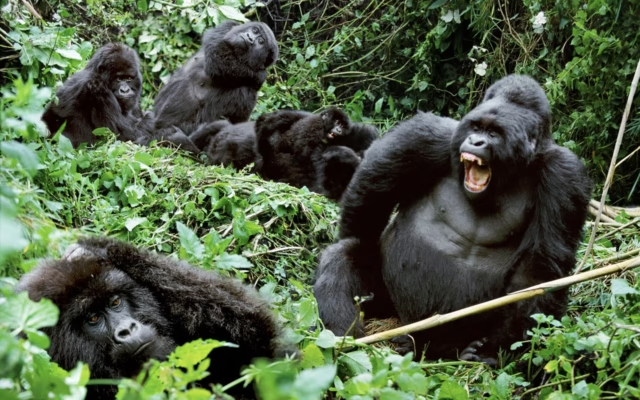
- Mountain gorilla: Ground-dwelling great ape; Bwindi and Mgahinga only
Why Safari Travellers Love Mantled Guereza
Guereza are approachable on habituated trails, photogenic in any light, and require no extra permit beyond standard park entry or chimpanzee trekking fees. They transform a chimpanzee trek morning into a multi-species primate day and reward patient Bigodi walkers with close canopy views. For travellers building Uganda's classic primate circuit, the mantled guereza is often the first colobus — and rarely the last they photograph.
Quick Reference Facts
- Scientific name: Colobus guereza
- Uganda strongholds: Kibale, Bigodi, Budongo, Bwindi
- Adult weight: ~9–14 kg (males larger)
- Tail length: Up to ~90 cm
- Diet: Specialist leaf-eater (folivore)
- Gestation: ~5–6 months
- IUCN: Least Concern
- Distinctive trait: No thumbs; white mantle and tail