Wildlife, ecology, and landscape at Lake Katwe
Lake Katwe sits in the Katwe–Kikorongo explosion crater field on the western edge of Queen Elizabeth National Park, a short drive from Mweya, Katwe village, and the corridors linking Lake Edward with Lake George. Unlike the open rift lakes where hippos and buffalo dominate visitor stories, Katwe is a closed volcanic crater filled with brine so concentrated that fish cannot survive. The wildlife conversation here is about extremophile ecology, seasonal flamingos, rift scenery, and how human salt economies have coexisted with this landscape for generations.
Most travelers reach Katwe on a half-day extension after a game drive or before a Kazinga Channel boat — not because the crater competes with Ishasha lions or Kyambura chimps, but because it answers a different question: how do communities live inside one of Africa's great protected-area geographies when the resource they depend on is salt, not timber or tourism lodges?
Saline chemistry and what can live here
The hyper-saline water of Lake Katwe comes from underground springs and long evaporation cycles within the crater depression. Salinity fluctuates with rainfall and pan management, but the lake remains fundamentally hostile to conventional freshwater fish assemblages. Instead, microbial life, algae, and invertebrates adapted to salty conditions underpin a narrow food web. When water levels and chemistry align, brine shrimp and algae blooms can support wading birds — especially flamingos — though numbers are variable and should never be promised as a daily spectacle.
Nearby Lake Munyanyange, often discussed in the same Katwe outing, is a shallow seasonal lake famous for lesser flamingo congregations when conditions suit. Guides sometimes pair Munyanyange flamingo scanning with Katwe salt interpretation on one route. Treat flamingo viewing as a bonus: wind, water depth, and disturbance from salt work can change visibility hour to hour.
Flamingos, waterbirds, and crater margins
Lesser flamingos draw photographers when present, filtering microscopic food from alkaline shallows. Greater flamingos occur less predictably. Other water-associated species — stilts, plovers, sandpipers, herons, and raptors overhead — appear on crater rims and seasonal pans rather than inside the main mining pools. Because Katwe is compact, birding is often done on foot near the rim and village approach roads with a guide who knows which pans are active and which edges are unsafe.
Compared with Mabamba Swamp papyrus specialists or Bigodi Wetland forest-edge lists, Katwe offers rift crater birding in an industrial-cultural setting. Lists are shorter, but the habitat story is distinctive: alkaline pans beside savannah woodland that still holds park-edge mammals after dark.
Mammals and Queen Elizabeth park-edge context
You will not plan Katwe for elephant or lion viewing, yet the crater lies inside the wider Queen Elizabeth ecosystem. Buffalo, elephant, and antelope use savannah woodland between Katwe village, the Kazinga corridor, and explosion crater rims — especially during early morning or late afternoon transits. Night drives are not standard at Katwe itself; instead, travelers often see mammals on the drive in from Mweya or when returning toward Kyambura Gorge.
Warthogs, baboons, and smaller mammals occur around village margins and roadside habitats. Hippos belong to Edward and George, not Katwe's brine pools. Keeping expectations accurate prevents disappointment: Katwe is a cultural-ecological stop where megafauna may appear en route, not a dedicated big-game arena.
Traditional salt mining as a living landscape
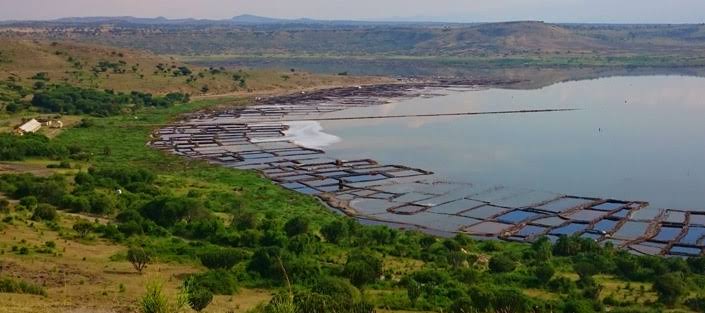
The defining human feature is traditional salt extraction. For centuries, communities have evaporated brine in pans, harvested crystallized salt, and carried product to regional markets. Workers — historically many women — wade into corrosive water using poles and split canoes, breaking salt crusts under intense sun. The work is physically demanding; responsible tourism means observing with permission, hiring local guides, and avoiding sensational photography that treats labor as backdrop without context.
Salt supports household income, school fees, and local trade networks tied to Kasese and park-edge towns. When you visit Katwe, you are seeing a working resource, not a museum exhibit. Pans expand and contract with market demand, seasons, and family plots. Guides explain which areas are active, where footing is safe, and how evaporation cycles interact with crater water levels.
Crater morphology and scenery
Katwe is one of numerous explosion craters dotting the Queen Elizabeth volcanic field — steep rims, circular depressions, and views across savannah toward the Rwenzori foothills on clear days. Photography rewards wide-angle rim shots, telephoto details of salt textures, and human-scale scenes of pan work when ethically arranged. Midday sun is harsh; morning and late afternoon improve contrast and worker comfort if community access allows.
Combining Katwe with a Kazinga Channel cruise the same day gives a sharp contrast: open hippo waterways in the morning, saline crater culture in the afternoon — or the reverse, depending on heat and boat schedules.
Conservation, park boundaries, and responsible visits
Queen Elizabeth's management framework surrounds Katwe, but village life and salt economies continue inside a complex land-use mosaic. Visitors should follow guide instructions on where walking is permitted, avoid stepping into unstable crusts or deep brine channels, and never remove salt samples without local agreement. Litter and sunscreen runoff into pans disrespect both ecology and workers.
Tourism income through guides, tips, and community arrangements can reinforce dignified interpretation if operators return value to Katwe households rather than treating the site as a free scenic pull-off. Ask your safari planner whether the visit includes a structured community guide and how fees are distributed.
How Katwe fits a wider western Uganda safari
Katwe rewards travelers who want depth on a Queen Elizabeth itinerary — a human story beside wildlife checklist tourism. Pair it with Lake Edward channel ecology, Lake George waterbird context, and optional Kyambura Gorge chimps on separate mornings. Longer circuits link onward to Fort Portal, Kibale, or Bwindi depending on direction.
For planning detail, see our guides on Lake Katwe bird watching, best time to visit, and how to get there — each covers a different angle of the same crater visit.