
Uganda Mangabey FAQs and Answers — quick answers on endemic range, Mabira and Kibale viewing, endangered status, grey-cheeked differences, and safari planning. Explore where to see Uganda mangabeys, behaviour, best time to visit, and safari experiences.
Uganda mangabey faqs — expert Uganda safari guide from local planners who know permits, parks, and realistic routing.
Uganda mangabeys are an Endangered species endemic to Mabira, Kibale, and Bugoma forests. For field identification, diet, and conservation context, see our facts and conservation guides — or compare with the wider-ranging grey-cheeked mangabey on combined primate walks.
- What is a Uganda mangabey?
The Uganda mangabey (Lophocebus ugandae) is an endemic forest monkey found only in Uganda. Medium-sized and arboreal, it lives in social troops within moist evergreen and semi-deciduous forests such as Mabira Forest Reserve and Kibale National Park.
- Where can I see Uganda mangabeys?
Mabira Forest Reserve is the flagship central Uganda site. Kibale National Park and Bugoma Forest Reserve hold western populations. See our where to see Uganda mangabeys guide for site-by-site detail.
- Are Uganda mangabeys found outside Uganda?
No. The species is endemic — every wild population occurs inside Uganda only. You cannot see Uganda mangabeys in Kenya, Tanzania, Rwanda, or the DRC. Plan a Uganda forest itinerary specifically.
- How do Uganda mangabeys differ from grey-cheeked mangabeys?
Uganda mangabeys (L. ugandae) are a distinct species recognised in 2007, found only in Uganda. Grey-cheeked mangabeys (L. albigena) range across central Africa and are commonly cited at Kibale's Bigodi Wetland. Range and taxonomy are the clearest differences for visitors.
- Do I need a permit to see Uganda mangabeys?
No dedicated mangabey permit exists. Sightings occur on guided forest walks at Mabira, during chimpanzee trekking approaches at Kibale, or on Bugoma ecotourism walks. Standard forest entry and guiding fees apply — unlike habituated great-ape trekking permits.
- Are Uganda mangabeys endangered?
Yes — the IUCN classifies the Uganda mangabey as Endangered. Habitat fragmentation, snaring, and forest loss threaten fragmented populations. See our conservation page.
- What is the scientific name of the Uganda mangabey?
Lophocebus ugandae — a crested mangabey species endemic to Uganda, elevated from grey-cheeked mangabey taxonomy in 2007.
- Can I see Uganda mangabeys on a chimpanzee trek?
Often yes at Kibale — troops may be encountered on approach trails during chimpanzee trekking, though chimps are the permit focus. A dedicated forest walk on a second morning improves mangabey odds.
- Is Mabira the best place for Uganda mangabeys?
Mabira Forest Reserve is the best-known and most accessible central Uganda site — ideal for day trips from Kampala. Kibale offers the largest protected western block. Both are essential strongholds.
- When is the best time to see Uganda mangabeys?
Year-round with peak comfort in dry seasons (June–September and December–February). Dawn walks maximise activity. See best time to see Uganda mangabeys.
- How big are Uganda mangabeys?
Adults weigh roughly 5–10 kg with head-and-body length around 40–60 cm, plus a long balancing tail. Males are slightly larger than females.
- What do Uganda mangabeys eat?
Primarily fruit — especially figs — supplemented with seeds, leaves, flowers, and insects. Diet detail on our Uganda mangabey diet page.
- How many Uganda mangabeys are left?
Population estimates vary with survey coverage across fragmented forests, but likely total only a few thousand individuals — a tiny global population confined to Uganda. Accurate counts require ongoing research at Mabira, Kibale, Bugoma, and smaller fragments.
- Can I combine Mabira with Jinja or Kampala?
Yes — easily. Mabira sits on the Kampala–Jinja highway. A dawn forest walk pairs naturally with Nile adventure activities or a Kampala overnight. Ideal central Uganda primate stop.
- Are Uganda mangabey walks suitable for families?
Mabira walks suit families with children who can walk quietly for two to three hours on uneven trails. Kibale chimp trekking has age limits; forest nature walks may be more flexible — confirm with operators.
- What should I pack for Uganda mangabey forest walks?
Sturdy closed shoes, long sleeves, rain jacket, insect repellent, binoculars, and water. The same kit serves chimpanzee trekking at Kibale.
- Which Uganda safaris include Uganda mangabeys?
Itineraries visiting Mabira, Kibale, or Bugoma can include mangabey forest time. Browse Uganda mangabey safaris and Uganda safari packages.
- Can I combine gorilla trekking with Uganda mangabey viewing?
Yes. Classic circuits run Mabira or Kibale (mangabeys and chimps) before or after Bwindi gorilla trekking. Most 10–12 day primate itineraries can include endemic forest time.
- Why are Uganda mangabeys important for conservation?
As a Uganda-only endemic, the species is a flagship for rainforest protection at Mabira, Kibale, and Bugoma. Losing forest fragments means global extinction — not just local decline. Tourism revenue supports guards and communities defending habitat.
- How can tourists help Uganda mangabey conservation?
Visit forests on licensed guided walks, pay official fees, never feed wild monkeys, and choose operators supporting local guides. Read our conservation page for full context.
Safari packages to see Uganda Mangabey
Bookable itineraries below include parks and activities where you are most likely to encounter Uganda Mangabey in the wild.
 Best
Seller
Best
Seller
3 Day Uganda Gorilla Trekking Safari
You visit
Bwindi Forest, Entebbe
This private Uganda gorilla trekking safari is a focused 3-day Uganda gorilla trekking road trip: a full-day mountain gorilla trek in Bwindi Impenetrable National Park—a UNESCO rainforest where roughl…
 Best
Seller
Best
Seller
5 Day Gorilla & Chimp Safari
You visit
Kibale Forest, Bwindi Forest, Entebbe
Combine Bwindi gorilla trekking with Kibale chimpanzee tracking.
 Best
Seller
Best
Seller
6 Days Uganda Gorillas, Chimpanzees & Wildlife Safari
You visit
Kibale Forest, Queen Elizabeth NP, Bwindi Forest, Entebbe
Primates plus plains in six days: Kibale chimps, Queen Elizabeth savannah, Bwindi gorillas and a Lake Mburo finale for zebra — the full Uganda highlight reel without rushing Kidepo or Murchison.
 Best
Seller
Best
Seller
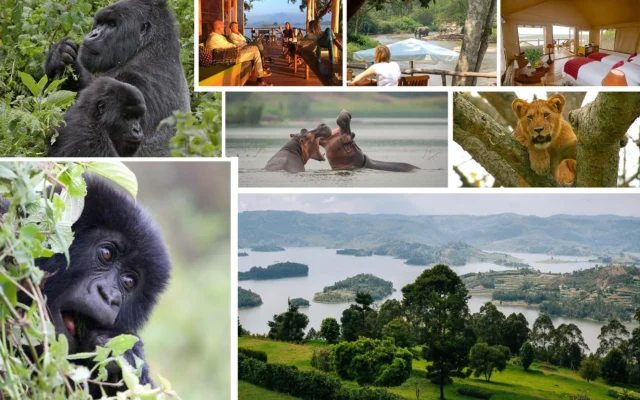
7 Day Uganda Wildlife & Gorilla
You visit
Murchison Falls, Kibale Forest, Queen Elizabeth NP, Bwindi Forest, Entebbe
Seven days with gorillas: the wildlife tour above plus Bwindi trekking on Day 6 — the single most booked private itinerary for Uganda Safari Tours guests who want chimps, savannah and gorillas in one…