Red-tailed monkey conservation in Uganda sits at the intersection of favourable global status and locally concentrated forest dependence. Classified Least Concern across Central Africa, Cercopithecus ascanius remains abundant inside Kibale National Park, Budongo Forest Reserve, and Semuliki National Park — yet entirely vulnerable to the habitat loss and snaring that threaten all western Uganda primates. This guide explains protection frameworks, threats, tourism benefits, and how red-tailed monkeys fit the wider chimpanzee and forest conservation story on habitat and safari circuits.
IUCN Status and Population Outlook
The IUCN Red List assesses red-tailed monkeys as Least Concern because of wide distribution across equatorial Africa and large overall numbers. The species is not approaching thresholds for Vulnerable listing at continental scale. National outlooks can differ: Uganda's populations are secure inside well-managed reserves but absent from landscapes where forest has been replaced by agriculture. Local abundance should not be mistaken for invulnerability — many Least Concern forest species have declined sharply in fragmented regions of the Congo basin.
Population trend is generally considered stable in protected areas with active law enforcement. Outside parks, hunting and habitat clearance continue to erode connectivity between forest blocks.
Protected Areas in Uganda
Uganda Wildlife Authority manages Kibale and Semuliki national parks; Budongo Forest Reserve operates under National Forestry Authority with Uganda Wildlife Authority collaboration on tourism and chimpanzee research. Together these areas shelter the country's most reliable red-tailed monkey populations.
- Kibale National Park — flagship primate reserve; decades of research and chimp tourism
- Budongo Forest Reserve — major mahogany forest; Kaniyo Pabidi chimp programme
- Semuliki National Park — lowland Congo-basin forest on the Albertine Rift floor
- Bigodi Wetland Sanctuary — community conservancy on Kibale margin; habituated troops
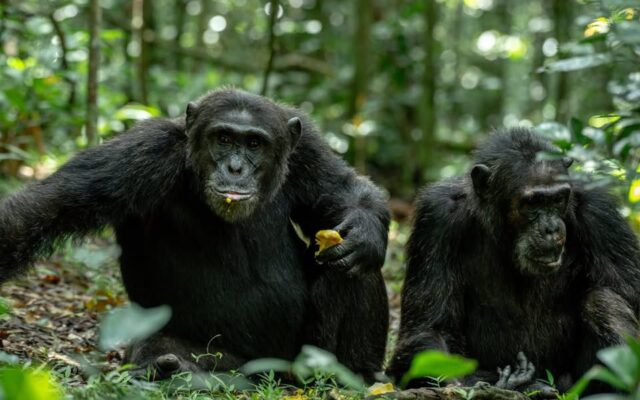
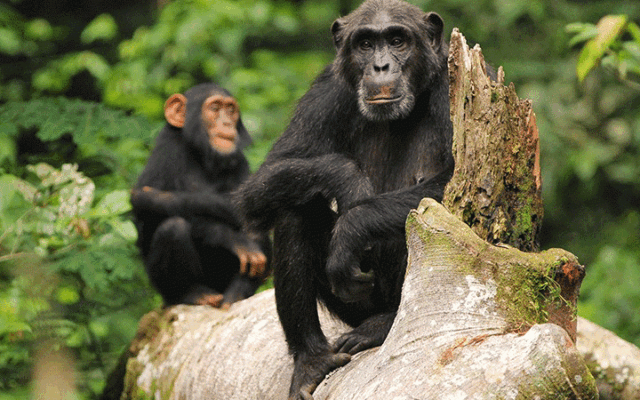
Red-tailed monkeys benefit from umbrella protection aimed at chimpanzees, elephants, and flagship birds — a reminder that conserving apex tourism species secures entire primate communities.
Habitat Loss and Fragmentation
Western Uganda faces steady pressure to convert forest to farmland, tea, and settlement. Fragmentation isolates troops, reduces genetic exchange, and increases edge exposure to snares and domestic dogs. Corridor protection between Kibale, wildlife forest reserves, and community woodlots is an ongoing conservation priority discussed in regional land-use planning — not always visible to visitors but fundamental to long-term guenon security.
Climate change adds uncertainty: shifting rainfall may alter fruiting phenology, stressing frugivores whose reproduction tracks food abundance. Long-term monitoring at Kibale provides baseline data for detecting such shifts.
Snaring and Bushmeat Hunting
Wire snares set for duiker and bush pigs kill or maim primates indiscriminately. Red-tailed monkeys caught in snares suffer limb injuries that prevent climbing — effectively a death sentence. Anti-poaching patrols and snare removal programmes operate in Kibale and Budongo; tourism revenue helps fund ranger presence. Visitors should report snares to guides immediately and never purchase bushmeat — a demand driver that sustains illegal hunting at forest margins.
Research and Monitoring
Kibale's primate research tradition — including studies of guenon ecology, predator–prey dynamics, and seed dispersal — generates knowledge that informs management. Red-tailed monkeys are abundant enough to feature in long-term datasets without targeted capture programmes. Research tourism and university partnerships strengthen the scientific case for maintaining full forest blocks rather than degraded fragments.
Tourism as a Conservation Tool
Chimpanzee trekking permits, park entry fees, and community programmes such as Bigodi channel revenue into conservation and local livelihoods. Red-tailed monkeys do not generate separate permit income, but they enrich the visitor experience that justifies forest protection economically. Lodges employing community members create alternatives to poaching and illegal timber extraction.
Responsible tourism practices — staying on trails, not feeding animals, maintaining distance, and choosing licensed operators — reduce stress on habituated troops and model low-impact forest use.
Community Conservancies
Bigodi Wetland Sanctuary demonstrates community-led conservation adjacent to Kibale. Guided boardwalks employ local guides; habituated red-tailed monkeys along the forest margin illustrate how buffer-zone management can extend habitat value beyond formal park boundaries. Similar models are discussed for other western Uganda forest edges, though implementation varies.
Regional Context
Red-tailed monkeys occur in Rwanda, Burundi, DRC, Tanzania, and beyond — populations are connected genetically only where forest corridors remain. Transboundary cooperation in the Albertine Rift aims to align protected-area management across political boundaries. Species like red-tailed monkeys, too common for single-country listing campaigns, depend on this landscape-scale thinking.
Captive Trade and Pet Trade
International trade in wild-caught primates is regulated under CITES; red-tailed monkeys are not prominent in the exotic pet market compared with larger apes or some parrots. Domestic pet keeping of wild monkeys occurs occasionally and carries disease risks including zoonotic transmission. Legal protection and public education discourage removal of infants from troops — an act that kills mothers and orphans socially incompetent juveniles.
Conservation Success Indicators
Healthy red-tailed monkey sightings along main trails indicate functioning fruit webs, intact canopy, and effective anti-snaring effort. Declining encounter rates would signal deeper ecosystem stress before rarer species disappear. Guides and researchers who walk the same paths daily are informal monitors — their observations complement formal surveys.
How Travellers Can Help
- Choose licensed operators who pay park fees and employ local guides
- Visit community conservancies such as Bigodi
- Never feed, touch, or pursue monkeys for photographs
- Report snares or illegal activity to rangers
- Avoid bushmeat and products from illegal timber
- Combine visits with chimpanzee trekking that funds core forest protection
Conservation Summary
Red-tailed monkeys are a conservation success inside Uganda's protected moist forests — common, visible, and secure where rangers patrol and tourism pays. Their future depends on the same forest matrix that sustains chimpanzees and Albertine Rift endemics. Supporting western Uganda's primate circuit is among the most direct actions travellers can take for Cercopithecus ascanius and the wider canopy community it represents.