Giant forest hog conservation sits at the intersection of global stability and local forest pressure. Hylochoerus meinertzhageni is classified Least Concern across a wide Central and West African range, yet every sounder depends on intact moist forest with soft ground for rooting and reliable wallows. Uganda's Kibale National Park and Queen Elizabeth National Park forest sectors remain important eastern strongholds. Link to habitat, where to see giant forest hogs, and safari experiences.
IUCN Status and Population Trends
The giant forest hog is listed Least Concern on the IUCN Red List, reflecting a broad African distribution from West Africa through the Congo basin to East African highland forests. Population trend is presumed stable in large protected landscapes, though precise counts are difficult because the species is secretive and forest-dwelling.
Least Concern does not mean locally secure. Forest hogs disappear quickly where moist woodland is cleared for agriculture, where snare lines target ground mammals, or where bushmeat demand rises on park margins. Uganda's tourism forests provide refuge that many unprotected forest blocks no longer offer.
Taxonomy and Regional Conservation Units
Uganda's populations belong to the East African forest form of Hylochoerus meinertzhageni, connected to wider humid forest networks across the Albertine Rift. Protecting Kibale rainforest and Queen Elizabeth's Maramagambo and Kyambura corridors protects hog habitat alongside chimpanzees, leopard, and forest elephants — a shared conservation landscape rather than a single-species reserve.
Habitat Loss — The Primary Threat
Outside protected areas, forest conversion to tea, cocoa, and subsistence agriculture fragments hog range. Even within park buffers, illegal logging and charcoal production shrink forest patches. Giant forest hogs cannot persist in open farmland or isolated ornamental woodland without rooting substrate, wallows, and escape cover — requirements that make them sensitive indicators of forest integrity.
Snaring and Bushmeat Pressure
Wire snares set for antelope and duiker kill giant forest hogs as by-catch. Hogs are also targeted deliberately for bushmeat in some regions because of their large body size. Uganda Wildlife Authority anti-poaching patrols in Kibale and Queen Elizabeth benefit all ground-dwelling mammals, including sounders that use forest tracks where snare lines are sometimes laid.
Protected Areas and Management
Uganda Wildlife Authority manages Kibale National Park and Queen Elizabeth National Park, including Maramagambo Forest and Kyambura Gorge sectors. Ranger patrols, research access roads used for tourism forest drives, and regulated chimpanzee trekking help maintain the moist forest ecosystems hogs require.
Community conservation at Bigodi Wetland Sanctuary protects forest–wetland ecotone habitat where hogs move between rainforest interior and papyrus margins — an example of buffer-zone management that extends protection beyond formal park boundaries.
Predation and Natural Mortality
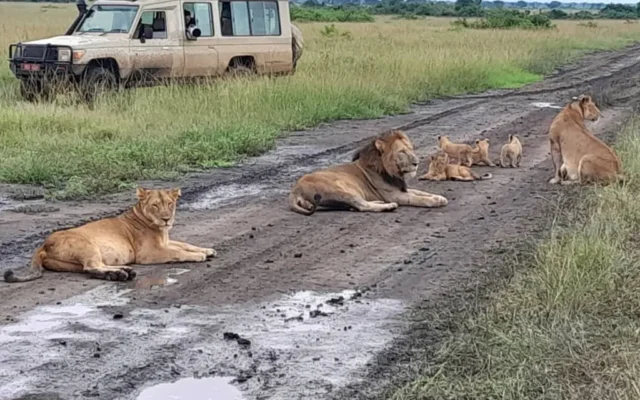
Leopard are the primary natural predator of giant forest hogs in Uganda's forest parks. Lion occasionally prey on hogs where Ishasha woodland meets open grassland. Predation is part of healthy forest ecology; the conservation concern is human-driven mortality and habitat loss, not natural predator–prey dynamics.
Climate Change
Altered rainfall patterns may shift wallow distribution, understorey composition, and fruiting calendars that hogs exploit seasonally. Montane and mid-elevation forests such as Kibale face long-term moisture and temperature shifts. Large protected landscapes give hog populations more resilience than tiny unconnected forest fragments.
Tourism as a Conservation Tool
Chimpanzee trekking permits, Queen Elizabeth forest drives, and multi-park western Uganda circuits generate revenue that funds ranger salaries and habitat protection. Giant forest hogs strengthen the forest safari product as a collector species — rewarding patient dawn drives without requiring a separate permit. Responsible visitors book licensed operators, stay on designated forest tracks, and avoid behaviour that habituates hogs to human food or close approach.
Research and Monitoring
Long-term mammal surveys in Kibale and Queen Elizabeth include giant forest hog records — sounder counts, trail camera detections, and rooting-sign transects documented by researchers and guides. Tourism forest drives contribute incidental sightings data that supplements formal monitoring when reported to park authorities.
How Travellers Can Help
- Visit protected forests on licensed safaris with Uganda Wildlife Authority fees paid
- Stay on designated forest tracks; off-road driving damages rooting habitat
- Never feed or approach giant forest hogs on foot without authorisation
- Report snares or poaching signs to rangers immediately
- Choose lodges that retain forest buffers rather than cleared monoculture margins
- Support community walks at Bigodi that fund local conservation patrols
Looking Ahead
Giant forest hog persistence in Uganda depends on keeping Kibale and Queen Elizabeth forest blocks connected, patrolled, and valued as tourism assets. For safari travellers, every quiet dawn encounter on a forest track reinforces the economic case for protecting Africa's largest wild pig — a species that embodies the hidden richness of Uganda's rainforest beyond its headline primates.
Browse giant forest hog safari experiences and Uganda safari packages that allocate forest time on western circuits.