Explore this species across our habitat guide, where to see page, and safari planning resources — plus forest parks such as Kibale and Queen Elizabeth.
Giant forest hog behaviour rewards patient forest observers — sounders that materialise from understorey shadow, wallow in communal mud, and vanish at the first sign of careless approach. Unlike the tail-up comedy of savannah warthogs, forest hogs trade spectacle for scale and secrecy. On a Uganda forest drive, five quiet minutes with a rooting sounder often delivers more memorable biology than a checklist of rushed species stops.
This guide explores social structure, daily routines, communication, predator defence, and what to watch for from the vehicle on Kibale and Queen Elizabeth forest circuits.
Sounders: The Family Unit
The core social unit is the sounder — typically an adult sow, her offspring of multiple age classes, and sometimes associated subadults. Sounders usually number six to fourteen animals but may be larger where habitat is rich. Members recognise each other individually and maintain cohesion through contact calls, shared wallows, and coordinated movement along forest trails.
On forest drive, identify the lead sow by position at the front of a crossing line; piglets follow in single file, often mirroring adult pace through track ruts.
Boars and Breeding Behaviour
Adult males are larger, more heavily tusked, and may associate with sounders during breeding periods or move independently through overlapping home ranges. Boar interactions include lateral threat displays, tusk clashing, and vocal challenges — rarely witnessed on tourist drives but documented in research studies within Kibale. Outside breeding season, boars are more solitary, appearing alone at wallows or clearing edges at dawn.
Daily Routine: Crepuscular Forest Rhythm
Giant forest hogs are primarily crepuscular — active at dawn and dusk with reduced midday activity. A typical day:
- Pre-dawn: movement from night resting cover toward feeding zones
- Morning peak: rooting along tracks, grazing forest clearings, wallowing in seeps
- Midday: shade rest in dense understorey; reduced surface activity
- Late afternoon: second feeding bout near water and clearings
- Dusk: retreat to thick cover for the night
This schedule makes dawn forest drives the primary tourism window — aligning hog activity with the same early starts required for chimpanzee trekking briefings at Kibale.
Wallow Behaviour
Wallowing is central to giant forest hog social life. Sounders share muddy pools, rolling and coating pelage in mud that cools the body and discourages biting flies. Wallow sites persist across seasons — experienced guides return to the same seepage points year after year. Waiting quietly near a wallow at first light is among the most reliable tactics for a close encounter in Queen Elizabeth Maramagambo Forest.
Communication
Forest hogs communicate through vocalisations, posture, and scent:
- Grunts and low calls: contact within sounders during foraging
- Alarm vocalisations: sharp calls when leopard or human threat detected
- Tusk display: head-low threat toward rivals or perceived danger
- Scent marking: rubbing and wallowing deposit social chemical cues
A sudden freeze-and-listen posture across a sounder often precedes flight — worth noting before reaching for camera gear.
Predator Awareness and Defence
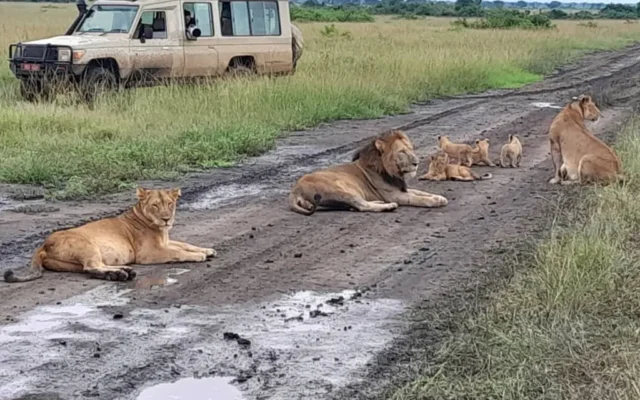
Leopard are the primary predator of giant forest hogs in Uganda's forest parks. Sounders respond with alarm calls, tight grouping, and rapid retreat to dense cover. Large boars may stand ground with tusk displays — enough to deter smaller predators but risky against experienced leopard. Lion occasionally prey on hogs where Ishasha woodland meets open grassland, adding a savannah predator dimension to Queen Elizabeth's mixed habitat.
Response to Vehicles and Humans
Forest hogs are more wary than habituated savannah warthogs. First approach often triggers retreat; repeated quiet exposure on Kibale research tracks has produced sounders that tolerate stationary vehicles at moderate distance. Guides emphasise engine-low idle, no sudden door movement, and no on-foot pursuit — ethics that preserve natural behaviour for the next vehicle.
Rooting and Foraging Behaviour
Rooting is methodical: snout down, tusks levering, head swinging side to side to excavate patches a metre or more across. Sounders may spread across a clearing while feeding, maintaining auditory contact. Piglets experiment with rooting technique beside sows — behaviour that reveals family learning across seasons.
Inter-Species Encounters
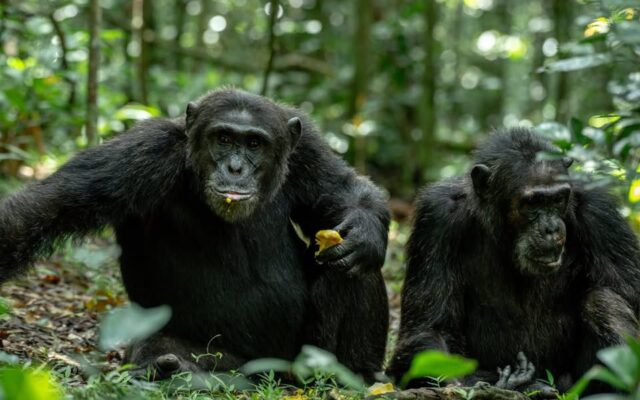
Forest drives may produce hog encounters alongside chimpanzees crossing roads, forest elephants blocking tracks, and bushbuck flushing from understorey. Hog sounders typically yield right-of-way to elephant but may hold ground against smaller species. These multi-species moments define Kibale and Maramagambo as holistic forest experiences rather than single-species destinations.
Viewing Ethics
Never feed forest hogs, never approach on foot without authorisation, and never block a sounder's escape route into cover. Flash photography at close range can alarm animals. Responsible observation preserves the wary wildness that makes a sighting feel earned rather than staged.
Planning Your Visit
Maximise behavioural observation via dawn timing, dry-season track access, and guides who interpret rooting sign and wallow locations. Cross-reference best time to see giant forest hogs and safari experiences for forest-rich itineraries.