Black-and-white colobus monkey habitat — expert Uganda safari guide from local planners who know permits, parks, and realistic routing.
Black-and-white colobus habitat is defined by mature tropical rainforest — tall emergents, fig-dominated canopy, and layered understorey where folivores partition vertical space with frugivorous guenons and other colobus species. In Uganda, Colobus guereza occupies the western forest belt centred on Kibale National Park and Budongo Forest Reserve. Understanding these ecosystems explains why colobus appear so reliably on chimpanzee trekking trails and Bigodi Wetland walks — and how where to see them maps onto broader primate safari planning.
Rainforest Canopy Specialists
Black-and-white colobus are not savannah animals, nor are they swamp specialists like sitatunga. They thrive where continuous forest canopy provides year-round leaf resources, escape routes from aerial predators, and sleeping sites along sturdy branches. This arboreal dependency explains their absence from Queen Elizabeth plains and Murchison north-bank grasslands — and their prominence wherever tall forest remains intact.
Research across East Africa shows colobus selecting young, protein-rich leaves rather than simply eating the most abundant foliage. They favour Celtis, Ficus, and other common rainforest tree genera — a selectivity that keeps troops moving between food trees through the day.
Altitude and Climate in Uganda
Kibale sits at roughly 1,100 to 1,600 metres above sea level; Budongo spans similar mid-elevation terrain on the Albertine Rift escarpment. Climate is tropical with bimodal rainfall — peaks typically around March to May and September to November. Leaf flush after rains influences foraging quality; dry seasons firm forest trails and improve morning light for photography without reducing colobus visibility.
Kibale National Park — Primate Forest Mosaic
Kibale protects roughly 795 square kilometres of mid-elevation forest interspersed with grassland patches and crater lakes. The park holds the highest primate diversity in East Africa — thirteen species including chimpanzees, red colobus, L'Hoest's monkeys, and grey-cheeked mangabeys alongside black-and-white colobus. Long-term research at Kanyawara and other stations confirms guereza as a core member of the park's folivore community.
Key Habitat Zones at Kibale
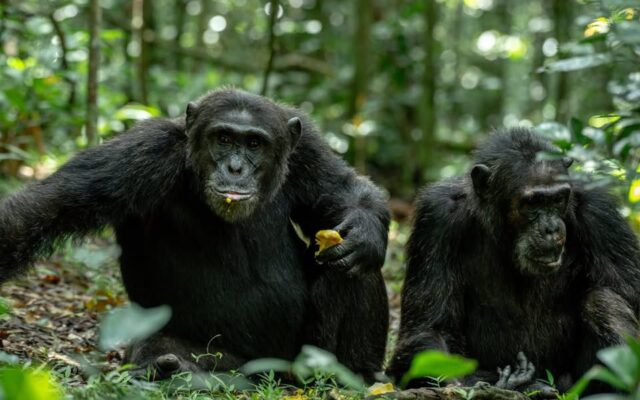
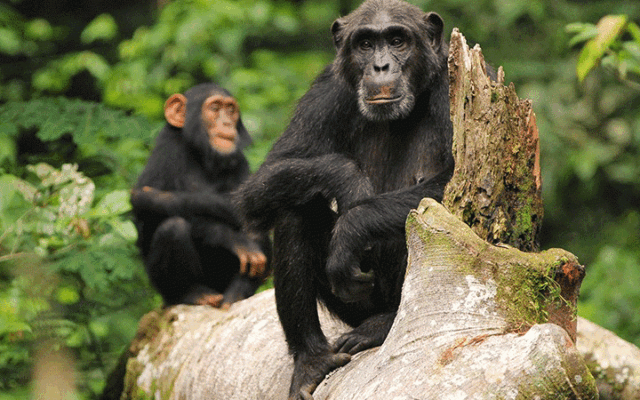
- Main chimpanzee trekking trails: Tall forest with mixed fig and Celtis canopy
- Kanyanchu sector: Habituated chimpanzee range with reliable colobus sightings
- Forest–grassland ecotones: Colobus occasionally feed in gallery trees along margins
- Crater lake fringes: Riverine forest patches with additional tree diversity
Budongo Forest Reserve — Murchison Circuit Stronghold
Budongo Forest covers roughly 825 square kilometres of moist semi-deciduous forest on the southern approach to Murchison Falls National Park. Ironwood, mahogany, and fig-dominated canopy support chimpanzees, black-and-white colobus on the same forest drives and walking trails. Kaniyo Pabidi and Busingiro sectors are the primary visitor access points.
Budongo's inclusion on northern Uganda circuits — Ziwa rhino, Murchison game drives, Nile boat cruises — makes colobus viewing accessible to travellers who might otherwise skip western primate forests.
Bigodi Wetland and Gallery Forest
Bigodi Wetland Sanctuary at Kibale's edge protects swamp forest and papyrus margins where colobus feed in fig trees at boardwalk level. The habitat is wetter and lower than core Kibale forest, but gallery trees and community protection maintain troops habituated to foot traffic — among the closest colobus viewing in Uganda.
Canopy Structure and Vertical Stratification
Multiple primate species share Kibale and Budongo by feeding at different heights. Black-and-white colobus typically occupy mid to upper canopy levels, sometimes overlapping with red-tailed monkeys below and mantled guereza in similar strata. This stratification reduces direct competition and explains why a single fruiting or leaf-flush tree may host several primate species at different tiers — a spectacle common on forest walks.
Forest Fragmentation Threats
Outside protected areas, charcoal production, timber extraction, and agricultural encroachment reduce canopy continuity. Colobus require connected forest — isolated fragments support smaller, vulnerable troops. Kibale's forest corridor links to Queen Elizabeth's Kyambura Gorge approaches in places, but sustained protection of Budongo's buffer zones remains essential.
Seasonal Habitat Use
- Wet seasons: Abundant young leaves; troops spread across forest; trails muddy
- Dry seasons: Selective feeding on remaining green foliage; firmer trails; dawn roaring peaks
- Year-round: Resident troops; no long-distance migration
What This Means for Safari Viewing
Plan forest walks with binoculars and a camera ready — colobus are arboreal and easily missed if you focus only on the trail floor. Listen for dawn roars and rustling canopy before looking up. Pair habitat knowledge with seasonal timing and Kibale–Budongo safari routes for the strongest sightings.
Quick Habitat Summary
- Primary habitat: Mature tropical rainforest canopy
- Uganda strongholds: Kibale, Budongo, Bigodi gallery forest
- Key trees: Fig, Celtis, mahogany, ironwood
- Altitude: Roughly 1,100–1,600 m in western Uganda
- Absent from: Open savannah parks
- Co-occurring primates: Chimpanzees, red colobus, guenons