
Blue Monkey FAQs and Answers — quick answers on biology, arboreal behaviour, Kibale and Bwindi viewing, chimpanzee and gorilla trek combinations, and forest safari planning. Explore where to see blue monkeys, behaviour, best time to visit, and safari experiences.
- What is a blue monkey?
The blue monkey (Cercopithecus mitis) is a medium-sized arboreal primate of African forests, recognised by blue-grey fur, a white throat and chest bib, dark facial mask, and a long balancing tail. In Uganda, blue monkeys are common in the canopies of Kibale National Park, Bwindi Impenetrable Forest, and Queen Elizabeth's forest sectors.
- Where can I see blue monkeys in Uganda?
The best places are Kibale National Park (during chimpanzee trekking), Bwindi (along gorilla trekking trails), and Queen Elizabeth National Park forest sectors including Kyambura Gorge and Maramagambo Forest. See our where to see blue monkeys guide.
- Are blue monkeys the same as golden monkeys?
Golden monkeys are a distinct endangered subspecies — Cercopithecus mitis kandti — specialised for bamboo forest in the Virunga Massif. Blue monkeys (C. mitis) are the widespread parent species found in lowland and montane forests across East Africa. Learn more about golden monkeys at Mgahinga.
- What do blue monkeys eat?
Blue monkeys are primarily frugivores, feeding on forest fruits — especially figs — supplemented by leaves, flowers, buds, and occasional insects. Diet shifts seasonally with fruiting cycles in the canopy. Full detail on our blue monkey diet page.
- How big are blue monkeys?
Adults typically weigh 4 to 8 kilograms, with males slightly larger than females. Body length is roughly 50 to 65 centimetres, but the tail adds another 75 to 90 centimetres — essential for arboreal balance.
- Are blue monkeys endangered?
Globally, blue monkeys are classified Least Concern by the IUCN because of their wide African range. In Uganda, populations remain healthy inside protected forests but depend entirely on habitat integrity — see our conservation page.
- Do blue monkeys live in trees?
Yes. Blue monkeys are strongly arboreal, spending most of their time in the forest canopy and rarely descending to open ground. Their long tails, grasping hands, and agile leaps are adaptations for life above the forest floor.
- How many blue monkeys live in a troop?
Troops typically number 10 to 40 individuals, organised as one-male groups with a dominant male, several adult females, and juveniles. Multiple troops may share overlapping home ranges within the same forest block.
- Can I see blue monkeys during chimpanzee trekking?
Yes — this is one of the most reliable ways to encounter blue monkeys in Uganda. Kibale National Parkchimpanzee tracking regularly passes troops in the canopy. Guides often point them out while searching for chimpanzees.
- Can I see blue monkeys during gorilla trekking?
Blue monkeys occur in Bwindi Impenetrable Forest and are frequently spotted along gorilla trekking trails — sometimes feeding in fig trees metres above the path. They are a common secondary primate on gorilla trekking days.
- What is the scientific name of the blue monkey?
Cercopithecus mitis — a species in the family Cercopithecidae (Old World monkeys). East African forest populations are often assigned to the subspecies C. m. stuhlmanni, sometimes referred to locally as Sykes' monkey.
- What predators hunt blue monkeys?
Leopards and crowned eagles are the most significant natural predators in Ugandan forests. Chimpanzees occasionally hunt blue monkeys in Kibale — a dramatic but natural part of forest ecology.
- When is the best time to see blue monkeys?
Blue monkeys are visible year-round in Uganda's forests. Dry seasons (June–September and December–February) offer easier trekking trails and comfortable conditions. Morning forest walks align with peak feeding activity. See best time to see blue monkeys.
- What does a blue monkey look like?
Blue monkeys have a blue-grey coat, white throat and chest, dark cap and face mask, and pale underside. The long tail is darker above and paler below. Juveniles appear darker and more uniformly coloured than adults.
- Do blue monkeys make noise?
Yes. Troops use alarm calls, grunts, and chirps to coordinate movement and warn of predators. A sharp troop alarm often alerts guides that a leopard or eagle may be nearby — read more on our behaviour page.
- Are blue monkeys found in Queen Elizabeth National Park?
Yes, in the park's forest sectors — notably Kyambura Gorge and Maramagambo Forest — rather than on open savannah game drives. Forest walks and chimpanzee tracking in these sectors offer blue monkey sightings.
- How long do blue monkeys live?
Blue monkeys live roughly 20 to 25 years in the wild. Females give birth to a single infant after a gestation of about five months, typically every two years.
- Which Uganda safaris include blue monkey viewing?
Any itinerary visiting Kibale, Bwindi, or Queen Elizabeth forest sectors can include blue monkeys. Browse blue monkey safaris and Uganda safari packages.
- Do I need a special permit for blue monkeys?
No. Uganda does not issue a dedicated blue monkey permit. Sightings occur during chimpanzee tracking, gorilla trekking, and guided forest walks covered by standard park and activity fees.
- How can tourists help blue monkey conservation?
Visit Uganda's forests on licensed safaris, pay official park fees, follow ranger guidance on treks, and choose operators supporting Uganda Wildlife Authority management. Forest tourism funds the habitat protection that keeps blue monkeys — and gorillas and chimps — in the wild. More on our conservation page.
Safari packages to see Blue Monkey
Bookable itineraries below include parks and activities where you are most likely to encounter Blue Monkey in the wild.
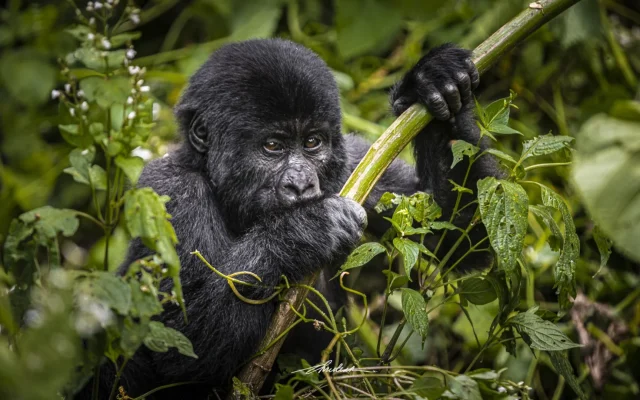 BestSeller
5 Day Gorilla & Chimp Safari
You visit
Kibale Forest, Bwindi Forest, Entebbe
Combine Bwindi gorilla trekking with Kibale chimpanzee tracking.
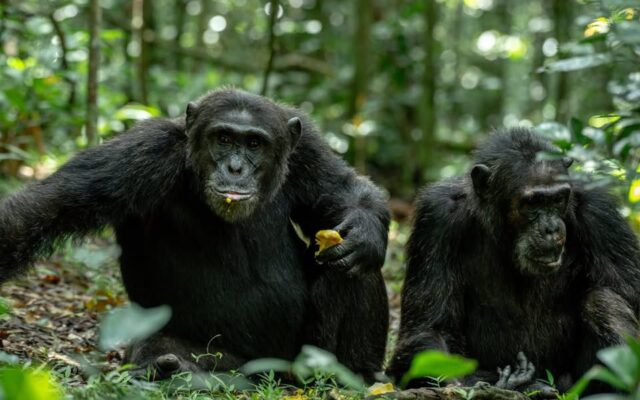 BestSeller
6 Days Uganda Gorillas, Chimpanzees & Wildlife Safari
You visit
Kibale Forest, Queen Elizabeth NP, Bwindi Forest, Entebbe
Primates plus plains in six days: Kibale chimps, Queen Elizabeth savannah, Bwindi gorillas and a Lake Mburo finale for zebra — the full Uganda highlight reel without rushing Kidepo or Murchison.
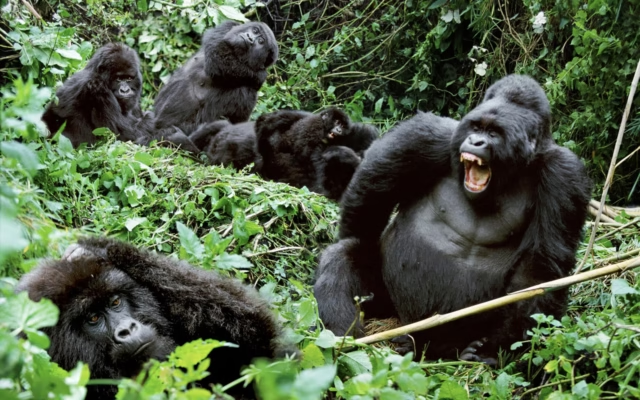 BestSeller
3 Day Uganda Gorilla Trekking Safari
You visit
Bwindi Forest, Entebbe
This private Uganda gorilla trekking safari is a focused 3-day Uganda gorilla trekking road trip: a full-day mountain gorilla trek in Bwindi Impenetrable National Park—a UNESCO rainforest where roughl…
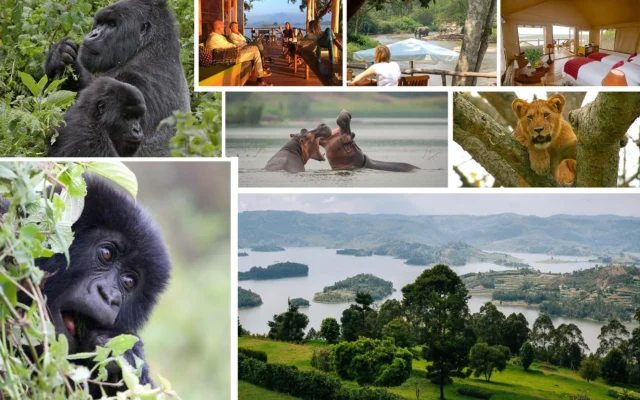 BestSeller
7 Day Uganda Wildlife & Gorilla
You visit
Murchison Falls, Kibale Forest, Queen Elizabeth NP, Bwindi Forest, Entebbe
Seven days with gorillas: the wildlife tour above plus Bwindi trekking on Day 6 — the single most booked private itinerary for Uganda Safari Tours guests who want chimps, savannah and gorillas in one…