Wildlife and primates in Mabira Central Forest Reserve
Mabira Forest Reserve is not a national park in the classic sense. You will not find elephant herds or lion prides moving through open savannah. Instead, the wildlife experience is intimate: tall canopy, tangled undergrowth, red-tailed monkeys crossing trails, Uganda mangabeys feeding in fruiting trees, butterflies on sunlit paths, and — with patience — duikers slipping through regenerating forest. That narrower focus is exactly why the site works so well as a half-day or full-day stop on the Kampala-Jinja corridor before Jinja, Source of the Nile, or a longer safari toward Mount Elgon or western parks.
Officially known as Mabira Central Forest Reserve, the forest is managed by Uganda's National Forestry Authority and covers roughly 306 square kilometers of moist semi-deciduous tropical forest north of Lake Victoria. More than 300 tree and shrub species, over 200 butterfly species, and a rich invertebrate community create the structural base for everything you might see on a guided walk. Mabira is also recognized as a Key Biodiversity Area, which reflects its importance for threatened and restricted-range species in a landscape where farms, towns, and highways surround the remaining green block.
Primates: Uganda mangabeys and forest monkeys
The ecological heart of Mabira Forest wildlife for many visitors is primate watching. The forest is one of the best-known sites in Uganda for the Uganda mangabey (Lophocebus ugandae), a species closely associated with this reserve in tourism and conservation literature. Troops move through the canopy in search of fruit, seeds, and insects; sightings depend on fruiting patterns, time of day, trail choice, and guide knowledge — not on a fixed viewing platform.
Red-tailed monkeys are also commonly reported along forest trails, often giving themselves away with movement and contact calls before you see them clearly. Vervet monkeys, olive baboons near forest edges, and occasional references to grey-cheeked mangabeys in broader sources add to the primate list. Nocturnal species such as pottos and galagos occur in the forest but are rarely seen on standard daytime walks.
When you encounter primates at Mabira, you are watching wild animals in habitat that still functions as a feeding and breeding ground — not a display enclosure. Good guides keep distance, avoid feeding monkeys, and read fruiting trees for recent troop movement. Some mornings produce a sighting within the first hour; other days require quiet searching between stream sections and regenerating patches. Either way, the outing teaches you how forest food webs work at eye level beneath a closed canopy.
Mammals, reptiles, and smaller forest life
Large mammals are not the draw. With luck and local knowledge, forest-adapted species such as duikers, bushbuck, and squirrels may occur on trails, but most visitors will remember chameleons on branches, fruit bats at dusk, skinks on logs, and the constant activity of insects and butterflies. NFA materials reference more than 200 butterfly species and many moths — a major part of Mabira's biodiversity that casual walkers often overlook until a guide points out color and form on the path.
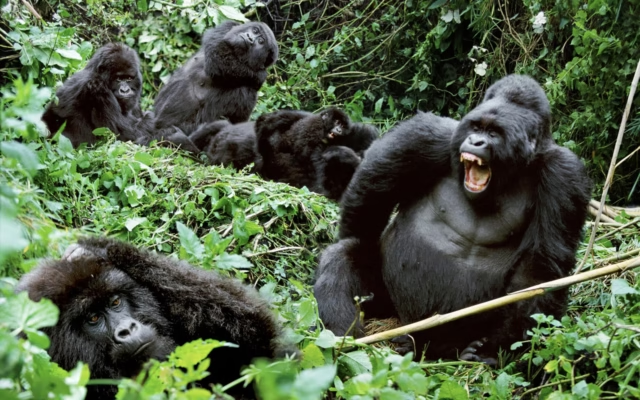
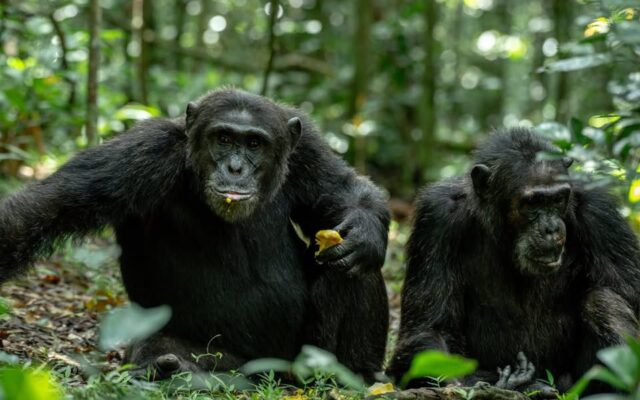
Compared with Kibale Forest chimpanzee forests or Bwindi mountain gorilla habitat, Mabira offers a completely different scale of encounter — less adrenaline, more patience, more reading of canopy movement and forest sound. Photographers often value that slowness: dappled light through strangler figs, mushrooms on decaying logs, and the sudden alertness when a guide signals monkeys ahead.
Plants as wildlife habitat
Mabira's plant life is equally important to the wildlife story. The reserve contains many tree and shrub species, including medicinal plants and historically valuable hardwoods. Guides can explain strangler figs, forest regeneration after past timber extraction, and how communities use or once used different plants. That botanical layer supports the animals you came to see: fruiting trees pull in primates, dead wood feeds insects that feed birds, and stream-side vegetation shelters frogs and reptiles.
The forest is not untouched wilderness. Like many accessible forests in East Africa, it has a long history of timber extraction, encroachment pressure, and recovery. That history gives Mabira a layered character. Some sections feel deep and wild; others show signs of past disturbance and active regeneration. For visitors, this makes the forest an excellent place to learn about conservation in a landscape where nature and development compete closely along the busy Jinja highway.
A working forest reserve, not a manicured park
Mabira is a Central Forest Reserve in a heavily used part of Uganda. The Kampala-Jinja road, sugar estates, towns such as Lugazi, and surrounding farmland all press against the forest boundary. Visitors who expect a silent wilderness may be surprised by distant traffic hum, community activity near access points, and the visibility of human pressure from some trail sections. Approaching the site with that realism makes the experience richer, because you see how Uganda's biodiversity persists close to the capital and the Nile adventure hub.
Seasonal rain, trail maintenance, and fruiting cycles all change what is visible week to week. A path that felt open in drier months may feel tighter when undergrowth is lush. Guides adapt routes accordingly. That variability is normal for tropical forest — and it is why repeat visits can feel different even on the same itinerary.
Responsible wildlife viewing
Keep voices low on trails, never feed primates, stay on marked paths, and follow your guide on distance around monkeys and nesting birds. Flash photography is inappropriate near sensitive wildlife. Wear closed shoes that handle mud, carry insect repellent, and avoid removing plants or disturbing leaf-litter habitats. Ethical viewing protects breeding animals and keeps Mabira viable for the next traveler.
Hiring official or reputable local guides directly supports the people who know the trails best. That income reinforces the value of intact forest habitat — a practical conservation outcome from a short morning in the trees.
How Mabira fits a wider Uganda safari
Most itineraries treat Mabira as a specialist stop: high-value forest ecology on the Kampala-Jinja route, not a multi-night big-game destination. It pairs naturally with Sezibwa Falls and Bujagali for a central Uganda day trip, or with Mabamba Swamp and Entebbe Botanical Gardens for a Lake Victoria birding arc before inland drives to gorilla or savannah parks. Before long transfers to Queen Elizabeth or Murchison Falls, it gives an immediate introduction to Uganda's rainforest ecosystems without the time commitment of Budongo Forest or Kibale.
For deeper planning, see our guides on Mabira Forest Reserve bird watching, best time to visit, and getting there — each covers a different angle of the same forest visit.