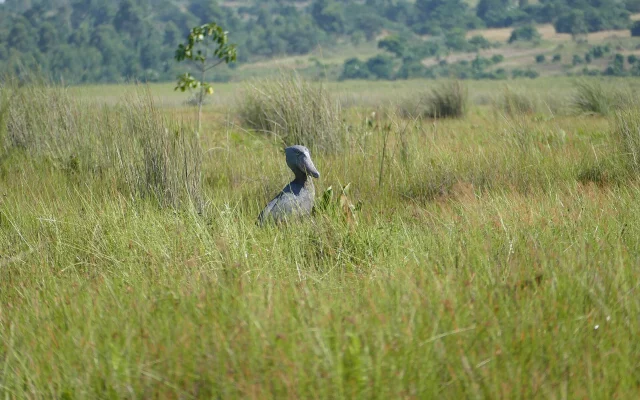
Wildlife and wetland ecology at Mabamba Swamp
Mabamba Bay Wetland System is not a national park in the classic sense. You will not find elephant herds or lion prides moving through open savannah. Instead, the wildlife experience is intimate: papyrus channels, shallow pools, lungfish in the mud, kingfishers on reeds, and — with patience — the upright silhouette of a shoebill hunting in still water. That narrower focus is exactly why the site works so well as a half-day add-on from Entebbe before a longer Queen Elizabeth or Murchison Falls safari.
The Ramsar-listed wetland covers roughly 2,424 hectares on the northern shore of Lake Victoria, west and northwest of Entebbe in the Wakiso and Mpigi area. Papyrus beds, floating vegetation, fishing grounds, and lake-edge margins create a mosaic that supports birds, fish, amphibians, reptiles, and invertebrates. Papyrus itself is part of the story: it filters water, buffers shoreline communities, supports fisheries, and gives structure to the channels your guide navigates.
The shoebill and lungfish connection
The ecological heart of Mabamba Swamp wildlife is the relationship between shoebills and lungfish. Shoebills (Balaeniceps rex) stand in shallow water for long periods, watching for lungfish and other aquatic prey. Lungfish are also important to local fishermen. That overlap once created real tension around the wetland. Community-based tourism has helped shift the balance: a living shoebill seen respectfully by visitors can be worth more to local guides and boat operators than a bird disturbed or removed from the system.
When you see a shoebill at Mabamba, you are watching a globally threatened species in habitat that still functions as a feeding ground — not a display aviary. Good guides keep distance, avoid flushing the bird, and read the water for recent movement. Some mornings produce a sighting within an hour; other days require quiet searching between channels. Either way, the outing teaches you how wetland food webs work at eye level from a canoe.
Mammals, reptiles, and smaller life
Large mammals are not the draw. With luck and local knowledge, wetland-adapted species such as sitatunga may occur in suitable swamp habitat, but most visitors will remember monitor lizards on mud banks, frogs calling from reeds, fish rippling in open pools, and butterflies along the margins. Fish eagles, herons, and kingfishers are part of the daily rhythm even when the shoebill stays hidden.
Compared with Kibale Forest chimpanzee forests or Bwindi mountain gorilla habitat, Mabamba offers a completely different scale of encounter — less adrenaline, more patience, more reading of water and reeds. Photographers often value that slowness: fishermen poling canoes, papyrus against morning light, and the sudden stillness when a guide signals a bird ahead.
A working landscape, not a manicured park
Mabamba is a working wetland. Fishing activity, papyrus harvesting, small-scale agriculture, transport, and shoreline pressure all interact with conservation goals. Ramsar designation (site number 1638, listed September 2006) recognizes international importance, but the bay remains lived-in. Visitors who expect a silent wilderness may be surprised by boats, voices at the landing, and the hum of Lake Victoria life. Approaching the site with that realism makes the experience richer, because you see how Uganda's biodiversity persists near cities and airports.
Water levels, invasive vegetation, runoff, and seasonal rain all change what is visible week to week. A channel that held open water in dry months may feel tighter when papyrus grows thick. Guides adapt routes accordingly. That variability is normal for freshwater wetlands — and it is why repeat visits can feel different even on the same itinerary.
Responsible wildlife viewing
Keep voices low in the canoe, never throw litter into the wetland, and follow your guide on distance around shoebills and nesting areas. Flash photography is inappropriate near sensitive birds. Wear a life jacket when provided, keep electronics in a dry bag, and avoid pressuring boatmen to chase wildlife for a closer frame. Ethical viewing protects breeding birds and keeps Mabamba viable for the next traveler.
Hiring local guides and community boat operators directly supports the people who know the channels best. That income reinforces the value of intact papyrus habitat — a practical conservation outcome from a short morning on the water.
How Mabamba fits a wider Uganda safari
Most itineraries treat Mabamba as a specialist stop: high-value wetland ecology near the airport, not a multi-night wildlife destination. It pairs naturally with Entebbe Botanical Gardens and Lutembe Bay Wetland for a Lake Victoria birding arc, or with Ngamba Island for a conservation-themed day on the lake. Before inland drives to gorilla or savannah parks, it gives an immediate introduction to Uganda's freshwater ecosystems.
For deeper planning, see our guides on Mabamba Swamp bird watching, best time to visit, and getting there from Entebbe — each covers a different angle of the same wetland visit.